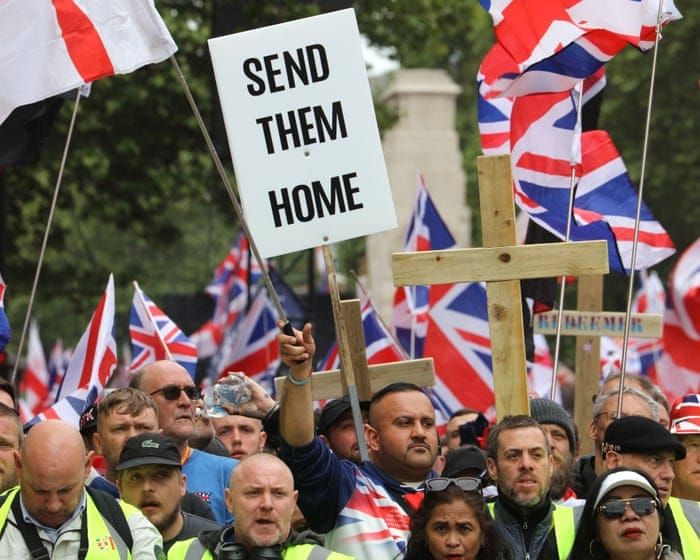
Tommy Robinson told tens of thousands of people gathered in London on Saturday to prepare for the "battle of Britain." JD Vance, the Vice President of the United States, responded by telling them to "keep on going."
That exchange — between a convicted fraudster banned from entering multiple countries and the second-highest official in the U.S. government — is not a diplomatic incident. It is a policy statement. And the policy is this: the American executive branch is now an active participant in the European far right's project to dismantle liberal immigration frameworks in allied democracies.
The Guardian US reported that Vance appeared to align himself with attendees of Robinson's "Unite the Kingdom" march, offering his encouragement directly. This is not a misquote. It is not a framing dispute. A sitting American vice president publicly endorsed the political energy of a movement whose figurehead told a London crowd to prepare for battle.
Tommy Robinson (born Stephen Yaxley-Lennon) is a far-right activist and founder of the English Defence League, a street protest movement with documented ties to extremist networks. He has multiple criminal convictions, including fraud and contempt of court. He is banned from entering Ireland and several other countries. His political brand centers on anti-Islam and anti-immigration rhetoric framed as cultural self-defense. His "Unite the Kingdom" rally drew tens of thousands to London in May 2026.
To understand what Vance's endorsement actually does, it helps to step back from the immediate outrage cycle and look at the structural picture. The American right has spent several years building what analysts describe as a transnational network of far-right political movements — coordinating messaging, sharing donor infrastructure, and lending legitimacy across borders. Vance flew to Budapest to campaign for Viktor Orbán, as we covered here. That visit was widely dismissed as an ideological curiosity. It wasn't. It was a pilot program.
The pattern is now visible enough to name. The U.S. vice president is not freelancing. He is functioning as an ambassador for a specific political project: the replacement of post-war liberal democratic norms — including refugee protections, multicultural immigration frameworks, and international human rights obligations — with an ethnically and culturally restrictionist model of governance. The UK is not a target of American foreign policy in the traditional sense. It is a partner in a shared political project, and Vance is doing what ambassadors do: showing up to encourage the home team.
The human stakes of this are not abstract. Britain's Muslim communities, its asylum-seeker populations, and anyone who has been targeted by Robinson's movement live with the material consequences of the political environment his rallies create. The research on stochastic political violence — the documented connection between dehumanizing rhetoric and real-world attacks — is not speculative. When political leaders legitimate movements that frame immigration as invasion and cultural battle, the people framed as the invaders bear the risk. Vance's "keep on going" is not a neutral comment. It is acceleration.
It is worth being precise about what Vance endorsed. Robinson did not call a rally to debate immigration policy. He called his supporters to prepare for a "battle." The language of battle, deployed before tens of thousands of people primed with anti-immigration grievance, is not metaphor in any politically responsible sense. It is incitement framed as inspiration. And the Vice President of the United States told that crowd: you're on the right track.
The Accountability Lens here runs in two directions. First, toward Vance: what is the theory of his role? A vice president who encourages foreign far-right activists is not conducting foreign policy in any conventional sense — he is conducting political organizing across international borders, on behalf of a movement rather than a government. The question of whether this constitutes interference in the domestic politics of a treaty ally has not been seriously asked in Washington. It should be.
Second, the accountability question runs toward the British government. Prime Minister Keir Starmer has been navigating a difficult line — maintaining the U.S. alliance while distancing the Labour government from the American right's most extreme positions. Starmer's government has been working to rebuild a European-facing foreign policy, as we have reported, precisely because the Trump administration has made the traditional "special relationship" increasingly conditional on political alignment. Vance's endorsement of Robinson's movement puts Starmer in an impossible position: condemning it risks U.S. diplomatic friction; ignoring it normalizes American executive support for a movement that directly targets communities Labour represents.
The Power and Money lens matters here too, though the financial architecture of this transnational far-right network is not yet fully documented. What is documented is the ideological infrastructure: Steve Bannon's explicit project of building a global nationalist movement, the role of American conservative foundations in funding European far-right media, and the repeated pattern of American officials — Vance most visibly — treating European elections and social movements as terrain for their own politics. The money follows the ideology. Where Vance goes, donor networks and media amplification follow.
There is a version of this story that American political media will cover as a controversy — a provocative statement, diplomatic eyebrows raised, a spokesperson clarifies. That framing misses what is actually happening. Vance is not being provocative. He is being consistent. He endorsed Orbán's Hungary as a model. He has repeatedly framed immigration as an existential civilizational threat. His comment to Robinson's crowd is not a departure from his political identity — it is an expression of it, delivered to an international audience that his movement is actively trying to grow.
The people who gathered for Robinson's "Unite the Kingdom" rally did not need Vance's permission to march. But they received something more valuable: legitimacy from the office of the Vice President of the United States. In the economy of far-right politics, that legitimacy is currency. It tells donors to keep giving, tells organizers to keep recruiting, tells members to keep showing up, and — most consequentially — tells the communities targeted by that movement that the most powerful government on earth considers their opponents to be on the right side of history.
Britain's far right has been trying to break into mainstream political legitimacy for decades. Tommy Robinson has been arrested, convicted, and banned from platforms and countries. What he has never had, until now, is an American vice president telling his rally attendees they are doing the right thing. That changes the political physics. Not because Vance's approval makes Robinson's movement correct, but because in the current global moment, American executive endorsement functions as a legitimacy signal that travels far beyond the specific statement that generated it.
The communities most directly at risk — Muslim Britons, asylum seekers, migrants — will not be consulted about whether this endorsement changes their safety calculus. They already know it does. The question for everyone else is whether the governments and institutions that are supposed to protect them will treat this as the escalation it is, or file it under "Vance says something provocative again" and move on. The latter response is exactly what movements like this depend on.