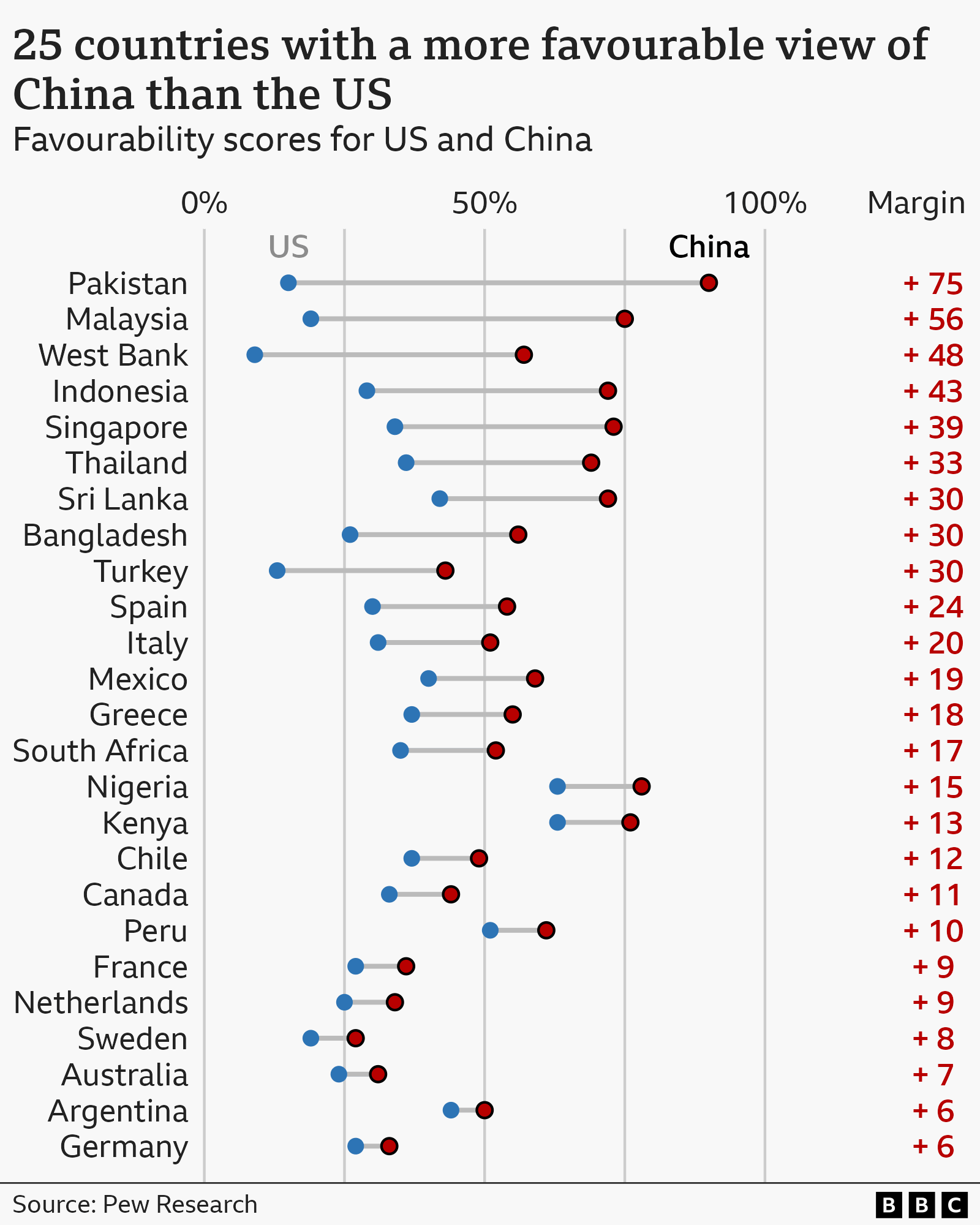
For most of the post-Cold War era, the United States could claim something no other country could: even when the world disagreed with American policy, it broadly trusted American leadership. That claim is now gone. A new Pew Research Center survey finds that more people around the world now express confidence in Xi Jinping than in the American president — and that more countries view China favorably than view the United States favorably. The survey is not a polling anomaly. It is a measurement of something that has been building for years and accelerated sharply in the past eighteen months.
The conventional reading of this data will be that it reflects Trump's personal unpopularity abroad. That reading is too comfortable. It lets American institutions off the hook, and it implies that a change in administration will reverse what has happened. Neither is true. What the Pew data documents is not a personality problem. It is the logical consequence of a sustained pattern of American behavior — broken commitments, coercive economic policy, unilateral military action, and the systematic dismantling of the multilateral frameworks the United States itself built. Trump accelerated that pattern. He did not create it from nothing.
Pew Research Center's annual Global Attitudes Survey asks respondents in dozens of countries whether they have confidence in world leaders to do the right thing in world affairs, and whether they hold favorable views of major powers. The survey has tracked these metrics across administrations for more than two decades, making it one of the most reliable longitudinal measures of global public opinion available.
That the world dislikes Trump has been documented since his first week in office. The deeper change is different: the United States has now lost the thing that made its power qualitatively different from China's. For decades, American dominance rested not only on military and economic superiority but on a degree of voluntary deference — other governments accepted American leadership, at least partially, because publics and elites believed American power came with some commitment to shared rules. That belief is the asset being liquidated. And unlike aircraft carriers or GDP figures, it cannot be rebuilt on a procurement schedule.
China has not become more trustworthy. Its human rights record, its treatment of Uyghurs in Xinjiang, its suppression of Hong Kong's political freedoms, and its increasingly coercive posture in the South China Sea — documented in our own coverage of Beijing's island-building strategy — have not improved. What has changed is the comparison. The United States sanctions allies without notice, withdraws from international agreements, deploys military force without congressional authorization, and treats multilateral institutions as inconveniences. The gap between American rhetoric and American conduct becomes visible to everyone outside the American media ecosystem. The Pew numbers are what that visibility looks like when it gets counted.
The geographic distribution of the shift matters as much as the overall figures. The countries where confidence in American leadership has fallen most sharply are not adversaries. They are partners — European allies, Southeast Asian nations, Latin American governments that spent decades calibrating their foreign policies around the assumption of American reliability. Their publics are not turning toward China because they admire Beijing's political system. They are turning toward China, or toward neutrality, because the cost-benefit calculation of alignment with Washington has changed. An America that imposes tariffs on allies, threatens to abandon security commitments, and builds Indo-Pacific strategies without the resources to sustain them is an America whose protection is worth less than it was.

Follow the money, and the picture sharpens. American foreign policy has long rested on a subsidy from allied trust — the willingness of other governments to absorb costs and defer to Washington in exchange for security guarantees and institutional access. That subsidy is being withdrawn. The economic consequences are not abstract: when global institutions lose confidence in the dollar's role as a neutral reserve currency, when trade agreements collapse into bilateral coercion, when the multilateral frameworks that governed everything from climate finance to pharmaceutical standards fracture along geopolitical lines, the costs fall on ordinary people — in higher prices, in reduced access to medicines, in disrupted supply chains that nobody voted for.
Responsibility matters as much as measurement. Who is responsible for this, and what interests does the damage serve? The erosion of American soft power is not a cost borne equally. It falls hardest on the communities and countries that depended on American-led institutions for protection — small nations without the bargaining power to negotiate bilateral deals, populations whose human rights protections were underwritten by American diplomatic pressure, and American workers whose export markets depend on the goodwill of trading partners who are now reconsidering. The beneficiaries of the erosion are concentrated: defense contractors who profit from a more militarized world, energy companies who benefit from the collapse of multilateral climate commitments, and the authoritarian governments — in Beijing, Moscow, Riyadh — whose legitimacy is strengthened every time American democracy visibly malfunctions.
A separate European Council on Foreign Relations survey, covered in our analysis of transatlantic alignment, found that only one in ten Europeans now describes the United States as an ally. That number was unthinkable five years ago. It is not unthinkable now because European publics have become anti-American. It is unthinkable because the behavior that the alliance was built on — predictability, institutional commitment, shared rules — has been replaced by something that looks, from Brussels or Seoul or Nairobi, indistinguishable from the unilateralism the United States spent seventy years warning the world about.

There is a pattern American foreign policy commentary consistently resists naming. Every time a Pew survey or an allied government expresses alarm, the response from Washington's foreign policy establishment is to treat the problem as communications — as though the world simply misunderstands American intentions and better messaging will correct the record. It will not. The world is not misreading American intentions. It is reading them correctly, through the behavior of American institutions over time. The question of whether that behavior reflects a temporary deviation or a structural shift in how the United States exercises power is precisely what the Pew data is measuring. The trend line suggests the latter.
None of this means China is winning in any deep sense. Beijing's model of governance generates its own resistance — among its own population, among the governments in its near abroad, and among the Global South nations that have discovered Chinese infrastructure investment comes with debt terms that constrain sovereignty. The Pew data does not show a world rushing toward China. It shows a world detaching from the American-led order and finding no adequate replacement. That is a more dangerous outcome than simple power transfer, because ungoverned spaces — in trade, in security, in climate — tend to be filled by whoever is willing to pay the short-term cost of filling them, regardless of long-term consequence.
The question for American foreign policy is not how to win a favorability contest. It is whether the institutions and commitments that generated American trust for seventy years can be rebuilt after being systematically dismantled — and whether the political will exists to do the rebuilding. The Pew survey does not answer that. But it does establish the baseline from which any recovery would have to begin. That baseline is worse than it has been at any point in the survey's history. And the forces that produced it are still in office, still making decisions, still spending the remaining credit on transactions that generate no return.