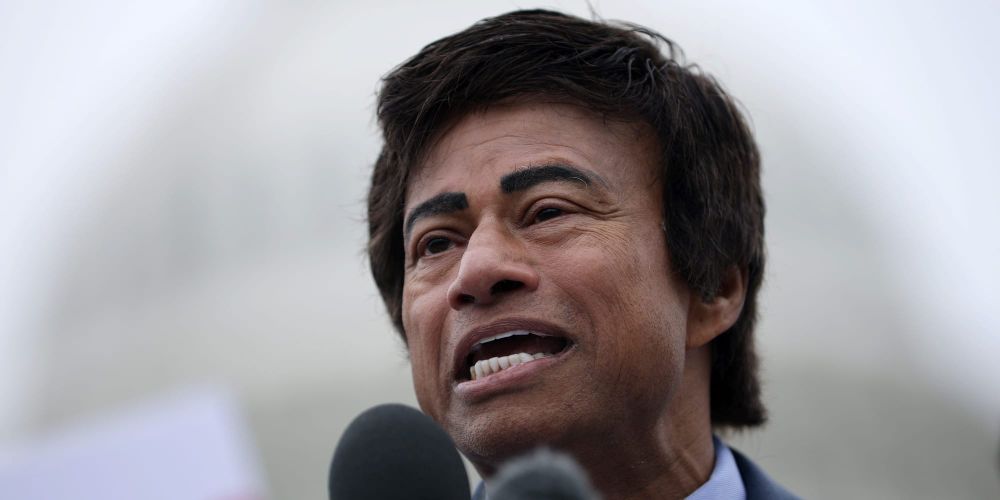
The money that flows into a congressional campaign is supposed to fund a political operation — mailers, field staff, digital ads, get-out-the-vote infrastructure. It is not supposed to be a crypto portfolio. According to reporting by The Intercept, Representative Shri Thanedar of Michigan did something closer to the latter: investing millions in campaign funds in cryptocurrency — and losing more than $600,000 in the process.
That is the part of this story that reads as financial recklessness. But there is a second part, and it is structurally more consequential: two-thirds of Thanedar's campaign cash arrived through AIPAC bundlers. That number is not a footnote. It is the architecture of how the congressman got elected and how he stays in office — and it tells you something about Democratic primaries that goes well beyond one candidate in Michigan.
AIPAC — the American Israel Public Affairs Committee — has spent years building an infrastructure for exactly this kind of dominance. It does not simply write checks to favored candidates. It operates through bundlers: networks of individual donors who pool contributions and deliver them as a coordinated bloc. The result is that a candidate can appear to have broad grassroots support while drawing the overwhelming majority of their funding from a single organized interest. As Tinsel News has documented, AIPAC has increasingly relied on shell groups and bundling networks to obscure the origin of its political spending — a practice that makes the true concentration of influence difficult to trace until financial disclosures force it into the open.
The Thanedar disclosures do exactly that. When two-thirds of a sitting congressman's campaign money traces back to a single foreign-policy lobby, the question of whose interests that congressman represents in Washington is not an accusation — it is an arithmetic problem. AIPAC's core policy priority is unwavering U.S. support for Israel, including military aid and diplomatic cover. A congressman who is 67 percent funded by that lobby's network is not an independent voice on those questions. He is a dependent one.
This is the systemic pattern that the Thanedar story exemplifies, and it extends far beyond his district. AIPAC and its allied groups have poured tens of millions of dollars into Democratic primaries in recent election cycles, specifically targeting members who broke with party leadership on Gaza, military aid, or ceasefire resolutions. The strategy is not to elect Republicans — it is to shape which Democrats survive. A progressive candidate who wins a primary without AIPAC support has demonstrated independence. A candidate who wins with two-thirds of their funding from AIPAC bundlers has demonstrated something else entirely.
The Democratic Party's internal fracture over Israel and Gaza has made this dynamic more visible, not more resolved. House Democratic leaders have been openly divided on Israel aid votes, with the split running along lines that track almost precisely with AIPAC funding exposure. Members who depend on pro-Israel bundler networks vote differently from members who built their coalitions from small-dollar donors and labor. That is not a coincidence. It is the predictable output of a financing system that has been deliberately constructed to produce that result.
The crypto dimension of this story adds a layer that is harder to categorize politically but equally important to name. Campaign finance law is built around the premise that donor money is held in trust for the political purpose for which it was given — running a campaign, reaching voters, winning elections. Investing those funds in speculative digital assets is a profound departure from that premise. Donors who gave to Thanedar's campaign gave to elect a congressman, not to fund a trading position in volatile cryptocurrency markets. When that position lost more than $600,000, the people who bore the cost were the donors whose money funded the bet — and, more abstractly, the democratic process those donations were meant to serve.
AIPAC does not make direct contributions to candidates from a single account. Instead, it operates through bundlers — networks of individual donors who are coordinated to give maximum contributions simultaneously. This allows the lobby to deliver concentrated financial support while individual contributions remain within legal limits. The aggregate effect only becomes visible through FEC disclosures, when the pattern of donors, timing, and amounts reveals the coordinated origin of what appears to be dispersed grassroots giving.
Consider what Thanedar's funding profile would have looked like without the AIPAC network. Strip away two-thirds of his campaign cash, and you are left with a candidate who could not have funded a competitive primary campaign on the strength of his own donor base. That dependence is the point. AIPAC bundling does not merely help candidates win — it makes them structurally reliant on the lobby's continued support in ways that shape behavior in office. A congressman who knows that his reelection depends on maintaining that funding relationship has a powerful incentive to vote accordingly, regardless of what his constituents might prefer.

Michigan's 13th Congressional District, which Thanedar represents, includes Detroit — a city with a substantial Arab American and Muslim American population that has been among the most vocal in the country in opposing U.S. military support for Israel's operations in Gaza. The disconnect between the district's demographics and its congressman's funding architecture is not subtle. It is the story of a political system in which the preferences of organized money routinely override the preferences of the people a representative is elected to serve.
The progressive challenge to this system has had real, if uneven, results. Chris Rabb's victory in Pennsylvania's 2nd Congressional District demonstrated that AIPAC's millions are not insurmountable — but winning against that financial infrastructure requires substantial alternative resources and an exceptionally motivated base. Most challengers do not have either. The asymmetry is structural: AIPAC's network can deploy coordinated bundled contributions to any competitive Democratic primary in the country. The progressive infrastructure capable of matching that at scale simply does not exist yet.
The broader Democratic reckoning with AIPAC money is accelerating in ways that Thanedar's situation makes concrete. Prospective 2028 presidential candidates are beginning to distance themselves from AIPAC publicly while their party continues to cash its checks — a tension that cannot survive contact with actual primary campaigns, where the money either arrives or it does not. Thanedar's disclosures offer a preview of what that tension looks like when it is fully quantified: a congressman whose political existence is 67 percent the product of a single foreign-policy lobby's organizing capacity, and who apparently treated the funds that lobby helped raise as a personal investment vehicle.
The $600,000 crypto loss will generate outrage, and it should generate scrutiny. But the more durable accountability question is the one the loss illuminates by accident: a campaign so thoroughly underwritten by one interest group that its financial decisions — however reckless — were made with money that arrived through a coordinated political network rather than a broad democratic coalition. The crypto losses are recoverable. The structural dependence they were funded by is the condition Thanedar will carry into every vote that matters to the people who paid for his seat.