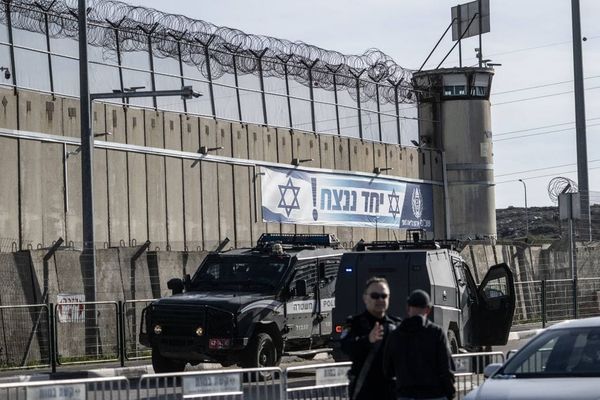
The man identified in Common Dreams' coverage of the investigation as Essa had already lost both feet — amputated after an Israeli missile destroyed his home. When Israeli soldiers brought him to Ofer military prison in the occupied West Bank, he arrived in a wheelchair. They shot him with rubber bullets anyway. Then they tied him up and fired a Taser at him, leaving electrical burn marks that were still visible on his skin a year after his release.
The weapon that burned him was made by Axon Enterprise, a Scottsdale, Arizona company formerly known as Taser International, with a market capitalization of roughly $30 billion and contracts with police departments across the United States. According to a joint investigation published Thursday by The Guardian and Arab Reporters for Investigative Journalism, Axon likely continues to supply Israeli authorities with electroshock devices — and has been documented showcasing its latest models to Israel's security agencies.
This is not a story about a rogue shipment or an isolated incident. It is a story about how the infrastructure of American corporate power becomes the infrastructure of occupation — and how export law, designed precisely to prevent this, is not being used.
The UN Committee Against Torture reported in November 2025 that torture — including electric shocks — had "escalated sharply since October 7, 2023." The committee specifically noted that electric shock devices were frequently used in "sexualized forms of torture." In March 2026, UN experts identified five additional accounts of detainees being shocked by electric batons or similar devices. Israel's own military found that soldiers accused of sexually assaulting a Palestinian prisoner at Sde Teiman detention camp in 2024 had used electric shocks during the attack — then dropped the charges against all five soldiers.
A second detainee described to The Guardian how his captors doused his body with water before applying the Taser in 2024 — a deliberate technique to amplify the electrical current through the body. He now suffers from visual impairment, spasms, and fainting spells. These are not side effects of a non-lethal deterrent used within its designed parameters. These are the documented consequences of a torture method, applied systematically, using a product manufactured in the American Southwest and exported to a government under active scrutiny by the UN Committee Against Torture.
The Council on American-Islamic Relations — the country's largest Muslim civil rights organization — responded Thursday by calling on Axon to immediately halt all contracts, shipments, and servicing of electroshock weapons to Israeli authorities. "It is unconscionable that equipment manufactured by an American corporation is reportedly being used to carry out acts of torture and abuse against detained Palestinians," CAIR said in a statement. The organization also called on the U.S. Department of Commerce to "rigorously enforce export oversight criteria to block the transfer of technologies to governments implicated in systemic human rights violations."
That request names the actual lever. The Department of Commerce administers the Export Administration Regulations, which are supposed to restrict the sale of U.S.-origin items to end-users engaged in human rights violations. The regulations exist. The enforcement mechanism exists. What is absent is the political will to use it — a pattern that runs consistently through the last two years of U.S. policy toward Israel, regardless of which party controlled the executive branch.
Axon's public-facing identity is built on a claim that its products save lives — that electroshock weapons reduce lethal force encounters between police and civilians. The company has cultivated that image carefully, pivoting from its earlier Taser branding toward a broader law enforcement technology platform that includes body cameras and cloud software. It positions itself as a company that makes policing safer and more accountable. That brand logic collapses entirely when the end-user is a military prison system that the UN has formally identified as a site of systematic torture.
Amnesty International had already called for restrictions on electroshock device use in Israeli prisons before this investigation published. The UN Human Rights Office had documented additional cases. These are not allegations that emerged from Thursday's reporting — they are a documented record that Axon has been aware of, and has continued to supply into, regardless.
The through-line here is not unique to Axon. It connects to a broader architecture of U.S. corporate involvement in Israeli military and detention operations that has faced almost no regulatory consequence — a pattern Tinsel News has tracked in its coverage of systemic abuse in Israeli detention facilities and the U.S. government's active obstruction of international accountability mechanisms. The question this investigation forces into view is not whether the abuse is happening — the UN, Amnesty International, and now The Guardian's on-the-record reporting confirm that it is. The question is who in the U.S. supply chain bears legal and moral responsibility for continuing to enable it.
Under the Export Administration Regulations, the Department of Commerce has the authority to add Israeli prison and detention authorities to its Entity List, which would prohibit U.S. companies from supplying them without a license — a license that would almost certainly be denied given the documented record. This has not happened. The State Department's annual human rights reports on Israel have noted concerns about detention conditions while the arms and technology pipeline has continued uninterrupted. The architecture of accountability exists on paper. It has not been applied.
For Essa — the man who lost his feet to an Israeli missile, then lost his body's integrity to an American stun gun in an Israeli military prison — the distinction between U.S. government inaction and U.S. government complicity is not an academic one. The burns on his skin were made by a product manufactured in Arizona. It was shipped under a trade relationship the U.S. government actively maintains. It was used by soldiers operating under a military command structure that receives U.S. diplomatic cover at every UN Security Council vote where a ceasefire resolution has been proposed.
Tinsel News has covered the UN's documentation of systematic torture of Palestinians in Israeli custody as a pattern that predates and extends beyond any single investigation. What Thursday's reporting adds is a named American manufacturer, a documented sales relationship, and a specific regulatory pathway that the U.S. government has chosen not to use. That choice is not passive. Export decisions are affirmative acts of policy. Every shipment of electroshock weapons to Israeli security forces after the UN's torture findings were published is a decision someone made — at Axon, at the Commerce Department, or both.

CAIR's call for a Commerce Department export block is the correct legal demand. But it arrives in a political environment where the current administration has sanctioned ICC officials investigating Israeli military conduct, vetoed ceasefire resolutions, and expanded weapons transfers to Israel over the objections of its own State Department lawyers. The regulatory mechanism CAIR is invoking exists within a government that has treated Israeli military accountability as a threat to be managed rather than a standard to be enforced.
That is what makes this story more than a corporate accountability case. Axon can be pressured — through its shareholders, through the law enforcement agencies that are also its domestic customers, through the reputational damage of being named in a UN-corroborated torture investigation. But the deeper problem is a U.S. export control system that is built to block technology transfers to adversaries and has been consistently applied to protect allies from the same scrutiny. Until that changes, the burns on Essa's skin are not just Axon's responsibility. They are a policy outcome.