Benjamin Davis did not write propaganda. He wrote briefs. He ran seminars. He assembled the kind of technical, sourced, peer-reviewable documentation that international institutions exist to produce — evidence of mass hunger in Gaza, calibrated to the standards of the Food and Agriculture Organization, the United Nations body whose entire mandate is to track exactly this kind of crisis. Then the Israeli mission to the FAO filed a formal complaint about his work. Then he was fired.
The Guardian first reported Davis's account this week, and The Hill followed with additional detail. Davis, a former FAO director, said the complaint was lodged directly in response to a seminar his team conducted that examined the hunger emergency unfolding in northern Gaza. The FAO's leadership, he said, sided with the complaint over the evidence.
Davis's firing is not an isolated personnel decision. It fits a documented, repeating pattern in which international institutions — the bodies specifically constructed to provide neutral, evidence-based assessments of humanitarian crises — have been systematically pressured to soften, suppress, or delay findings when those findings implicate Israeli military operations. The FAO did not fire a rogue actor. It fired a function.
The Food and Agriculture Organization of the United Nations is the primary international body responsible for monitoring food security and hunger worldwide. Its mandate includes producing independent technical assessments of food crises — including those caused by conflict. Member states fund it. Member states also, as this case illustrates, can file complaints against its staff.
To understand why this matters beyond one official's career, consider what was at stake in Davis's work. Gaza's food situation has been characterized by multiple independent monitoring bodies as catastrophic. The Integrated Food Security Phase Classification — the international standard for measuring famine — has repeatedly placed portions of Gaza at Phase 5, the highest designation, meaning famine conditions. The UN's own World Food Programme has documented near-total collapse of food supply systems in the north. These are not contested findings at the margins of humanitarian science. They are the consensus of every credible monitoring mechanism that has been permitted access.
Davis's seminars and briefs were adding institutional FAO weight to that consensus. The Israeli mission's complaint, and the FAO leadership's response to it, removed that weight. The question worth asking is not whether Davis was fired — he was — but what the FAO's leadership believed it was protecting when it acted on that complaint rather than defending its own staff's documented work.
The responsibility here runs in two directions. The first runs toward the Israeli mission, which made a political intervention into a technical process. Governments file complaints with UN agencies. That is within their rights as member states. But filing a complaint against a food security official for documenting food insecurity is not a procedural grievance — it is an attempt to make the evidence disappear by removing the person who assembled it. The complaint's subject was not Davis's methodology. It was his conclusions.
The second runs toward the FAO's leadership, headed by Director-General Qu Dongyu. An institution that responds to political pressure by removing the staff member rather than defending the scientific record has not resolved a conflict — it has chosen a side. The FAO's credibility as an independent technical body rests on its ability to produce findings that inconvenience powerful member states. When it cannot do that, it becomes something closer to a diplomatic instrument than a monitoring agency. The people most harmed by that transformation are the ones the agency is supposed to be watching out for: the hungry.
This is not the first time the humanitarian evidence base on Gaza has been subjected to institutional pressure. As Tinsel News has covered, the pattern of using institutional levers to insulate Israeli military conduct from accountability extends across multiple bodies — from the ICC to the UN Security Council to, now, the FAO. The United States has vetoed Security Council ceasefire resolutions. The ICC's investigation faced direct threats from U.S. officials. What happened to Benjamin Davis fits the same structural logic: find the mechanism producing inconvenient documentation, and apply pressure to the mechanism.
The agency's funding adds a further dimension. The FAO is funded by member state contributions. Major donor states — including the United States and members of the European Union — have influence over the agency's political environment that goes well beyond formal voting rights. An agency leadership that is sensitive to donor pressure, or to the diplomatic relationships of powerful member states, has structural reasons to respond to a complaint from the Israeli mission in ways it might not respond to a complaint from a smaller, less geopolitically connected state. Davis was not fired in a vacuum. He was fired inside an institution that exists within a political economy of power.
Consider precisely what was lost when Davis was removed. The briefs and seminars he produced were not opinion pieces. They were technical assessments of food access, supply chain collapse, and population-level nutrition in a territory under siege. That documentation — produced inside an official UN agency, by a credentialed director — carries institutional weight that independent reporting and NGO assessments, however rigorous, do not fully replicate. When governments and international courts eventually examine what happened in Gaza during this period, the FAO's record will be part of the evidentiary landscape. Removing Davis did not just end his career. It created a gap in that record.
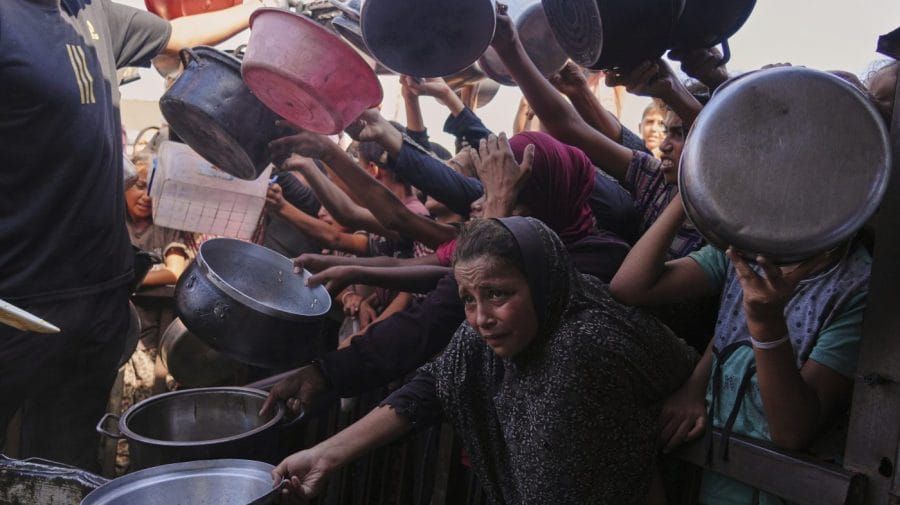
That abstraction needs grounding. The people who needed Davis's documentation to exist are not officials or diplomats. They are the roughly 2.3 million people in Gaza whose access to food has been controlled, restricted, and in large portions of the territory effectively eliminated by the conditions of the siege. For them, the institutional fight over one FAO director's employment is not a bureaucratic story. It is a story about whether the world's monitoring systems will accurately record what is happening to them — or whether those systems can be pressured into silence one complaint at a time.
The FAO has not, as of this writing, offered a public accounting of the decision. Director-General Qu has not explained what review process, if any, was applied to the Israeli mission's complaint before Davis was removed. The agency has not stated whether it assessed the accuracy of Davis's work before acting on the political objection to it. That silence is its own answer. An institution confident it had made a defensible scientific and administrative decision would be able to say so.
What comes next is not abstract. Other FAO staff are watching. Other UN officials working on Gaza documentation are watching. The message the agency sent — that producing accurate findings about hunger in Gaza can cost you your position — will shape what those officials are willing to document, how they frame their conclusions, and how much institutional risk they are willing to accept in service of their mandate. That chilling effect is precisely what political complaints against technical staff are designed to produce, and it follows the same logic former FCC officials warned about when describing how license reviews reshape what broadcasters are willing to say. It does not require firing every inconvenient researcher. It only requires firing one.
The FAO was built to be the world's food conscience — the body that names famines when governments would rather not name them, that counts the hungry when counting them is politically costly. Benjamin Davis was doing that work. His documentation sat alongside a broader body of evidence — including the bombing of water infrastructure serving thousands of displaced families — that together described a humanitarian catastrophe being systematically erased from the institutional record. The institution that fired him for doing it owes the people of Gaza, and the international public that funds it, a full accounting of why a member state's complaint outweighed its own evidence.