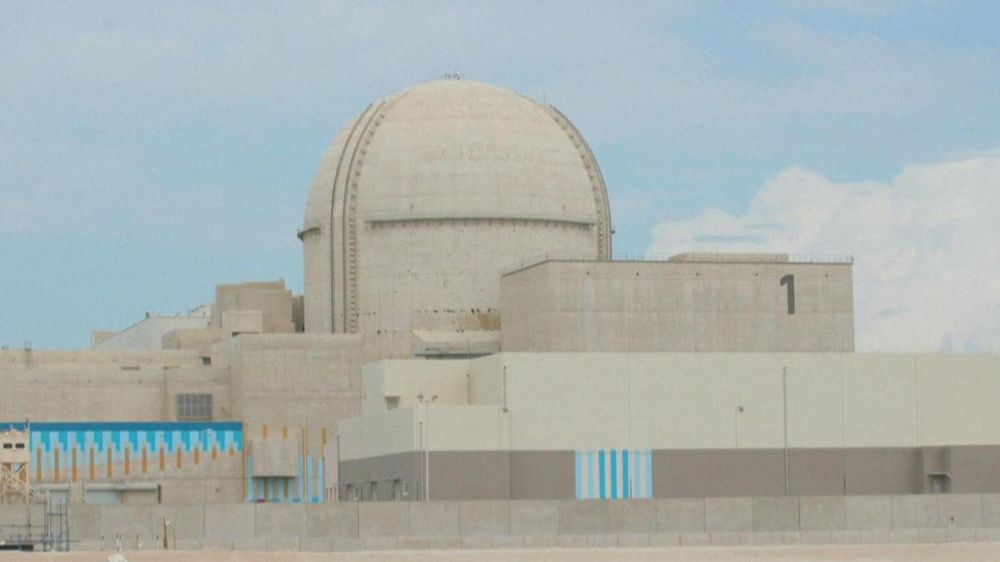
The Barakah nuclear power plant sits on the coast of Abu Dhabi emirate, about 270 kilometers west of the capital. It is the Arab world's first operational nuclear power station — four reactors, years behind schedule, billions over budget, built by a South Korean consortium and operated under International Atomic Energy Agency oversight. The UAE has spent two decades and roughly $30 billion constructing its case that a Gulf state can be trusted with civilian nuclear power. A strike near that facility, reported by BBC News, is not just an attack on a building. It is a message to every government, every bond market, and every insurer on earth: the rules of this conflict are being rewritten.
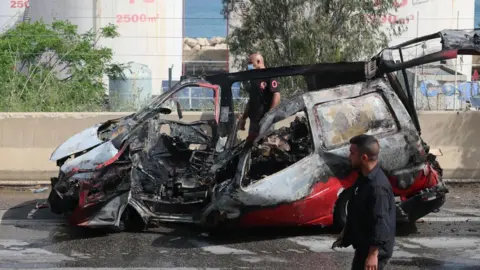
The UAE government called it a "dangerous escalation" and said it is investigating the source. That phrase — dangerous escalation — is diplomatic language for a threshold being crossed. The UAE has not been a direct party to the fighting between U.S. and Israeli forces and Iran. It hosts American military assets. It has normalized relations with Israel. It has positioned itself as a stable, Western-aligned node in a volatile region. A strike near Barakah is a direct challenge to that positioning — and to the idea that Gulf states can remain commercially open while a war burns around them.
Barakah is the Arab world's first operational nuclear power station, located in Abu Dhabi emirate. Built by South Korea's KEPCO at an estimated cost of $30 billion, it comprises four APR-1400 reactors and is designed to supply up to 25% of the UAE's electricity. It operates under IAEA safeguards and has been central to the UAE's argument that Middle Eastern states can responsibly operate civilian nuclear infrastructure.
The original thesis here is one the source material doesn't make: this attack matters less as a military event and more as a market event. The conversation about Iran and Gulf energy has focused almost entirely on oil — tanker attacks, Strait of Hormuz closure scenarios, Kharg Island, price-per-barrel. As Tinsel News has covered, the Strait of Hormuz controls roughly 20 percent of the world's oil supply, and energy prices have already surged 40 percent since the Pentagon's Iran strikes disrupted global oil routes. But a nuclear facility is a different category of target entirely. It does not need to be breached to cause catastrophic economic damage. It only needs to be attacked.
Nuclear power plants are insured through a labyrinthine system of national indemnity pools and international conventions — the Vienna Convention on Civil Liability for Nuclear Damage, the Price-Anderson framework in the U.S., bilateral arrangements in the Gulf. None of these frameworks were designed for a scenario in which a civilian nuclear facility in an active conflict zone is a military target. The moment an insurer begins pricing that scenario, the cost of operating nuclear power in any state adjacent to conflict becomes functionally prohibitive. The Barakah strike — whatever its scale, whatever its source — just handed every actuarial table in the world a new variable.
Follow the money further. The UAE's sovereign wealth funds — Abu Dhabi Investment Authority and Mubadala among them — hold assets estimated at well over $1 trillion. The UAE has spent years building a reputation as the region's financial safe harbor: the place where capital parks when the neighborhood gets loud. A nuclear facility strike, even an unsuccessful or peripheral one, erodes that reputation in ways that cannot be repaired by a government statement. Foreign direct investment into the UAE in 2023 exceeded $22 billion, according to UNCTAD data. That number is premised on stability. Stability just took a direct hit.
The power and money lens here extends beyond Abu Dhabi. Gulf Cooperation Council states have collectively announced hundreds of billions in energy investment over the past decade — solar, gas, nuclear, hydrogen. Much of that investment is premised on the region being a production and transit hub, not a battlefield. Saudi Aramco's valuation, Qatar's LNG contracts, the UAE's green energy ambitions — all of it is underwritten by the assumption that Gulf infrastructure exists outside the direct logic of the Iran conflict. That assumption is now operationally false.
Iran's government has not claimed responsibility. No group has. The UAE says it is investigating. But the systemic pattern here does not require attribution to be legible. The trajectory of this conflict has moved, step by step, from military installations to energy infrastructure to, now, nuclear-adjacent targets. Each step has expanded the definition of what is a legitimate target. Each step has been followed by statements of condemnation and then, after a suitable interval, normalization. The international community condemned the Houthi tanker strikes. It condemned the Abqaiq attack in 2019. It condemned the Aramco drone strikes. Condemnation has not functioned as deterrence.
The human impact dimension of a nuclear facility attack is not hypothetical. Barakah sits on a coast. Abu Dhabi city's population exceeds 1.4 million. The broader emirate holds several million more. A radiological event at Barakah — even a partial containment failure from a conventional strike — would not respect the tidy geography of geopolitical conflict. It would move with wind and water. The populations at risk are not combatants. They are South Asian migrant workers who built the towers of the capital and have no exit plan. They are Emirati families. They are the 200,000-plus expatriates from Western countries who live and work in the UAE and whose governments have not briefed them on evacuation scenarios because those scenarios were considered too alarming to acknowledge publicly.
Accountability requires naming who benefits from the current trajectory. Iran — or the network of armed groups it arms and directs — has a documented strategic interest in demonstrating that Gulf states cannot guarantee the security of their infrastructure while remaining aligned with Washington. Every strike that goes unanswered expands that demonstration. Every strike near a high-value civilian target raises the cost of Gulf alignment with U.S. policy. This is not random violence. It is coercive signaling directed at governments that have not yet chosen a side — and it is working, because the international community has no credible mechanism to make it stop.
The U.S. role cannot be left unnamed. Washington has sold $8 billion in weapons to Gulf nations while fighting a war that those same Gulf states are now being drawn into as targets. American military assets on UAE soil make the UAE a party to the conflict whether Abu Dhabi wants that designation or not. The United States has not publicly acknowledged that its military presence in the Gulf makes Gulf civilian infrastructure a target. That silence is a policy choice with consequences that will now be visible on every energy market that opened this week.
The question of what deters the next strike is the only question that matters now. The UAE has no nuclear weapons. Its air force is formidable but not designed for the kind of sustained retaliatory campaign that would make targeting Barakah costly enough to stop. It depends on American extended deterrence — the credibility of U.S. commitment to defend Gulf allies. That credibility has been badly damaged by two years of erratic American policy. The architecture of Gulf security was built on the premise that Washington's word meant something. The strike near Barakah is, among other things, a test of whether it still does.
Oil prices are the metric everyone will watch. They are the wrong metric. The more important number is the risk premium now baked into every infrastructure project in the Gulf, every insurance contract covering a nuclear facility within 1,000 miles of this conflict, every sovereign debt instrument issued by a state that hosts American forces. That premium does not go away when a ceasefire is announced. It compounds. The strike near Barakah did not need to breach a reactor wall to change the global energy calculus. It only needed to happen — and it did.