Nine activists who showed up to a Texas immigrant detention facility on the Fourth of July — some carrying fireworks, one carrying an AR-15 — left a three-week trial in March with terrorism convictions. On Tuesday, they were sentenced to at least 50 years in prison each. The sentences did not emerge from a legal vacuum. They were built by a federal apparatus that has spent the better part of two years systematically reclassifying protest as insurrection, and dissent as domestic terror.
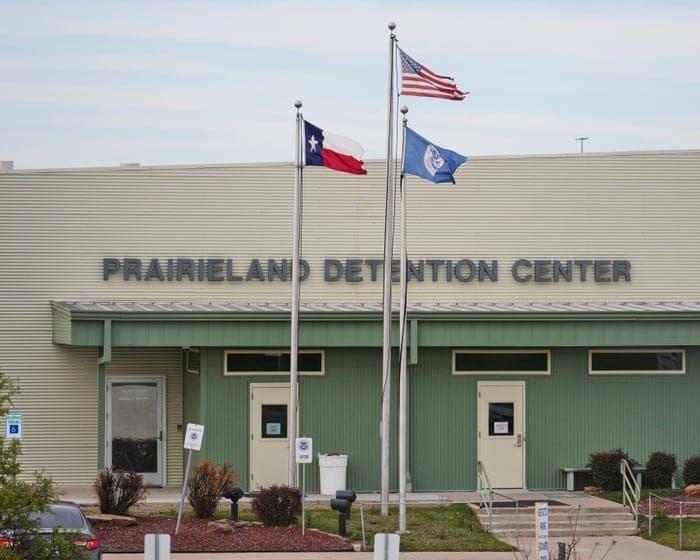
The case, which The Guardian US has covered as a closely watched test of the Trump administration's crackdown on dissent, began at the Prairieland Detention Center in Alvarado, Texas, south of Fort Worth. The facility is operated by the GEO Group, the private prison contractor whose political spending and government contracts Tinsel News has previously documented. The demonstrators arrived late at night on July 4 with a plan to set off fireworks near the facility — a noise demonstration intended to show solidarity with people detained inside.
What happened next is where the legal case was built. A few protesters broke away from the main group and vandalized cars in the parking lot, damaged a guard shack, slashed the tires on a government van, and broke a security camera. When a police officer arrived and drew his weapon, one of the activists — separated from the main group, in the woods — fired an AR-15, hitting the officer in the shoulder. The officer survived.
Fifty-year sentences for protest-related activity are not a normal feature of American jurisprudence. The charges — terrorism — required prosecutors to convince a Texas jury that a noise demonstration at a detention center constituted an act designed to intimidate or coerce a civilian population or government policy. That legal theory, applied to a Fourth of July protest, is the core of what civil liberties attorneys are calling a precedent-setting expansion of domestic terrorism law.
The legal architecture that produced these convictions is worth examining closely. Prosecutors did not simply charge the person who fired the weapon. They charged all nine activists under a theory of collective culpability — that the group, by arriving together with a shared purpose, bore collective responsibility for the most extreme act committed by any individual within it. That theory, applied to a protest, has implications that extend far beyond Alvarado, Texas.
Civil liberties attorneys and legal scholars have warned for years that domestic terrorism statutes, written broadly after September 11 to target organized political violence, were available for prosecutorial overreach against social movements. The Prairieland case is the clearest test yet of whether that warning was prescient. A jury in Texas said yes: showing up to protest at an immigration detention facility, in a group where one person later fired a weapon, is terrorism. The sentence confirms it.
The prosecution leaned heavily on the defendants' alleged association with antifa — a label, not an organization, that has served as a political accelerant since 2020. The administration has publicly declared antifa a domestic terrorist organization, a designation that has no formal legal standing but carries enormous rhetorical power in front of a jury. The question of whether any of the nine defendants had formal ties to any organized group was apparently less important to the prosecution than the label itself.
This is the pattern the administration has been building toward. Consider the trajectory: in Spokane, Washington, three ICE protesters were convicted of felony conspiracy charges for a 2025 demonstration — one of them a combat veteran. In Florida, the governor signed legislation giving a single official the power to label student groups as terrorist organizations without court review. In Newark, the mayor imposed a curfew around an ICE detention center as detainees inside reported being beaten for striking. The Prairieland sentences are not an outlier. They are the current ceiling of a structure that has been under construction for years.
What the Prairieland case adds to that structure is scale. Fifty years is not a sentence designed to punish what happened on July 4. It is a sentence designed to be heard. Every organizer who has ever planned a demonstration at a detention facility, every activist who has ever stood in a group where another person made a choice they did not endorse, every person who has ever protested immigration enforcement — this sentence is addressed to them. The message is not subtle: the cost of showing up could be the rest of your life.
The detained population at facilities like Prairieland — the people the July 4 protesters came to support — exists in its own legal limbo. Ninety-three percent of ICE street arrests have targeted Latinos, a pattern that civil rights organizations have documented as profiling, not enforcement. The people inside Prairieland that night have no equivalent legal recourse to the activists who tried to reach them. One group just received 50-year sentences for a noise demonstration. The other group is detained without the procedural protections that would make such a sentence possible at all.
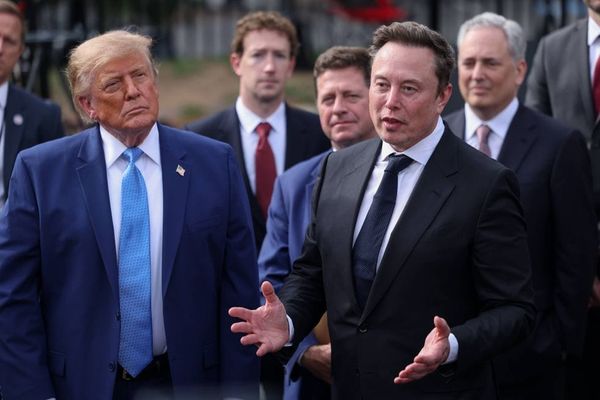
The political context surrounding the prosecution is not incidental. The administration has been explicit about its intent to use the legal system to suppress organized opposition to its immigration enforcement agenda. The Department of Justice, as Tinsel News has reported, has functioned in this administration as a political instrument — its prosecutorial priorities shaped by loyalty to the White House rather than the independent judgment of career prosecutors. The Prairieland case fits that pattern precisely: a protest targeting a detention facility becomes, through prosecutorial framing, an act of terrorism against the state.
It is worth being precise about what actually happened on July 4 in Alvarado. A group of people arrived at a detention facility at night with fireworks. Several of them vandalized property. One of them shot a police officer. The officer survived. None of that is in dispute. The dispute is whether those facts — combined with the political motivation behind the demonstration — constitute terrorism in a constitutional sense, and whether 50-year sentences for nine people, most of whom did not fire a weapon, are proportionate to any legitimate penological purpose.
The answer the Texas court gave is now part of the legal record. And that record will be cited. Future prosecutors in future cases involving future demonstrations at future detention facilities will point to Prairieland as precedent. The 50-year sentences are not just punishment for what happened — they are instructions for what happens next.
The international dimension of this case has received almost no coverage in American media. Protest criminalization at this scale — terrorism charges, multi-decade sentences, collective culpability applied to political demonstrations — is a feature of authoritarian legal systems, not liberal democracies. Britain's recent sentencing of Palestine Action protesters under terrorism statutes drew widespread condemnation from civil liberties organizations on both sides of the Atlantic. The Prairieland sentences are more severe, applied to a country whose founding document enshrines the right to assemble and petition the government. That gap between constitutional text and prosecutorial practice is the story American media is not telling.
The accountability question that follows from all of this is not simply whether these sentences will survive appeal — though they should be appealed, and the collective culpability theory in particular is constitutionally fragile. The larger accountability question is who benefits from a legal environment in which 50-year terrorism sentences are available tools against immigration protesters. The GEO Group, which operates Prairieland and whose political donations flow to the legislators who fund detention expansion, benefits from a legal system that treats protest at its facilities as terrorism. The administration, which has made immigration enforcement the centerpiece of its political identity, benefits from a chilling effect that makes future demonstrations less likely. The detained people inside Prairieland on July 4 benefit from nothing in this outcome.
The Prairieland Nine, as they will almost certainly come to be known, are now serving sentences longer than most Americans will live as free adults. The legal theory that put them there — that political protest, when it occurs in proximity to violence, becomes terrorism — is now available to any prosecutor in any jurisdiction who wants to use it. The next test of that theory will not require fireworks or an AR-15. It will only require a prosecutor willing to reach for a statute that a Texas jury just confirmed can stretch this far.