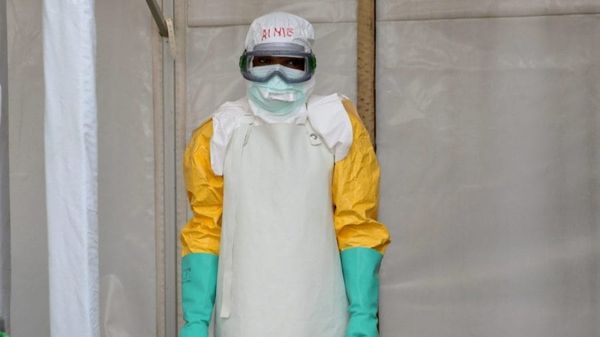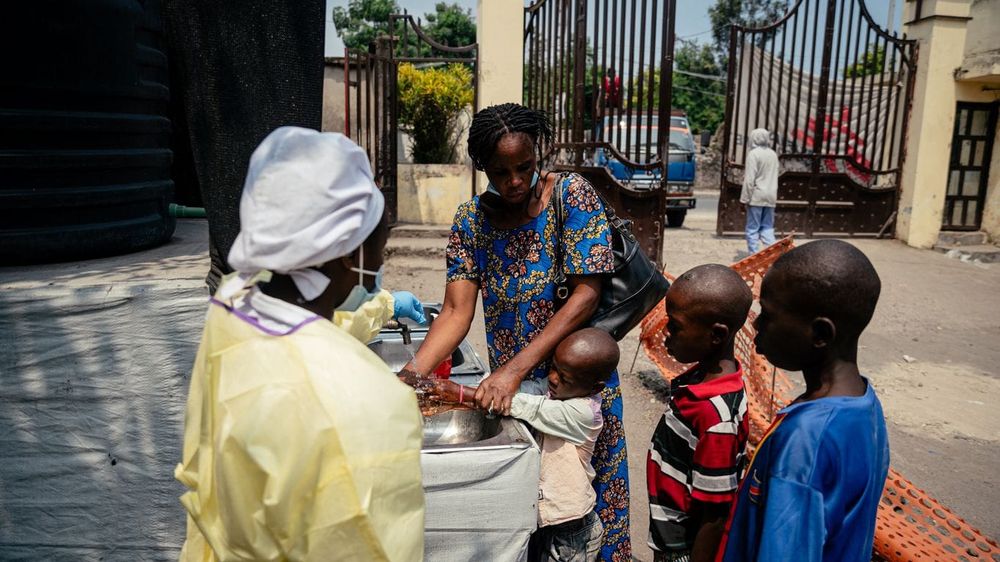
Thirty confirmed cases. More than 500 suspected. At least 130 suspected dead. And a strain of Ebola virus for which no approved vaccine exists, spreading through one of the most conflict-fractured, densely populated, and mobile border regions on the planet.
Those are the numbers WHO Director General Tedros Adhanom Ghebreyesus presented Monday, when the World Health Organization declared the current Ebola outbreak in the Democratic Republic of Congo a public health emergency of international concern — the organization's highest alert designation. Two confirmed cases, including one death, have already been recorded in Uganda among people who crossed from the DRC. One American working in the DRC has tested positive and is being transported to Germany for treatment, the CDC confirmed.
The strain is Bundibugyo. It is one of four Ebola strains known to cause illness in humans, per the CDC. It is also the one for which scientists have no approved vaccine — a critical distinction from the Zaire strain, which drove the 2014–2016 West Africa outbreak and for which a vaccine was eventually developed at enormous cost in lives and resources. This time, the immunological toolbox that public health officials would normally reach for is largely empty.
But the absence of a vaccine is not the only structural problem. It may not even be the most consequential one. The outbreak is unfolding at a moment when the global health infrastructure specifically designed to detect, track, and contain emerging pathogens in low-income, conflict-affected countries has been gutted — and the country most responsible for building that infrastructure over two decades spent the first months of 2025 dismantling it on a spreadsheet.
USAID's global health programs, which funded disease surveillance networks, community health workers, laboratory capacity, and emergency response logistics across sub-Saharan Africa, were among the first casualties of the administration's foreign aid cuts. As Tinsel News documented in March, those cuts did not merely reduce funding — they severed relationships, disbanded trained teams, and eliminated the institutional memory that takes years to rebuild. The people dying from the consequences of that decision are not American. They are Congolese. They are Ugandan. They are the residents of border communities whose names will not appear in the policy debates in Washington that determined their fate.
Jennifer Nuzzo, director of the Pandemic Center at Brown University School of Public Health, told Axios that the conditions on the ground make a repeat of 2014 plausible. "Many people are worried that we could have another 2014 situation on our hands," Nuzzo said. "That was the largest, deadliest outbreak of Ebola on record, and the conditions on the ground and the lack of tools to combat this particular Ebola virus make people very worried that we could see similar circumstances happen again." She also noted what may be the most alarming data point of all: "We actually don't know how large the situation already is, but it's certainly poised to become much, much larger."
That uncertainty — the gap between confirmed cases and suspected cases, between what has been documented and what is actually circulating — is itself a product of infrastructure failure. Surveillance systems identify cases. Laboratory networks confirm them. Community health workers trace contacts. When those systems are degraded or absent, the number you see is not the number that exists. The 30 confirmed cases and 500 suspected cases are not two estimates of the same reality. They are a measure of how much of the reality remains invisible.
The Bundibugyo strain of Ebola is rare — it was first identified in Uganda in 2007 — and, critically, has no approved vaccine. The rVSV-ZEBOV vaccine deployed during the 2018–2020 DRC outbreak targets the Zaire strain. Fatality rates for Bundibugyo have ranged from 30–50% in past outbreaks, per the WHO. It spreads through direct contact with bodily fluids of infected persons, and Ebola is challenging to contain once human transmission is established, per the CDC.
The DRC is not an abstraction. It is a country of 100 million people, bordered by nine nations, with active armed conflict in its eastern provinces — the precise region where this outbreak is concentrated. The conflict is not incidental to the outbreak; it is the condition that makes containment hardest. Armed groups disrupt health worker access. Displacement moves infected people across borders before contact tracing can follow. Trust in government health authorities, already fragile after years of violence and instability, collapses when the armed men at a checkpoint and the armed men near the health clinic are indistinguishable.
Nasia Safdar, an infectious diseases physician and professor at the University of Wisconsin-Madison, told Axios that Ebola concerns her more than the recent hantavirus outbreak, specifically because the community transmission dynamics in the DRC are fundamentally different from the contained environment of a cruise ship. The comparison matters: hantavirus spread in a bounded, traceable setting. Ebola is spreading in a war zone with porous borders and compromised health infrastructure. These are not comparable containment challenges.
The Global Preparedness Monitoring Board — co-convened by the WHO and World Bank — released a report Monday warning that general public health reforms have not kept pace with rising pandemic risk. That report lands at a moment when the United States, historically the largest single funder of global health preparedness, has not merely reduced its contribution but actively reversed it. Travel restrictions for those without U.S. passports arriving from Uganda, DRC, and South Sudan were announced Monday, along with enhanced port health screening. These are reactive measures. The proactive measures — the surveillance networks, the trained responders, the laboratory chains — were cut before the outbreak began.
This is the accountability question that the current outbreak forces into view: who decided that the infrastructure built to prevent this kind of emergency was expendable, and what did they think would happen instead? The answer is not complicated. The administration that cut USAID's global health programs knew those programs existed to prevent pathogen spread. The argument for cutting them was not that they were ineffective. It was that they cost money and served people outside the United States. That is a policy choice. It is also a choice with a body count that is still being tallied.
The outbreak's reach into Uganda — a country with stronger health infrastructure than the DRC — is the first signal that containment is already failing at the border. The confirmed death in Uganda of a traveler from the DRC is precisely the scenario that cross-border surveillance programs were designed to detect early and interrupt fast. Whether those programs are still functioning at the capacity needed is, at this point, an open question. The people who would have known the answer worked for organizations that no longer have their funding.
The fatality rate for Bundibugyo Ebola has ranged between 30 and 50 percent in past outbreaks, per the WHO. In a best-case scenario, the current outbreak is contained to the numbers already documented. In the scenario that public health experts are actually planning for, the 500 suspected cases are the visible edge of something much larger moving through communities where no one is counting yet. The 2014–2016 West Africa outbreak infected more than 28,600 people and killed 11,325 before it was brought under control — and that outbreak had a vaccine in development, a relatively stable operating environment compared to eastern DRC, and a U.S. government that treated global health infrastructure as a strategic asset rather than a line item to eliminate.
None of those conditions hold today. The outbreak the world is now trying to contain is unfolding in the wreckage of the system that was supposed to prevent it — and the people bearing that cost live in Butembo, in Goma, in the border towns of southwestern Uganda, in places whose distance from Washington made them easy to defund and will make them hard to save.