The government's position, stripped to its core, was this: a noncitizen who criticizes a foreign government's policies can be deported at the Secretary of State's personal discretion, with no hearing, no appeal, and no requirement to show harm. Secretary of State Marco Rubio invoked two provisions of the Immigration and Nationality Act to make it happen — one allowing deportation if the secretary "personally determines" that speech "compromises a compelling foreign policy interest," the other permitting visa revocation at pure discretion. For months, that framework held.
On Friday, it didn't. Northern District of California Judge Noël Wise, appointed by former President Joe Biden, ruled that the administration violated both the First Amendment and the Fifth Amendment's due process protections when it moved to deport international students for speaking publicly in support of Palestinian rights, Common Dreams reported. "Stated plainly, in the United States, freedom of speech belongs to the people. It is not the government's to take," Wise wrote.
That sentence is not a rhetorical flourish. It is a judicial finding that the executive branch constructed a mechanism specifically designed to punish political speech — and called it immigration enforcement.
The lawsuit challenged two provisions of the Immigration and Nationality Act that Secretary Rubio used to justify the deportations. The first allows the secretary of state to deport a noncitizen for speech if the secretary "personally determines" the speech "compromises a compelling foreign policy interest." The second allows visa revocation entirely at the secretary's discretion. Judge Wise found both unconstitutional as applied.
The case was brought by the Foundation for Individual Rights and Expression in August 2025 on behalf of The Stanford Daily — Stanford University's student newspaper — and an anonymous female plaintiff identified as Jane Doe. The newspaper's argument was direct: student journalists on visas had stopped covering pro-Palestinian protests on campus because they feared deportation. They were not speculating. The policy had already been used against named individuals. Self-censorship was the documented, intended effect.
"The reporters in our newsroom shouldn't have to fear that writing a story will result in their deportation," Stanford Daily editor-in-chief George Porteous wrote after the ruling. "Today's victory means they won't have to." That statement describes something that should not have been possible in the first place: a functioning campus newsroom in the United States where reporters made coverage decisions based on whether a story might get them expelled from the country.
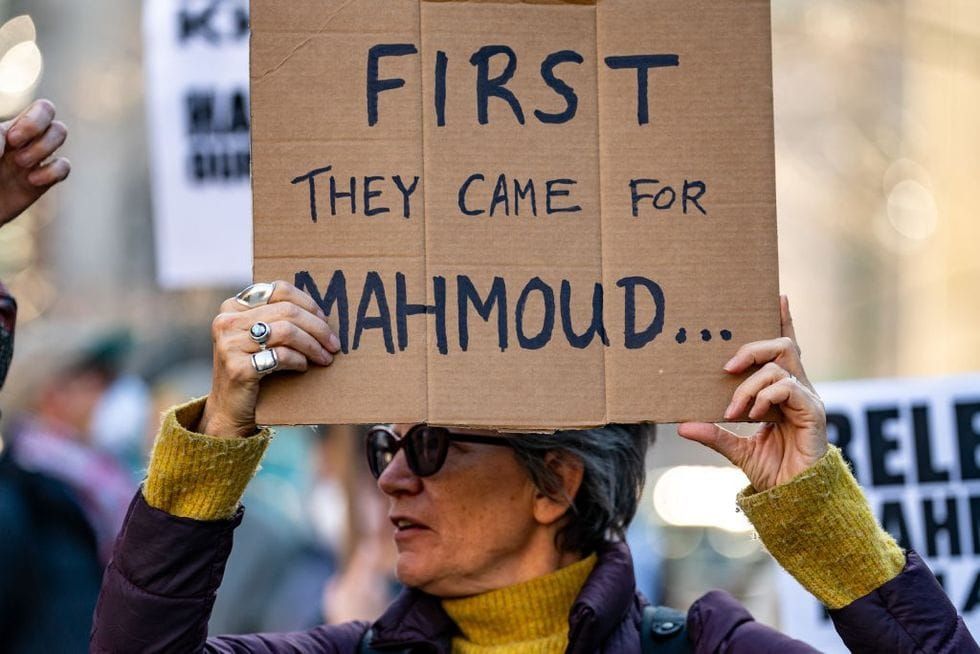
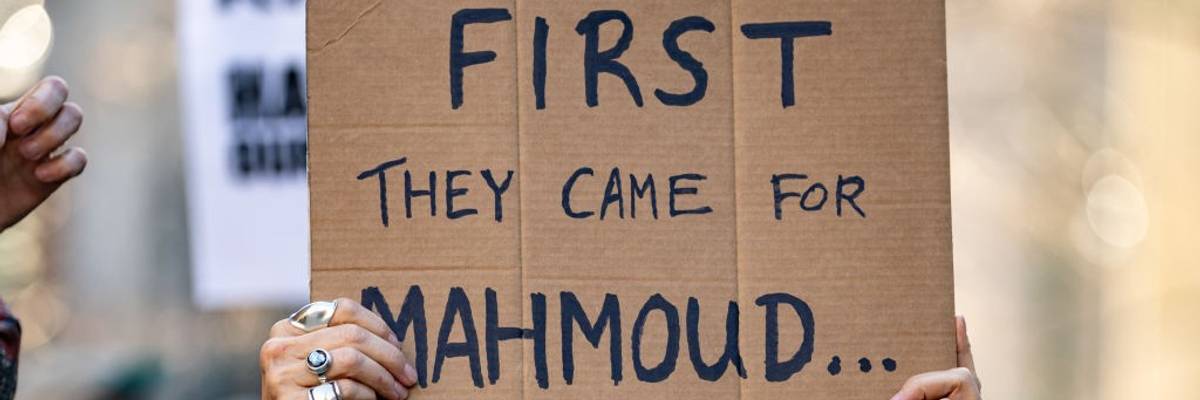
The students targeted by name were not abstractions. Mahmoud Khalil, a Columbia University student who holds a green card — not a visa, a green card — was detained by Immigration and Customs Enforcement early in the second Trump administration. Mohsen Mahdawi, also a Columbia student, and Rümeysa Öztürk, a Tufts University student, faced the same machinery. On Saturday, Khalil posted on social media: "A federal judge just ruled that the Trump admin's use of immigration law to deport me and other noncitizen students for pro-Palestinian speech is unconstitutional. No one should fear speaking up for Palestine."
Khalil's case had its own prior data point that the administration preferred to ignore: the FBI cleared Khalil two days before his arrest. The administration kept calling him a threat anyway. That sequence — cleared by the FBI, detained by ICE, labeled dangerous in press statements — is not a bureaucratic miscommunication. It is a description of how the apparatus worked: the threat designation was not the cause of the detention. It was the justification constructed afterward.
The Council on American-Islamic Relations welcomed the ruling with a statement that named the constitutional principle at stake: "This ruling reaffirms a fundamental American principle that the government cannot deport people simply because it dislikes their political views. Students do not surrender their constitutional rights at the classroom door, and international students do not surrender their freedom of expression when they come to study in the United States."
That framing — students do not surrender their rights at the classroom door — echoes the Supreme Court's 1969 ruling in Tinker v. Des Moines, which established that constitutional rights do not evaporate when students enter school buildings. What is new here is the government's attempt to apply a different standard to noncitizens: not merely restricting speech, but threatening the legal status that allows a person to remain in the country as the mechanism of suppression. This is a qualitatively different kind of censorship than anything a domestic policy can achieve. You cannot deport a citizen for a protest sign. You can, the administration claimed, deport a green card holder.
That distinction matters because the ruling's stakes extend beyond the students named in the case. The INA provisions Rubio invoked were not written for this purpose — they were stretched to cover it. The "compelling foreign policy interest" language was designed to address genuine national security threats, not to give a cabinet secretary a veto over campus political speech. Using it this way required the administration to argue, in effect, that criticism of a foreign government's conduct — Israel's military campaign in Gaza — constituted a threat to U.S. foreign policy interests sufficient to justify deportation. Judge Wise found that argument constitutionally untenable.
The pattern here is not isolated to this case. Civil disobedience for Palestinian rights has been designated legally equivalent to supporting al-Qaeda in other proceedings. Foreign journalists in the United States lost their long-term visas under a policy critics said targeted those covering sensitive subjects. The architecture being built is consistent: use immigration status, visa authority, and national security framing to suppress political speech that the administration finds inconvenient — then dare the courts to stop it.
Courts have been stopping it, piece by piece. But each ruling is reactive. The administration files a new justification, invokes a different statutory authority, moves the target to a different jurisdiction. The chilling effect — the Stanford Daily reporters who did not cover protests, the Jane Doe who feared retaliation, the Khalils and Mahdawis who spent months in legal limbo — accumulates regardless of how each individual case resolves. By the time a court rules the deportation unconstitutional, the speech has already been suppressed. The protest went uncovered. The op-ed was not written. The demonstration was not attended.
What Friday's ruling does is establish, clearly and on the record, that the statutory provisions Rubio relied upon cannot constitutionally do what he used them to do. That is significant. It removes a specific legal tool from the administration's arsenal and creates precedent that other courts can cite. It does not, by itself, prevent the administration from finding new tools, invoking different authorities, or simply continuing to detain people while cases work their way through the courts.
The administration's project was never primarily about deporting specific students. It was about establishing that the government could — that noncitizens who enter the United States for education should understand their political speech exists at the sufferance of whoever holds the Secretary of State's office. That project failed in the Northern District of California on Friday. It has not yet failed everywhere. And in each case, the failure arrives only after the speech it was built to suppress has already gone quiet.