The United States Postal Service was never designed to be an instrument of electoral policy. It delivers medicine, bills, and birthday cards to 167 million addresses. It is constitutionally grounded, politically neutral by design, and operated by a quasi-independent board insulated from direct White House control — at least in theory. That theory is now being tested in federal court.
Twenty-four states have filed a lawsuit to block a presidential order directing the USPS to restrict its role in mail-in voting, according to The Guardian US. The filing came days after the Supreme Court lifted one injunction that had blocked part of the order — a procedural opening that state attorneys general moved quickly to close through a new legal challenge. What the lawsuit frames as a constitutional crisis over ballot access is, at its structural core, something more specific: the transformation of a federal logistics agency into a mechanism for determining which votes get counted.
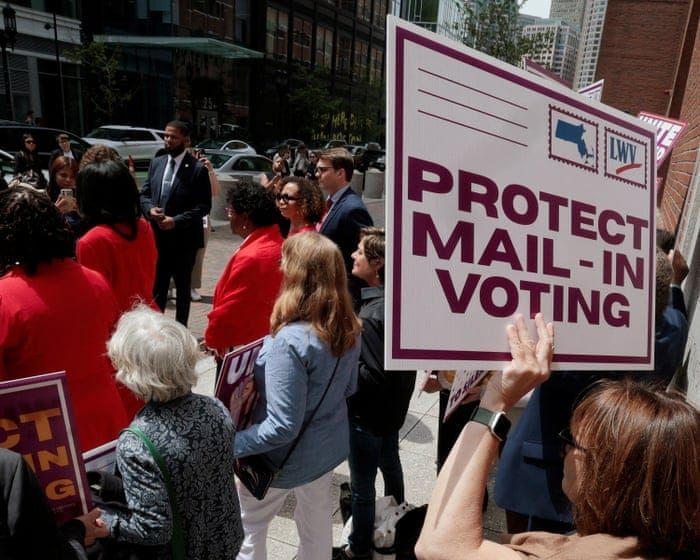
The mechanics of the order matter. Mail-in voting is not a peripheral feature of American elections — it is, in many states, the primary means by which rural voters, elderly voters, disabled voters, shift workers, and military personnel cast ballots. After pandemic-era expansions normalized vote-by-mail across party lines, roughly 46 percent of all ballots in the 2020 general election were cast by mail, according to the MIT Election Data and Science Lab. Any federal action that degrades the postal infrastructure supporting that volume of ballots is, functionally, a restriction on participation — regardless of how it is labeled.
That labeling is where the accountability gap lives. The order does not declare itself a voter suppression measure. It does not say: we are making it harder to vote. It operates through the postal system's administrative capacity — through processing timelines, acceptance windows, forwarding rules, and return deadlines. The effect is downstream and diffuse. The cause is centralized and deliberate. This is the architecture of modern disenfranchisement: not a poll tax or a literacy test, both of which courts could strike immediately, but a logistics constraint that produces the same outcome while resisting the same legal remedy.
The Supreme Court's decision to lift one of the injunctions blocking the order is not a ruling on its merits. Courts distinguish between the question of whether a restriction is ultimately lawful and the question of whether it should be paused while litigation proceeds. The Court's action means the administration can begin implementing portions of the order during the litigation window — which, in the context of a midterm election cycle, is not a procedural footnote. Implementation during an election cycle is implementation during an election. The damage to voter access does not pause while appeals are resolved.
The states suing to block the order are making a federalism argument, a separation of powers argument, and a voting rights argument simultaneously. The federalism claim holds that states, not the federal executive, have primary authority over election administration under Article I of the Constitution. The separation of powers claim holds that the president cannot direct a quasi-independent agency to implement a policy that Congress has not authorized. The voting rights claim holds that the practical effect of the order falls disproportionately on communities — rural, elderly, low-income, disabled — whose access to polling places is already constrained.
All three arguments have merit. The more important observation is that they should not need to be made at all. The USPS's role in election administration is not a loophole or an improvisation — it is a deliberate infrastructure choice that Congress and the states built over decades precisely because it is reliable, accessible, and politically insulated. An executive order that redirects that infrastructure toward a partisan electoral outcome is not a policy disagreement. It is an institutional attack on a mechanism that exists to make the franchise available to people who would otherwise be excluded from it.
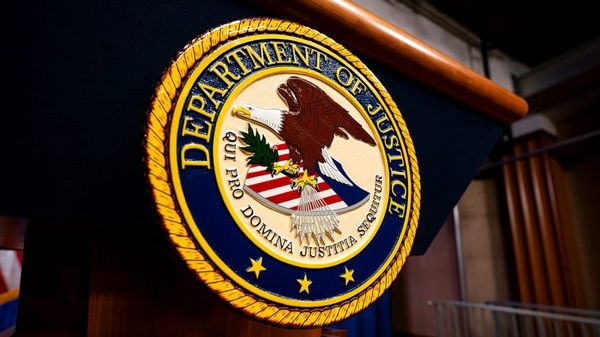
The Postal Service Board of Governors is designed to operate independently of direct presidential control. The Postmaster General serves a fixed term and is appointed by the Board, not the White House. Presidential orders directing the USPS to alter its election-related services sit in legally contested territory — the administration's authority to issue them has never been definitively settled by the Supreme Court, which is why the current litigation is structurally significant beyond this specific order.
Follow the money, and this story runs through the midterm calendar. The states filing suit are, without exception, states where competitive House and Senate races will be decided in part by mail ballot returns. That is not a coincidence — it is the political geography of why this order was issued when it was issued. Restrictions on mail voting that take effect in the weeks before a November election compress the window in which voters can seek alternative means of participation. Voters with the fewest alternatives — those without transportation, those working multiple jobs, those in rural counties where polling places have been consolidated — absorb the restriction disproportionately.
This lawsuit belongs to a longer sequence that Tinsel News has covered across multiple fronts: the normalization of armed federal agents at polling places, the removal of independent members from the Election Assistance Commission, and the Supreme Court's Alaska mail ballot ruling that already threatens rural and Indigenous voters. Each action, considered alone, can be framed as procedural. Considered together, they constitute a coordinated narrowing of the electorate — not through a single dramatic act, but through the patient erosion of the systems that make voting accessible to people the majority coalition does not need.
The legal question the courts will ultimately resolve is whether the executive branch has the authority to direct the USPS to restrict election-related services without explicit congressional authorization. That question has a clean answer in administrative law: agencies cannot exceed the statutory authority Congress has granted them, and presidential orders cannot manufacture that authority unilaterally. But the courts move on their own timeline, and elections do not wait for appellate briefing schedules.
The twenty-four states filing this lawsuit are, in effect, doing what Congress has declined to do: treating the systematic degradation of ballot access as an emergency requiring an immediate institutional response. The Georgia election officials who certified 2020 are gone, replaced by loyalists. The federal agency that certifies voting machines has lost its independent members. The postal system — the last piece of election infrastructure that remained structurally insulated from political pressure — is now the target.
What the states are suing to protect is not a preference about how people vote. It is the proposition that the federal government cannot use the agencies it controls to determine who gets to vote at all. If the courts do not hold that line before November, the question of whether they hold it afterward becomes considerably less consequential.