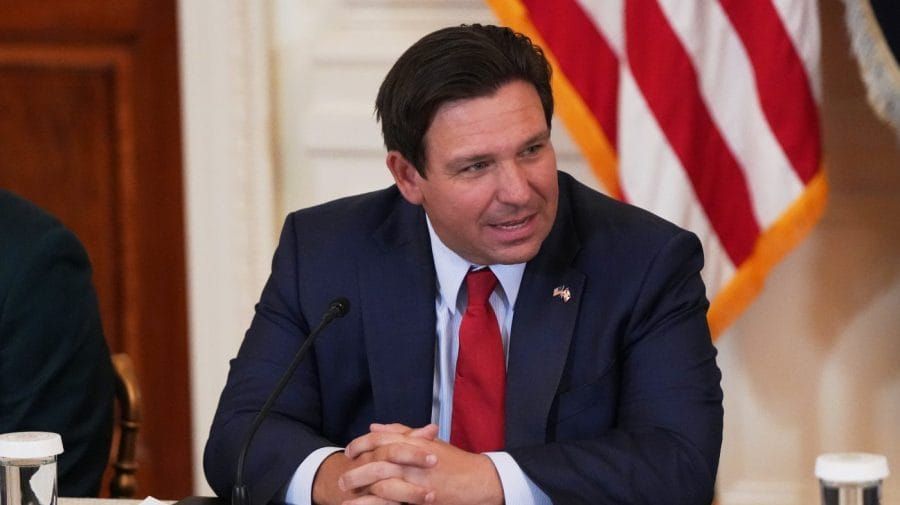
The Florida legislature passed a new congressional map Wednesday that would shift the state's House delegation from a 20-8 Republican advantage to 24-4 — erasing four competitive or minority-represented districts in a single session. Gov. Ron DeSantis proposed the lines. Republican lawmakers approved them on a party-line vote. The map now awaits his signature, which is expected. But the architecture behind this moment was not built in Tallahassee. It was built by the United States Supreme Court.
The 2023 ruling in Allen v. Milligan reaffirmed that states cannot draw congressional maps that dilute the voting power of minority communities under the Voting Rights Act. But a separate line of decisions — running through Rucho v. Common Cause in 2019 — established that federal courts have no authority to strike down partisan gerrymanders, no matter how extreme. Those two rulings exist in uncomfortable proximity: the Court will protect racial minorities from targeted map-drawing, but it will not protect anyone from maps drawn to maximize partisan advantage, even when race and partisanship overlap in ways that make the distinction nearly impossible to maintain. Florida Republicans have spent the past two years stress-testing exactly where that line sits, as The Hill reported in its coverage of Wednesday's vote.
The original thesis here is one the source material does not make: this redistricting push is not primarily a story about Florida. It is a proof-of-concept for how far a state Republican party can move after Rucho removed the federal judicial check on partisan line-drawing. Florida is the stress test. If the map survives legal challenge — and there is a credible argument it will — every Republican-controlled legislature in the country will have a working model for how to translate a state-level majority into a durable, court-insulated congressional lock.
The speed of the process matters as much as the outcome. Lawmakers fast-tracked the new lines with the 2026 midterms explicitly in mind, according to The Hill's reporting. That urgency is not incidental — it is the strategy. Courts take time. Elections do not wait. By passing new lines now, Republicans bank the map's advantages into the next cycle before any legal challenge can produce an injunction, a ruling, and a remedy. This is the same logic that drove DeSantis's first redistricting push in 2022, when he personally submitted congressional maps that a state court later found violated Florida's own Fair Districts amendment. That ruling came after the election. The seats were already won.
In Rucho v. Common Cause (2019), the Supreme Court's conservative majority ruled 5-4 that federal courts cannot review partisan gerrymandering claims — even when maps are drawn with the explicit intent to entrench one party's power. The ruling left enforcement entirely to state courts and state constitutions. In Florida, the Fair Districts amendment was supposed to be that check. DeSantis's 2022 maps tested it. The 2025 maps are testing it again.
Follow the power arithmetic. Republicans currently hold a 20-8 majority in Florida's congressional delegation — already a substantial edge in a state that voted for Donald Trump by a 51-48 margin in 2024. A 24-4 map would make Florida's congressional representation look less like a competitive purple state and more like a deep-red one-party stronghold. The gap between the state's actual partisan composition and its congressional delegation would become one of the largest in the country. That gap has a name: it is the measurable output of a gerrymander. For a deeper look at how these line-drawing mechanics work state by state, see our guide to how gerrymandering works.
The districts most at risk under the new map are those with significant Black and Latino populations — communities whose political preferences have been most consistently targeted in Florida's redistricting fights. This is where the racial and partisan overlap becomes legally and morally consequential. Under the Voting Rights Act, states cannot draw maps that crack or pack minority communities to dilute their collective voting power. Under Rucho, states can draw maps to maximize partisan advantage. The problem is that in Florida, as in much of the South, Black and Latino voters vote overwhelmingly Democratic. A map drawn to eliminate Democratic seats will, in practice, eliminate the districts where Black and Latino voters hold decisive influence. Republican mapmakers have learned to describe this outcome in partisan terms, not racial ones — a framing that Rucho effectively ratified.
DeSantis's role in this process is worth naming precisely. The governor did not wait for the legislature to draw lines and then review them. He proposed the map himself. That is an unusual degree of executive involvement in what is nominally a legislative function — and it is consistent with DeSantis's broader posture toward Florida's institutional structures, which he has treated less as independent branches of government than as instruments of his political agenda. His record on this specific issue includes personally submitting the 2022 congressional maps that state courts later found unconstitutional, a process that mirrors a broader pattern of conservative executives testing judicial limits on state power — and finding those limits softer than they appeared.
The legal challenges are already forming. Civil rights groups and Democratic-aligned organizations have signaled they will challenge the new map under the Voting Rights Act, arguing that eliminating majority-minority districts crosses the line that even Rucho left intact. Those challenges will move through Florida's state courts, which are no longer the independent check they once were — DeSantis has appointed five of the seven Florida Supreme Court justices currently serving. The court that would ultimately review this map for compliance with the Fair Districts amendment is substantially composed of judges chosen by the man who drew the map it is being asked to evaluate.
The national implications arrive in 2026. House Republicans currently hold a thin majority — thin enough that a shift of five or six seats in competitive states could flip chamber control. Florida's new map, if it survives legal challenge and takes effect before November 2026, would effectively lock in four additional Republican seats before a single vote is cast. In a chamber where margins are measured in single digits, that is not a redistricting story. It is a power transfer story. The question of who controls the House — and therefore who controls the legislative agenda, committee chairs, and the certification of a future presidential election — may be answered in part by lines drawn in a Florida legislative session that lasted less than a week.
That timeline should not be treated as a procedural footnote. Voters in the four districts most threatened by the new map — communities whose representation in Congress is the direct object of this exercise — have no meaningful recourse before 2026. The courts will be slow. The legislature has already acted. The governor will sign. The machinery of democratic accountability, in this instance, is running significantly slower than the machinery of partisan entrenchment. That asymmetry is not an accident. It is the design.
The broader pattern is one this publication has tracked in other contexts: democratic structures being hollowed out not through dramatic rupture but through procedural accumulation, each individual action defensible in isolation, the cumulative effect visible only when you step back far enough to see the shape. Democracy experts have noted that the system has "stabilized" — but at a meaningfully diminished level. Florida's congressional map is one more data point in that accounting.
If the map takes effect and Republicans hold those 24 seats in 2026, the Florida experiment will have produced its proof of concept: a governor can personally draw congressional lines, a compliant legislature can pass them in days, a remade judiciary can sustain them, and the federal courts — bound by Rucho — cannot intervene on partisan grounds. Every Republican-controlled statehouse is watching. The lines being drawn in Florida this week may be the template for the next decade of American congressional politics.