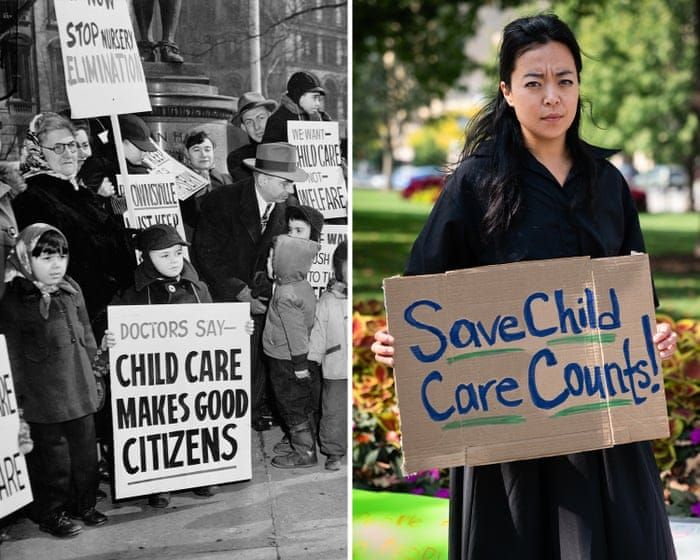
The United States spends less on early childhood education as a share of GDP than nearly every peer nation in the developed world. For decades, that gap was treated as a budgetary constraint, a cultural preference, or simply the natural order of things. Then the pandemic closed every daycare in America simultaneously, and overnight, roughly 11 million children lost their childcare arrangements while their parents were still expected to work. The policy that had been called too expensive, too radical, or too socialist turned out to be something simpler. It was the thing holding the entire economy together, provided almost entirely by underpaid women, and priced out of reach for the families who needed it most.
That is the context in which Francesca Hong, a democratic socialist running in Wisconsin's Democratic gubernatorial primary on August 11, has built a campaign around a promise of free childcare — and found, according to The Guardian US, that the message lands with voters across ideological lines. "When we talk about free childcare, you can connect to folks whether it's on an economic argument or just purely that it's the right thing to do for our kids," Hong told the Guardian. "I always like to remind folks: if we don't take care of our kids, who's going to take care of us?"
Hong is not alone. She is part of a wave of democratic socialist candidates — many affiliated with or influenced by the Democratic Socialists of America — who have made universal childcare a centerpiece of their campaigns at the state and local level. As Tinsel News has documented, DSA has now helped elect more than 300 candidates across 40 states, dismantling the narrative that socialist politics belong only in coastal cities. Free childcare is one of the policies doing the dismantling.
The more interesting question is not whether the policy is popular — polling consistently shows it is — but why it took so long to become a viable electoral platform, and what that delay cost the families who needed it.
The average cost of center-based childcare in the United States exceeds $15,000 per year per child in most states — more than the average annual cost of in-state college tuition. The U.S. spends approximately 0.4% of GDP on early childhood education, compared to an OECD average of over 0.8%. Childcare workers earn a median wage of under $14 per hour, placing the profession among the lowest-paid in the economy despite its acknowledged social importance.
The economics of American childcare have been broken for a generation. The sector operates in what policy analysts call a "trilemma": care that is affordable for families is too cheap to pay workers a living wage; care that pays workers fairly is unaffordable for most families; and care that does both requires public subsidy that the political system has consistently refused to provide. That refusal was not accidental. It reflected a set of choices — about who does care work, who pays for it, and whose economic contributions count — that benefited some interests and punished others.
The interests that benefited were not mysterious. A workforce kept at home by unaffordable childcare is a workforce that cannot organize, cannot demand higher wages, and cannot run for office. Predominantly women, disproportionately women of color, the parents priced out of the labor market by childcare costs are also the parents least likely to have the financial cushion to weather a political campaign. The childcare crisis is a political crisis dressed in the language of personal responsibility.
The pandemic stripped that language away. When every parent in America suddenly confronted the same problem at the same time — when the childcare infrastructure collapsed visibly, publicly, and all at once — the fiction that this was a private matter of family budgeting became impossible to maintain. "Overnight, people realized how essential it was," as the Guardian's framing of the moment put it. The political opening that followed was real. The question was who would walk through it.
The answer, in state after state, has been candidates like Hong: democratic socialists running on explicit public provision, not tax credits, not vouchers, not public-private partnerships, but the government paying for childcare the way it pays for public schools. The framing is deliberate. Tax credits benefit families with enough income to owe taxes. Vouchers route public money through private markets that can discriminate, exclude, and fail. Universal public provision is the only mechanism that reaches every family regardless of income, employment status, or geography.
That distinction matters enormously for understanding why corporate Democrats largely avoided the issue for so long. Vouchers and tax credits preserve the private market. Universal public provision threatens it. The childcare industry — particularly the private, for-profit sector — has a direct financial interest in preventing the government from becoming the primary provider. And the private childcare industry, like most industries, has lobbyists, trade associations, and political relationships with the legislators who write childcare policy.
Wisconsin is a particularly high-stakes laboratory for this argument. It is a genuine battleground state, one where Democrats have spent years trying to identify messages that move voters who feel economically abandoned without alienating the donor class that funds the party's infrastructure. The conventional wisdom held that democratic socialist candidates were electoral liabilities in states like Wisconsin — too far left, too ideologically pure, too easy to caricature. Hong's campaign is a direct test of that assumption.
What the Guardian's reporting documents is that the test is not going the way the conventional wisdom predicted. Free childcare, it turns out, is not a hard sell in a state where the average family spends a significant portion of household income on care for children under five. It is not a hard sell anywhere that the economic reality of childcare costs has landed on working families with full force — which is to say, everywhere.
The deeper argument Hong and her counterparts are making is that the pandemic exposed not just a policy gap but a systemic failure of political imagination. The United States had the resources to build universal childcare decades ago. It had the evidence — from France, from Germany, from Scandinavia, from Quebec — that public childcare produces measurable returns in child development, maternal labor force participation, and long-term economic output. What it lacked was a political coalition willing to name the problem as a public responsibility rather than a private one.
That coalition is now being built, candidate by candidate, primary by primary. It is being built by people who are, in many cases, former restaurant workers, teachers, and community organizers rather than lawyers and lobbyists. Hong herself fits that profile: an unlikely candidate, as the Guardian describes her, in one of the country's most contested states, running on a platform that the party establishment would have called politically impossible five years ago.
The accountability question embedded in this story is not primarily about Hong or about Wisconsin. It is about the Democratic Party's relationship with the families it claims to represent. For years, moderate Democrats offered childcare policy in the form of incremental tax credits that left the underlying market intact and the underlying crisis unresolved. The Child Tax Credit expansion of 2021 — which briefly cut child poverty nearly in half before Congress allowed it to expire — demonstrated both that direct public investment works and that the party was unwilling to make it permanent when the political cost became apparent.
That expiration is worth examining alongside the current moment. When Congress chose not to extend the expanded Child Tax Credit, it chose to let millions of children slip back into poverty. The families who lost that support did not receive a press release explaining the legislative dynamics. They received a smaller bank account. The political cost of that choice is now materializing in primaries across the country, in the form of candidates who are willing to say plainly that the government can pay for childcare, and that the only reason it has not is that the people who benefit from the status quo have more political power than the people who suffer under it.
There is a global dimension to this story that American political coverage routinely misses. The United States is not pioneering universal childcare — it is one of the last wealthy democracies to seriously debate it. Countries that built public childcare systems decades ago, including those in Scandinavia and, closer to home, the Canadian province of Quebec, did not do so because they were more progressive in some abstract cultural sense. They did so because the economic case was clear and the political will existed to act on it. The U.S. delay is not a mystery of culture. It is a story about power: who had it, who used it, and who paid the price while they did.
As Tinsel News has reported, the Democratic Party's relationship with its donor infrastructure shapes which policies get elevated and which get quietly shelved. Universal childcare threatens enough concentrated interests — private providers, employers who benefit from a constrained labor supply, financial institutions that have built products around the childcare financing gap — that it has consistently found itself on the wrong side of the party's internal negotiations, even when polling showed it on the right side of public opinion.
Hong's campaign is, among other things, a test of whether that calculation has changed. The August 11 primary will not resolve the question definitively. But it will add a data point to a growing body of evidence that the political feasibility of universal childcare has shifted — not because the policy changed, but because the pandemic forced the underlying reality into plain sight for long enough that voters could see it.
The families paying $15,000 a year for childcare while earning $50,000 already understood what the policy debate was slow to acknowledge: that a system requiring parents to spend a third of their income on care for a child under five is not a functioning market. It is a failure. The question is whether the political system will respond to that failure by patching it with credits and vouchers, or by treating it as the public infrastructure problem it has always been. Democratic socialists are betting that voters, given the choice stated plainly, will choose the latter — and that the party apparatus that spent years telling them the choice was impossible will have to follow.