Secret ballot is not a preference. It is the architectural foundation of democratic participation — the guarantee that a voter cannot be punished, pressured, or identified based on how they cast their vote. Every modern democracy treats it as non-negotiable. The United States has enshrined it in practice for over a century. And according to a Princeton researcher whose work prompted Georgia to convene an emergency meeting, it may now be breakable with publicly available data and off-the-shelf artificial intelligence.
The findings, reported by The Guardian US, describe a method in which existing public election records — the kind routinely released by county clerks and state election offices — can be combined with AI tools to probabilistically link individual voters to their specific ballots. The research did not require any breach of a secure government database. It did not require a hacker. It required publicly available information and a model smart enough to cross-reference it.
Georgia's emergency meeting is the right response to the wrong framing. State officials are treating this as a Georgia problem. It is not. Every state that maintains public voter rolls, releases ballot sequence data, or publishes cast-vote records — which is most of them — faces a version of the same exposure. The emergency is national in scope. The emergency meeting is local in jurisdiction.
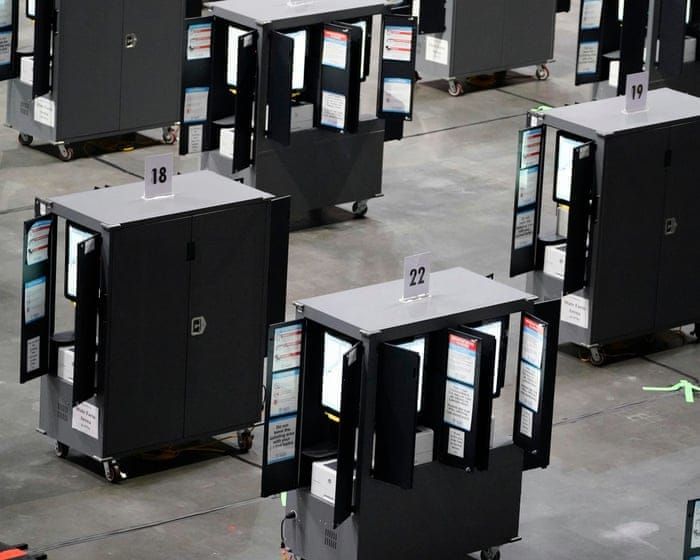
Secret ballot laws prohibit election officials from revealing how specific voters voted. But they do not always prohibit the release of ballot sequence data, cast-vote records, or the order in which ballots were processed. When those records are combined with publicly available voter file data — including when a voter checked in, which precinct they used, and what time polls closed — AI can narrow the field of possible matches to a small enough number to make identification probabilistically viable.
The specific mechanism matters. Most voters assume ballot secrecy works like this: their name is checked off a list, their ballot is separated from any identifying information, and the two are never reconnected. What the Princeton research appears to document is a gap between that assumption and operational reality. Election administration produces data artifacts — cast-vote records, ballot sequence logs, check-in timestamps — that are individually innocuous but collectively reconstructable. AI does not need a direct link between a voter's name and their ballot. It needs enough correlated data to make the link statistically probable.
This is not a new category of vulnerability in principle. Election security researchers have warned about cast-vote record exposure for years. What has changed is the capability of the tools doing the cross-referencing. The AI models available in 2026 are categorically more powerful at pattern-matching across large, heterogeneous datasets than anything available five years ago. A vulnerability that was theoretical at lower capability levels becomes operational at higher ones. The Princeton researcher did not discover a flaw in election law. They documented that the technological context surrounding that law has changed faster than the law anticipated.
The accountability question is not primarily about bad actors, though bad actors are the obvious concern. The deeper accountability question is: who released this data, under what legal framework, and who decided that framework was adequate? Cast-vote records and ballot sequence data are released in many states because transparency advocates — reasonably — pushed for more public access to election processes after 2000 and 2020. The argument was that more data would enable more independent auditing and more public confidence. That argument had merit. It also had a technological assumption baked into it: that the data, even if public, could not be meaningfully reconstructed into individual voter identification. That assumption is now in question.
The people most immediately at risk from ballot de-anonymization are not abstract. They are voters in states with documented histories of voter intimidation. They are workers whose employers have expressed political preferences and whose livelihoods could be affected by disclosed votes. They are domestic violence survivors who use confidential address programs but still vote. They are members of minority communities in jurisdictions with documented histories of retaliation. Secret ballot protections exist precisely because these categories of people exist — because the historical record is unambiguous that when votes can be traced, votes can be coerced.
The commercial dimension runs in an unexpected direction. Election data is a commercial product. Voter files are bought and sold by campaigns, political consultants, data brokers, and research institutions. The ecosystem around election data is large, profitable, and lightly regulated. Any methodology that can extract individual vote choices from public records is not only a privacy threat — it is a commercially valuable capability. The question of who else has developed similar tools, and whether any of them are already in use, is one Georgia's emergency meeting is almost certainly not positioned to answer.
This failure connects to a broader set of AI-enabled privacy failures across American institutions: systems designed before modern AI capabilities existed are being stress-tested by tools their architects never anticipated. The legal frameworks governing what data can be released, retained, or cross-referenced were written in a different technological moment. The gap between what those frameworks assumed was safe and what is now technically achievable is widening, and it is widening faster than legislatures or regulatory agencies are moving to close it.
The federal Election Assistance Commission, the body nominally responsible for election security standards, recently lost its last independent members — a development that makes a coordinated federal response to a cross-state vulnerability structurally harder to achieve. Election security in the United States is administered state by state, with federal guidance that states are not required to follow. A vulnerability that exists in the publicly released data practices of dozens of states requires a response that no single state emergency meeting can produce.
Georgia's emergency meeting, whatever it produces, will be insufficient by design. Not because Georgia's officials lack competence or urgency, but because the problem is not a Georgia problem. It is a problem of a national data-release ecosystem — built incrementally, in good faith, for legitimate transparency purposes — that AI has transformed into a potential surveillance mechanism. Fixing it requires a federal audit of what election data is released, under what conditions, and whether those conditions remain adequate given current AI capabilities. It requires the kind of cross-jurisdictional coordination that American election administration is structurally resistant to. And it requires confronting the uncomfortable reality that transparency and anonymity, which democratic theory treats as complementary values, can be placed in direct tension by sufficiently powerful pattern-matching tools.
The midterms are weeks away. The data that creates this exposure is already public. The AI tools capable of exploiting it are already available. Georgia will hold its meeting. The other 49 states will watch — or won't. And voters who go to the polls believing their choices are private may be operating on an assumption that a Princeton researcher has just shown is no longer guaranteed.