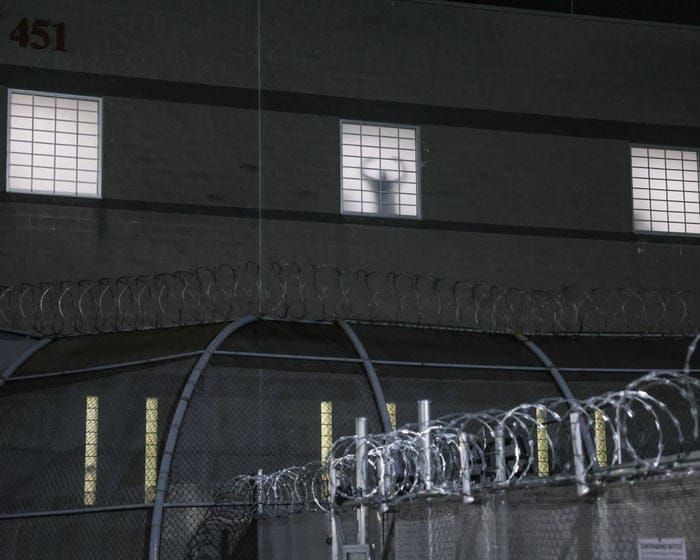
Hunger striking is one of the few forms of protest available to a person who has been stripped of nearly everything else. No phone. No attorney. No court date. No freedom of movement. The body becomes the only instrument of dissent left. The Trump administration's response, confirmed in a government document reviewed by The Guardian, was to override that too.
A report from ICE's own health service agency, the ICE Health Service Corps (IHSC), confirms that at least one person detained in immigration custody was subjected to forced feeding, forced hydration, forced urinary catheterization, or involuntary blood draws after beginning a hunger strike between October and December of last year. The document was published online by the IHSC in February. It is the first confirmed instance of the administration using forced medical treatment on a hunger striker since Donald Trump began his second term.
Healthcare associations and international human rights organizations have a consistent position on this: it is torture. The World Medical Association's Declaration of Tokyo states that physicians must not participate in forced feeding of hunger strikers who are capable of rational judgment. The UN Special Rapporteur on Torture has classified force-feeding in detention as cruel, inhuman, or degrading treatment. The American Medical Association has opposed it for decades. The clinical consensus is not ambiguous.
The ICE Health Service Corps document, published in February 2025 and reviewed by The Guardian, discloses that an unnamed patient who began hunger strikes between October and December 2024 "was subject to force feeding, hydration, or forced urinary catheterization, or involuntary blood draws." It is the first documented confirmation that the Trump administration has used forced medical treatment against hunger strikers in immigration detention.
What makes the IHSC document significant is not just what it confirms — it is what the administration chose to do with the information. The document was published, not concealed. It was filed as part of routine agency reporting. The forced treatment of a hunger striker was recorded as a matter of bureaucratic fact, unremarkable enough to be entered into the official record without apparent concern that it would be recognized as a human rights violation. That is not an oversight. That is institutional normalization.
The accountability question here runs in two directions. The first is immediate: who authorized the forced treatment? Forced feeding does not happen without a physician present, without a directive from facility management, without a chain of command that approved it. The IHSC is a federal agency. It operates under the authority of ICE, which operates under the authority of the Department of Homeland Security. Someone signed off on this. That person's name is not in the document.
The second accountability question is structural. ICE detention has operated for years with limited independent medical oversight. Detainees have died in custody at rates that prompted congressional inquiries, with families routinely denied answers about the circumstances. The IHSC — the same agency that produced this document — is simultaneously the entity responsible for detainee healthcare and for reporting on that care. There is no independent body with authority to review its clinical decisions in real time. The agency that committed the act is also the agency that documents it.
This arrangement has a name in regulatory theory: it is a captured oversight structure. When the regulator and the regulated entity are the same institution, the documentation of wrongdoing becomes indistinguishable from its justification. The IHSC published a record of forced catheterization. Nothing in that publication constitutes accountability. It constitutes a paper trail that, without external pressure, leads nowhere.
The detained person in this case was not named. The facility was not named. The specific dates of forced treatment were not specified beyond the window of October to December. This anonymization is standard in IHSC reporting, but its effect is to make the human being at the center of the story invisible — a patient number, a case file, a data point in an agency document. Behind that anonymization is a person who chose to stop eating as an act of protest, and who was then held down and fed against their will, or catheterized against their will, or had blood drawn against their will.
Hunger strikes in immigration detention are not rare. Detainees at facilities including Delaney Hall in New Jersey have staged hunger strikes to protest conditions, indefinite detention, and the denial of legal process. The strikes are, by design, a communication: the detainee is telling the facility, the agency, and the government that they would rather suffer than continue to accept the terms of their confinement without protest. Force-feeding is the government's reply: your suffering is not your own to choose.

The international human rights framework around this is settled, and it matters that the administration is operating in explicit defiance of it. The same framework that classifies force-feeding as torture also classifies indefinite immigration detention without charge as a human rights concern. The same framework that requires humane treatment of detainees also requires access to counsel, to courts, and to family. The Trump administration has treated that framework not as a constraint but as an obstacle — a set of external standards to be documented around rather than complied with.
The publication of this document by the IHSC is not evidence of transparency. It is evidence of impunity. Governments that fear accountability conceal. Governments that have concluded accountability will not come do not bother. The IHSC entered forced catheterization of a hunger striker into the official record because no one in the current oversight architecture — not Congress, not the courts, not the agency itself — has given the administration reason to believe that record will cost it anything.
That calculation may prove correct. The legal architecture protecting detainees from abuse has narrowed significantly under recent court rulings. Congressional oversight of ICE detention conditions has been episodic and largely without enforcement consequence. The international bodies whose frameworks classify this conduct as torture have no jurisdiction over U.S. domestic detention policy.
What remains is the document itself — a government agency's own record that it subjected a person in its custody to procedures that the medical profession and international law classify as torture. The person's name is not in the document. The authorizing official's name is not in the document. What is in the document is enough. The administration published its own evidence, and whether Congress, the courts, or the agency itself acts on it will decide whether that record becomes accountability or stays a paper trail leading nowhere.