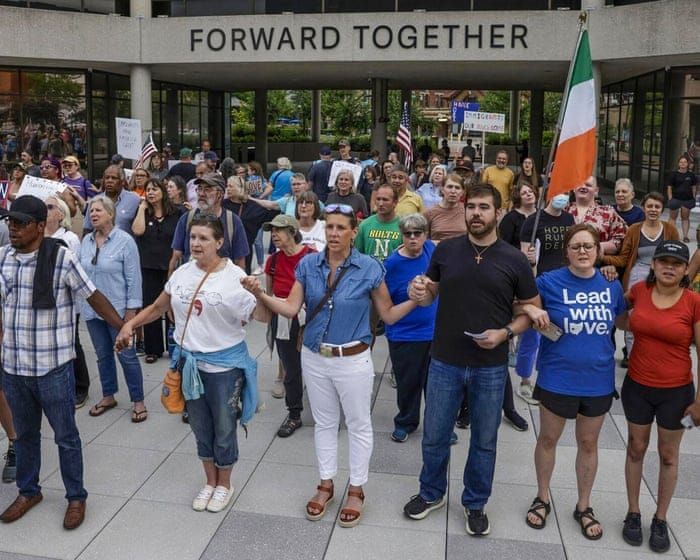
Springfield, Ohio had been losing people for decades. Manufacturing left, population contracted, storefronts emptied. Then, beginning around 2020, Haitian immigrants arrived in significant numbers — and the city began to recover. Restaurants reopened. Warehouses filled their rosters. A hospital that had struggled to staff night shifts found workers. The recovery was visible, measurable, and documented.
This week, the Supreme Court ruled to strip Temporary Protected Status from hundreds of thousands of Haitians living and working in the United States, according to The Guardian US, which has covered the Springfield community extensively. The ruling puts an estimated 400,000 Haitians at direct risk of deportation — and potentially threatens more than a million people with precarious immigration status. Springfield's Haitian community, which had already endured a nationally televised smear campaign during the 2024 election, is now confronting the possibility that everything they built here is contingent on a government decision made without them.
The original thesis the coverage of this ruling rarely makes explicit: the Springfield story is not a human interest sidebar to the legal question. It is the legal question's answer. A community that demonstrably revived a declining American city is being told its presence is provisional — not because it failed, but because it succeeded in a country that built a legal architecture designed to make that success removable.
Temporary Protected Status was not designed as a path to permanence. Congress created it in 1990 as a humanitarian stopgap — a way for people from countries experiencing natural disasters, armed conflict, or extraordinary conditions to remain legally in the United States while conditions in their home country remained dangerous. Haiti's designation followed the catastrophic 2010 earthquake. It has been renewed repeatedly since, including after the 2021 assassination of President Jovenel Moïse and the subsequent collapse of state authority. The State Department's own travel advisory for Haiti currently rates it at Level 4: Do Not Travel — its highest threat designation, shared with active war zones.
TPS does not grant permanent residency. It does not create a citizenship pipeline. It requires registration, biometric screening, and regular renewal. Holders pay taxes, are authorized to work, and are explicitly barred from receiving most federal public benefits. The status is, by design, temporary — but it is also, by documented reality, the legal foundation on which hundreds of thousands of people built American lives, raised American-born children, and contributed to American communities. Springfield is the proof of concept.
TPS is a humanitarian immigration designation granted by the Department of Homeland Security to nationals of countries experiencing ongoing armed conflict, environmental disasters, or other extraordinary conditions. It grants temporary authorization to live and work in the U.S. but does not provide a path to permanent residency. Haiti's TPS designation has been renewed multiple times since the 2010 earthquake. The State Department currently classifies Haiti as a Level 4 travel risk — its highest threat level.
The Supreme Court's ruling arrives inside a broader legal architecture that has been systematically dismantled over the past eighteen months. As Tinsel News has reported, courts have already eliminated due process protections for millions of people facing deportation, stripping individuals of the right to a hearing before removal. The TPS ruling adds a new layer: it removes the legal status that would have entitled those individuals to remain in the country in the first place. Together, these rulings construct a system where people can be stripped of status and removed without meaningful judicial review — a sequence that legal scholars have compared to administrative exile.
The accountability question here is specific and traceable. The Trump administration moved to terminate Haiti's TPS designation in its first term, a decision blocked by federal courts. The current administration renewed that effort. The Supreme Court, remade by three Trump appointments, has now cleared the path. This is not a neutral legal outcome — it is the completion of a policy project that began with the president's public description of Haiti as a "shithole country" in 2018 and continued through his false claim, repeated during the 2024 presidential debate, that Haitian immigrants in Springfield were stealing and eating residents' pets. That claim was investigated by local authorities and found to have no basis in fact. It did not matter. The smear spread nationally, Springfield's Haitian community received bomb threats, and the city's schools went into lockdown.
The political economy of that moment deserves scrutiny. Springfield's Haitian residents had, by that point, become central to the functioning of local employers — warehouses, food processing facilities, and healthcare providers that had struggled for years to fill positions. The labor they provided was not invisible. It was documented, taxed, and essential. The political decision to target them was made not in ignorance of this fact but alongside it. The smear was not a mistake — it was a deployment. It transformed a community's economic contribution into a liability by making their presence a culture-war flashpoint.
The power and money lens here runs in multiple directions. The industries that employed Haitian workers in Springfield benefited from a labor pool that was legally authorized but structurally vulnerable — people who could not easily advocate for better wages or conditions without risking attention to their immigration status. TPS holders are, in this sense, a category of worker that capital has historically found useful: present, productive, and deportable. The Supreme Court ruling does not eliminate that utility. It concentrates it. Employers in industries dependent on immigrant labor now hold even greater power over workers who have even less legal ground to stand on.
For Springfield specifically, the economic consequences are not abstract. The city's recovery — its reopened businesses, its staffed hospitals, its functioning labor market — was built in significant part on the presence and productivity of Haitian residents. A mass deportation would not simply remove people. It would remove the workforce that rebuilt the city, the tax base those workers contributed to, the children enrolled in local schools, and the social infrastructure that had begun to form around a community putting down roots. What gets described in immigration enforcement terms as "removal" is, in municipal economic terms, a collapse.
The human impact is not separable from the legal question. These are people who came to the United States after an earthquake killed more than 100,000 people, who registered with the federal government, who submitted to background checks, who built lives under a legal status the government repeatedly renewed — and who are now being told that the renewal was a promise the government can revoke at will. Many have American-born children. As Tinsel News has documented, 145,000 U.S. citizen children have already been separated from their parents through immigration enforcement. The TPS ruling sets the stage for that number to grow.
The Haitian community in Springfield did everything the implicit social contract of immigration asked of them. They came through legal channels, registered with the government, paid taxes, worked, and rebuilt a city that had been declining for a generation. The Supreme Court's ruling does not engage with that record. It does not have to. The ruling operates at the level of legal status, not human contribution. But the gap between what the law says and what the community built is the story — and it is a story about what "temporary" has always meant in American immigration policy: not a description of conditions in the home country, but a description of the rights the host country is willing to extend.
Springfield's Haitian residents are not waiting for a political debate to resolve their futures. They are living inside it. The ruling that came down this week is not the end of their legal fight — challenges will follow, and the status of more than a million people creates significant political and logistical pressure on any administration attempting mass removal. But the Supreme Court has now made clear that the legal foundation those lives were built on can be pulled out from under them by executive action and judicial approval, without regard for what those lives contributed or what their removal would cost. That is the ruling's actual meaning — and Springfield already knows what it looks like when a city loses the people who held it together.