The body camera footage does not leave much room for interpretation. A Pennsylvania police officer yelled "Drop to the ground," then began a second command — "Stop or I'll..." — and fired two shots before finishing the sentence. The man in front of him, 22-year-old Glenwood Earl Pysher IV, was unarmed. His hands were in the air. He had knocked on the wrong door while looking for friends late at night. He was hit twice in the chest and killed.
The officer was charged Tuesday with voluntary manslaughter, according to The Guardian US. Not murder. The distinction is not a technicality. It is the architecture of a legal system built, over decades, to make it extraordinarily difficult to hold police officers criminally accountable for the people they kill — even when the killing is caught on camera, even when the victim's hands are in the air.
Voluntary manslaughter, in Pennsylvania and most U.S. jurisdictions, typically requires proving that the defendant acted in the heat of passion — that something provoked a momentary loss of self-control. It carries a significantly shorter sentence than first- or second-degree murder. It also carries a lower evidentiary bar for acquittal. For prosecutors, it is a charge that signals seriousness without fully committing to the argument that what happened was murder. For the officer, it is a charge designed, in practice, to be survived.
Voluntary manslaughter in most U.S. states requires proving the defendant acted in the "heat of passion" following adequate provocation — a standard that grants significant legal latitude. Murder charges require proving intent or extreme recklessness. In police cases, prosecutors routinely choose manslaughter over murder, citing the difficulty of proving intent against officers trained to make split-second decisions. Critics argue this framing prejudices the outcome before trial begins.
Pysher was a college student. He was not armed. He was not fleeing. He was not threatening anyone. The sequence of events captured on body camera — a command issued, a trigger pulled before the command was complete — does not describe a situation where an officer exhausted other options. It describes a situation where an officer shot a man who had not yet been given the chance to comply. That is not heat of passion. That is a decision made in under two seconds, and the law is being asked to treat it as something less than murder.
The pattern here is not new, and it is not particular to Pennsylvania. Since the expansion of police accountability coverage following the 2020 uprisings, a consistent pattern has emerged in the rare cases where officers are charged at all: prosecutors reach for manslaughter rather than murder, juries acquit at high rates even on reduced charges, and the legal standard of "objective reasonableness" — established by the Supreme Court in Graham v. Connor in 1989 — gives officers enormous latitude to claim they feared for their lives, regardless of whether the fear was warranted by the facts. Tinsel News has covered how qualified immunity extends similar protection in civil courts, insulating officers from lawsuits even when their conduct is later found to have been unconstitutional.
The wrong-house scenario has become its own grim American subgenre. In 2023, Ralph Yarl, a Black teenager in Kansas City, was shot by a homeowner after ringing the wrong doorbell. That same year, Kaylin Gillis was shot and killed in upstate New York after a car she was in turned into the wrong driveway. These cases involved civilians, not officers, and resulted in murder convictions. The standard applied to those shooters was not the standard being applied here. The officer who shot Pysher is being offered a legal framework that the civilians who shot Yarl and Gillis were not — because the law specifically constructs a different framework for law enforcement.
That framework has a name. The "objective reasonableness" standard asks not whether a reasonable person would have fired, but whether a reasonable police officer, given the totality of the circumstances, could have believed lethal force was necessary. Courts have interpreted this to mean that an officer's training, experience, and perception of threat — however subjective — can justify a shooting that no civilian would escape prosecution for. Pysher had his hands in the air. The officer fired before completing a verbal command. Under the civilian standard, that is murder. Under the law as applied to police, it becomes a question of what the officer believed in the moment — a question juries have historically answered in officers' favor.
The problem also extends to what happens after charges are filed. Data from the Washington Post's Fatal Force database and research by Philip Stinson at Bowling Green State University have documented that from 2005 through the early 2020s, fewer than 200 officers in the entire United States were charged with murder or manslaughter for on-duty shootings — out of thousands of fatal incidents. Of those charged, more than a third had charges dropped or were acquitted. The numbers are not a statistical anomaly. They are the intended output of a system that treats police killings as categorically different from other killings.
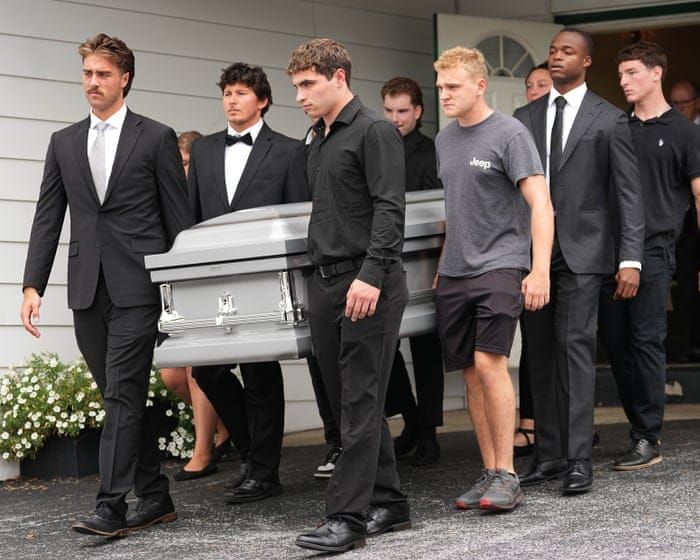
Glenwood Pysher's family is left to navigate that system now. Their son went looking for his friends and found a door he did not recognize. He put his hands up. He was shot twice before the officer finished telling him to stop. The state of Pennsylvania has decided that this warrants a voluntary manslaughter charge — a charge that, historically, officers walk away from more often than not. The charge is being framed as accountability. It is more accurately described as the ceiling of what the system is willing to offer.
Accountability in policing has been the subject of sustained legislative failure at the federal level. The George Floyd Justice in Policing Act, which would have reformed the objective reasonableness standard and curtailed qualified immunity, passed the House in 2021 and died in the Senate. As Tinsel News has reported, federal prosecutors have since abandoned high-profile police accountability cases, and the current administration has shown no appetite for reviving reform efforts. The legal terrain for families like the Pysher family is not improving. It is contracting.
The body camera footage in this case is damning by any ordinary standard of evidence. An unarmed man, hands raised, shot before the officer's own verbal command was complete. The fact that this footage produced a voluntary manslaughter charge rather than a murder charge is not a reflection of what the footage shows. It is a reflection of what the system has decided, in advance, it is willing to see.
If the officer is convicted — and that remains genuinely uncertain — he will face a sentence that does not reflect what the footage documents. If he is acquitted, the footage will have changed nothing. Either outcome will have been produced not by the facts of what happened on that doorstep, but by a legal architecture constructed specifically to make it nearly impossible to call a police killing murder, even when the victim's hands were in the air. That architecture is the story. Glenwood Pysher's death is what it costs.