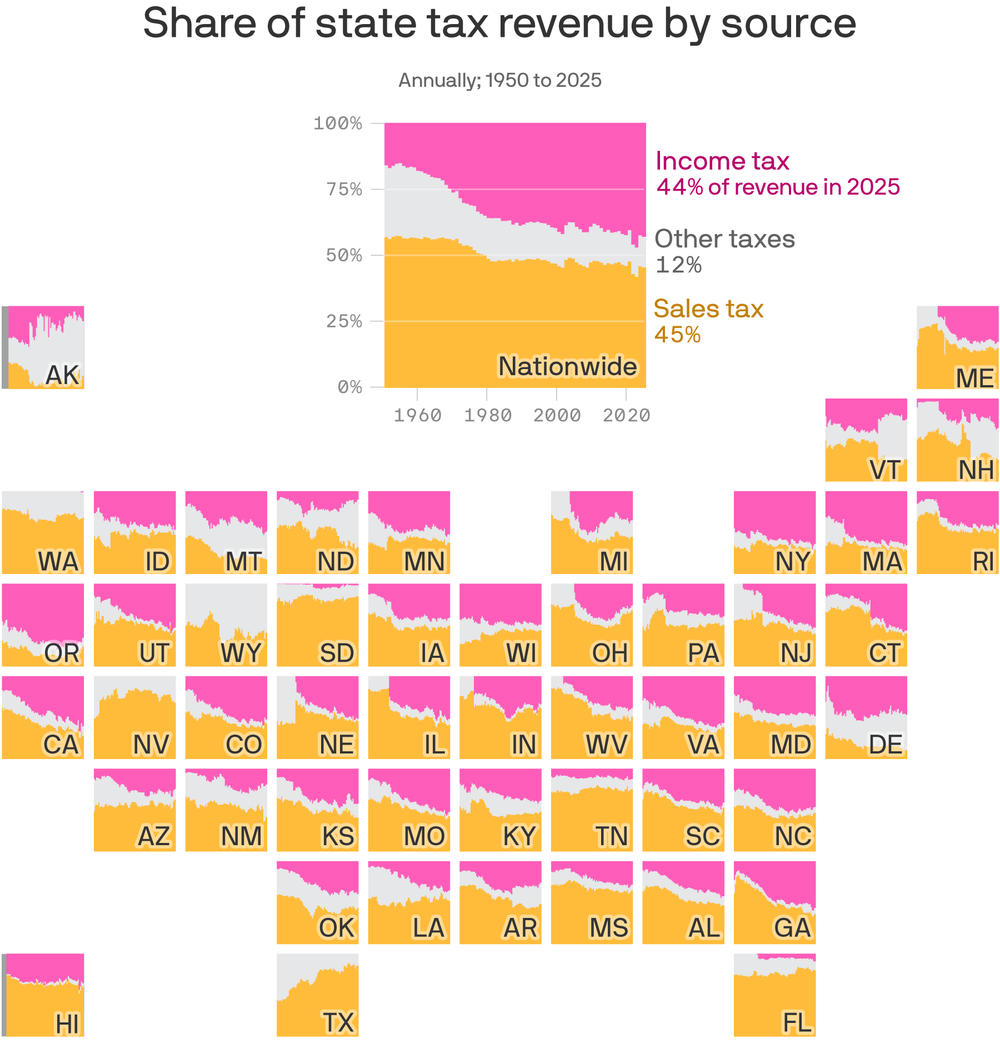
In 2025, Texas collected 86.6 percent of its state tax revenue from sales and gross receipts taxes, according to an Axios analysis of new U.S. Census state tax data. Florida came in at 80.3 percent. South Dakota at 83.1. These are the states that have spent decades advertising themselves as low-tax destinations — places where government stays out of your wallet, where businesses thrive and families keep what they earn.
The advertising works because it is technically true. None of those states levy a broad personal income tax. A high-earning software executive relocating from California to Texas will see a real, substantial reduction in her tax burden. The savings are not fiction. They are just not evenly distributed. For a family earning $35,000 a year, the story runs in the opposite direction.
Consumption taxes — levied on purchases of goods, fuel, insurance, and services — are structurally regressive. A family spending nearly all of its income on necessities pays sales tax on nearly all of its income. A family earning ten times as much saves and invests a large share of it, shielding that portion from the tax base entirely. The rate on the receipt looks flat. The effective rate on income is not. This is not a controversial claim in public finance. It is the foundational reason income taxes were designed in the first place.
What the Axios data makes visible — and what the "low-tax state" marketing obscures — is that these governments did not eliminate taxation. They restructured who bears it. The cost of roads, schools, emergency services, and public health did not disappear when Texas and Florida abolished income taxes. Those costs were redistributed downward, onto the people least equipped to absorb them.
When the U.S. Census Bureau began collecting state government finance data in 1902, no state collected a general sales tax on consumer purchases. By 2025, every state collected some form of general or selective sales and gross receipts tax, and those taxes made up 45.4 percent of state tax revenue nationally. The shift from income to consumption taxation accelerated in the Sun Belt as states competed to attract businesses and high-income residents — a competition that low-income residents never asked to enter and cannot opt out of.
The political economy of this system deserves scrutiny. Wealthy individuals and corporations benefit directly from the absence of income taxes on wages, capital gains, and business profits. They also have the resources to lobby for and sustain the political conditions that keep income taxes off the table. The result is a tax structure that looks like a gift to everyone but functions as a gift primarily to those at the top. The working poor in Texas are not tax-free. They are just taxed differently, in ways that are harder to see on a campaign flyer.
The racial dimension of this pattern is not incidental. As the Axios analysis notes, Black and Hispanic households are disproportionately represented among lower-income and lower-wealth Americans. A tax system that extracts a higher effective share from low-income families therefore falls harder on Black and Hispanic communities — not by explicit design, but by structural consequence. In states with no income tax and heavy reliance on consumption taxes, that structural consequence is maximized. The "low-tax state" brand, sold as universal liberation from government overreach, operates in practice as a mechanism that reinforces existing wealth and racial inequality.
This is not purely a red-state phenomenon, and the data makes that clear. Washington, a state that has voted Democratic in every presidential election since 1988, relies on sales and gross receipts taxes for 74.6 percent of its state tax revenue — the sixth-highest share in the country. Washington has no broad-based personal income tax, a fact that progressive legislators have tried and failed to change for decades. The consumption tax burden on low-income Washingtonians is not softened by the state's political identity. The regressivity is structural, not partisan.
What this means practically: the "low-tax" competition between states is not a race to reduce the overall burden of government on residents. It is a race to shift that burden. The question is never whether residents will pay for public services. The question is which residents will pay more. And in every state that has eliminated income taxes while maintaining consumption taxes, the answer has been the same: the ones who can least afford it.
Critics of high-income-tax states have a real argument: California, New York, Massachusetts, and Connecticut, which together collect 60 to 71 percent of state tax revenue from income taxes, face genuine volatility. Their budgets are exposed to market swings, executive bonus cycles, and the migration decisions of a small number of very high earners. A bad year on Wall Street can crater Albany's revenue projections. That is a legitimate fiscal vulnerability. But the solution to income-tax volatility is not a consumption tax that falls hardest on the poor. It is a more diversified tax base — one that spreads the burden more equitably across income levels and revenue sources.
The deeper problem is that the "low-tax state" framing has successfully removed this trade-off from public debate. When Texas or Florida politicians declare victory over taxation, the implicit promise is that everyone benefits equally from the absence of an income tax. The Census data shows that promise is false. The benefits are concentrated at the top; the costs are dispersed downward. That is not a tax cut. It is a transfer — from lower-income residents to higher-income ones, laundered through the neutral-sounding machinery of consumption taxation.
The same dynamic shapes debates over federal policy. As Tinsel News has reported, the states whose congressional delegations voted to cut food assistance for hundreds of thousands of children are largely the same states running consumption-heavy tax systems that squeeze low-income families at the state level. The federal cuts and the state tax structures are not separate phenomena. They are two expressions of the same political project: reducing the obligations of the state to its poorest residents while maintaining — and in some cases expanding — the benefits flowing to its wealthiest ones.
The families bearing the weight of this system rarely appear in the tax policy debate. They are the abstraction behind the headline numbers — the ones whose grocery bills, gas purchases, and insurance premiums are quietly funding state governments that advertise themselves as having no taxes at all. That framing is not an oversight. It is the point. A tax system designed to be invisible to its heaviest payers is also a political system designed to be invisible to the people who might demand it change.
The Axios analysis of Census data gives the numbers a name. What it does not do — and what the political debate almost never does — is follow those numbers to the families behind them. In the states most dependent on consumption taxes, low-income residents are not living in a low-tax environment. They are living in a high-tax environment dressed in someone else's marketing. And as federal courts have begun to document, the policy architecture that extracts from the poor at the state level is often the same architecture that resists any federal intervention designed to compensate for it.
The next time a governor touts his state's zero income tax as proof of fiscal virtue, the relevant question is not what high earners save. It is what the family buying groceries and filling a gas tank in that state pays — as a share of everything they earn. That number tells a different story. It is the one that almost never gets told.
Billionaire wealth has reached record highs while working families absorb an ever-larger share of state fiscal burdens — a pattern Tinsel News has tracked across multiple fronts. The consumption tax regime is one of the least-discussed mechanisms driving that divergence. It runs quietly, every day, at every register. As that pressure compounds at the state level, 4.8 million people lost health coverage this year when federal subsidies expired — another layer stripped from the same families already paying the highest effective tax rates in their states.