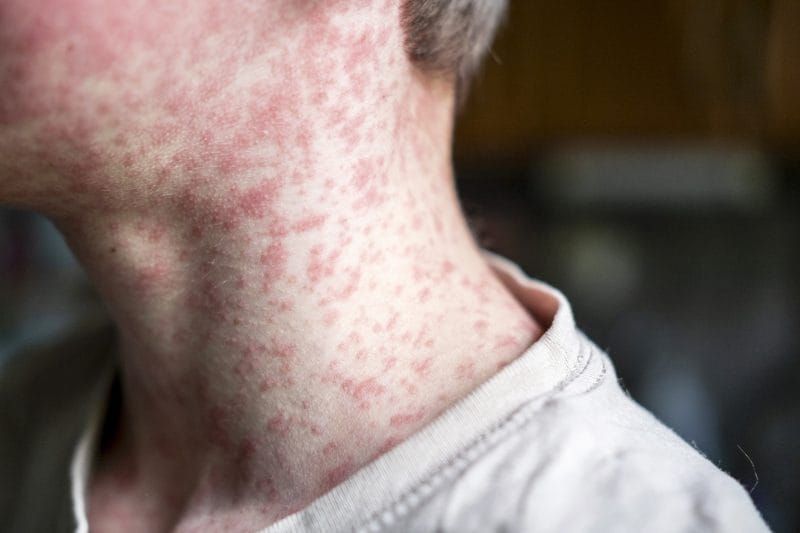
The United States crossed a grim threshold this month. As of July 23, the CDC has confirmed 2,318 measles cases in 2026 — more than the 2,289 recorded across all of 2025, and still climbing. The country is not yet through summer. The question worth asking is not just how many cases there are, but where they are — and why those places, and why now.
The answer is not a mystery. It is a policy outcome.
Before Robert F. Kennedy Jr. became Secretary of Health and Human Services, several states moved to weaken vaccine requirements in ways that aligned with his public positions. Philosophical exemptions were broadened. School vaccine verification was loosened. Public health messaging shifted away from the clear, evidence-based recommendations that had sustained herd immunity thresholds for decades. The states that moved earliest and furthest in that direction are now, not coincidentally, the states appearing most frequently in the CDC's outbreak data. As Tinsel News has previously reported, measles and whooping cough outbreaks have surged specifically in states that adopted RFK Jr.'s vaccine policies — a pattern that predates his federal appointment and has only deepened since.
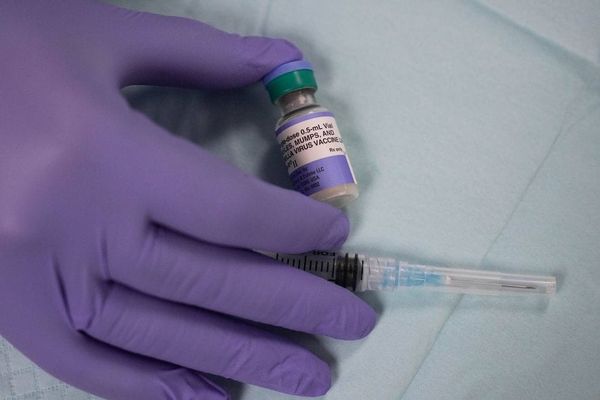
This is not the story of a virus that outsmarted public health infrastructure. Measles was declared eliminated in the United States in 2000. The measles, mumps, and rubella vaccine is among the most effective medical interventions ever developed — two doses confer roughly 97 percent immunity. The infrastructure to stop measles outbreaks existed, had been proven, and required only maintenance. What happened instead was deliberate erosion.
The accountability question here has two layers. The first is state-level: which governors and legislatures chose to weaken exemption standards, and who lobbied for those changes? The political genealogy of anti-vaccine legislation in states like Idaho, Florida, and Montana runs directly through the network of organizations Kennedy built and funded over two decades before entering government. His group, Children's Health Defense, spent years providing legal support, model legislation, and political cover to lawmakers willing to chip away at the public health requirements that kept vaccine-preventable diseases at bay. The legislative output of that campaign is now readable in epidemiological data.
The second layer is federal. Kennedy's confirmation as HHS secretary gave that same ideological infrastructure access to the agencies responsible for the CDC, the Advisory Committee on Immunization Practices, and the public messaging apparatus that shapes how millions of Americans understand vaccine safety. Within months of taking office, Kennedy fired committee chairs who had kept federal health guidance insulated from political interference — a structural change whose consequences extend well beyond any single policy decision. When the people responsible for maintaining the independence of scientific advisory bodies are removed, the science those bodies produce loses its credibility as a public health tool. That erosion is slow, and then it is fast.
Herd immunity requires something specific for measles. Because the measles virus is among the most contagious pathogens known — with a basic reproduction number estimated between 12 and 18, meaning one infected person can transmit to that many susceptible individuals in an unvaccinated population — the threshold for community protection sits at approximately 95 percent vaccination coverage. Below that threshold, the virus finds enough unvaccinated individuals to sustain chains of transmission. States that granted broad philosophical or religious exemptions did not need to drop coverage dramatically to fall below the threshold. A few percentage points in the wrong direction, concentrated in particular school districts or communities, is sufficient.
Measles requires approximately 95% vaccination coverage to prevent sustained community transmission — the highest threshold of any vaccine-preventable disease in common circulation. A drop of just a few percentage points in localized communities can be enough to allow outbreaks. States that broadened exemptions in 2022–2025 did not need to see dramatic coverage declines to become vulnerable.
The communities bearing the cost of that calculation are not the ones who made it. Children too young to be vaccinated, immunocompromised individuals for whom the vaccine is medically contraindicated, and families in communities with high concentrations of exemptions — these are the people for whom herd immunity is not an abstraction. It is the mechanism by which the health decisions of others become a matter of personal survival. When coverage drops in a school district, the unvaccinated kindergartner next to the child whose parents filed a philosophical exemption has no individual recourse. The policy made the risk for them.
The power-and-money dimension of this story is less discussed than the public health dimension, but it is inseparable from it. Kennedy's decades of anti-vaccine litigation and advocacy were funded in part through Children's Health Defense, which has continued operating as HHS has shifted its vaccine policy posture — creating a situation in which the organization that built the ideological case for weakening vaccine requirements now has a direct line to the federal agencies responsible for reversing any damage done. The financial infrastructure of the anti-vaccine movement and the regulatory infrastructure of the federal health apparatus are, at this point, managed by overlapping personnel. That is not a conflict of interest in the colloquial sense. It is a structural capture.
There is a comparison worth making explicit. In 2019, the United States recorded 1,282 measles cases — the highest annual total since elimination — driven largely by outbreaks in Orthodox Jewish communities in New York where vaccination rates had declined. Public health officials at every level treated that outbreak as a crisis. Mayors declared public health emergencies. State legislators moved to close exemption loopholes. The CDC coordinated aggressively with local health departments. The outbreak was contained. The political will to contain it existed because the institutional infrastructure for doing so had not yet been dismantled, and because no senior federal official had spent twenty years arguing that the containment effort itself was suspect.
That political will is now structurally absent. A Republican senator — Bill Cassidy of Louisiana, himself a physician — said publicly earlier this year that Kennedy bore direct responsibility for rising measles and whooping cough case counts. The statement was notable precisely because it came from within the coalition that confirmed Kennedy. It did not change policy. As Tinsel News reported at the time, measles and whooping cough outbreaks were already surging in states that had adopted Kennedy's vaccine framework, and the political accountability mechanism that should have followed that acknowledgment — oversight hearings, legislative correction, a reversal of the advisory committee purge — has not materialized.
The point is not that vaccines work. That is established science. It is that the 2026 measles outbreak is not a public health failure in the traditional sense — a novel pathogen, a coverage gap, an overwhelmed system. It is the predictable output of a policy campaign that ran for two decades at the state level and is now operating at the federal level. The cases are not happening despite the policy. They are happening because of it. The geography of the outbreak is the policy, made visible in epidemiological data.
What that means going forward is specific. The states that have not yet experienced significant outbreaks but have loosened exemption standards in the last three years are not safe — they are next. The federal advisory infrastructure that would normally generate evidence-based responses to a worsening outbreak has been restructured to be responsive to the same ideological framework that produced the outbreak. And the 2,318 cases confirmed as of July 23 represent a floor, not a ceiling, for a calendar year that has five months remaining.
Measles was eliminated in this country in 2000. The elimination was not a lucky accident. It was the result of sustained, evidence-based public health policy that required political will to maintain. That will was systematically undermined, over years, by people who are now in charge of the agencies responsible for the response. The children being hospitalized with measles complications this summer are the most precise possible measure of what that project has cost.