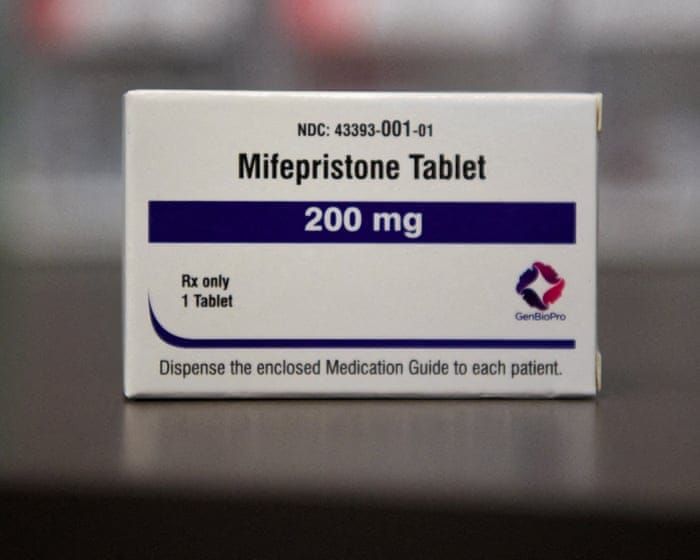
Nearly two-thirds of all abortions in the United States are now medication abortions. Most of those involve mifepristone. The Fifth Circuit issued a ruling on Friday that would have prevented providers from prescribing it through the mail. By Monday, the Supreme Court had temporarily blocked that ruling — and the order was signed by Samuel Alito, the justice who wrote Dobbs.
That is not reassurance. That is the court telling you exactly where the next fight will be.
According to The Guardian US, the Monday order pauses a Fifth Circuit ruling that had imposed new limits on mifepristone's accessibility — specifically, blocking abortion providers from prescribing the drug through the mail. The stay preserves the status quo while the legal challenge proceeds. It does not resolve the underlying question. It does not protect mifepristone in the long run. It keeps the lights on while the case that could turn them off moves through the courts.
The procedural mechanics here matter. A circuit court stay is a tool designed to prevent irreparable harm while a case is being heard. When the Supreme Court issues one, it signals that at least some justices believe the lower court's ruling raises serious enough questions to warrant a pause. It does not signal that those justices will ultimately rule in favor of access. Alito signing the order is the court's administrative structure at work — not an ideological conversion. The author of Dobbs did not become a defender of abortion rights on a Monday morning in May.
What the Fifth Circuit's Friday ruling actually did is worth examining on its own terms. The court ruled to prevent abortion providers from prescribing mifepristone through the mail. This is not a fringe restriction. Mail-order prescription has been the mechanism through which medication abortion expanded into states with otherwise hostile legal environments. Telehealth providers operating across state lines — and the shield laws passed by states like California, Colorado, and Massachusetts to protect them — depend on the ability to prescribe and ship mifepristone without a physical clinical encounter. If that pipeline closes, the practical effect is an abortion restriction that operates regardless of what any individual state's law says. As Tinsel News has previously reported, telehealth abortion pills have quietly become the mechanism through which state bans are circumvented — which is precisely why this legal challenge exists.
The Fifth Circuit is not a neutral arbiter here. It is the most conservative federal appellate court in the country, and it has been the venue of choice for plaintiffs seeking to challenge federal regulatory authority over abortion medication since at least 2023. The court's jurisdiction includes Texas, Louisiana, and Mississippi — states where abortion is already banned — which is why anti-abortion legal groups chose to file there. A circuit court that reliably produces rulings favorable to one side of a legal dispute, filed in that court by design, is not functioning as a check on power. It is functioning as a legislative tool with a robe on it.
The Systemic Pattern here is not subtle. The legal strategy targeting mifepristone has always operated on two tracks simultaneously. The first track challenges FDA approval authority — arguing that the agency did not have the power to approve mifepristone in 2000, or that it exceeded its authority when it later expanded access via mail. The second track, which the Fifth Circuit pursued on Friday, challenges prescription and distribution practices without touching the underlying approval. Track two is more likely to survive Supreme Court scrutiny because it does not require overturning the FDA's regulatory authority wholesale. It just makes the drug functionally inaccessible while leaving it technically legal. The outcome is the same. The legal architecture is harder to dismantle.
The Human Impact of the Fifth Circuit's now-paused ruling would have been immediate and geographically concentrated — but not limited to the states you might expect. The assumption that a mail-order restriction would only affect people in abortion-hostile states misses how medication abortion actually functions. Patients in states with legal abortion also use telehealth services and mail-order prescriptions because of cost, distance, lack of local providers, and privacy concerns. A ruling that ends mail-order mifepristone prescriptions ends those options everywhere, not just in Texas. The people most affected are those with the fewest alternatives: people in rural areas, people without transportation, people who cannot take time off work, people who cannot afford to travel. The geography of the ruling's harm is a map of economic precarity, not just a map of conservative governance.
The Fifth Circuit ruled on Friday to prevent abortion providers from prescribing mifepristone through the mail. The Supreme Court's Monday stay pauses that ruling while litigation continues — it does not resolve the underlying legal question about mail-order prescription access. The case now moves toward a full Supreme Court review.
The Accountability question that the Monday order does not answer: who benefits from keeping this case alive? The legal organizations pursuing mifepristone restrictions are not operating in a vacuum. They are part of a coordinated, funded strategy to eliminate medication abortion access through the federal courts — a strategy that predates Dobbs and accelerated after it. The Fifth Circuit was chosen as a venue because its composition made a favorable ruling probable. That ruling was then appealed to a Supreme Court whose majority was built by the same ideological networks. The system is not malfunctioning. It is functioning exactly as designed.
There is a parallel story here about what the Supreme Court's internal dynamics actually look like. Alito signing the stay does not mean the court's conservative bloc is fractured on medication abortion. It means the court followed its standard procedural practice for emergency applications from the Fifth Circuit. The more revealing signal is the speed: the stay came within days of the circuit ruling, before the full court could weigh in collectively, suggesting that the application was handled administratively rather than through full conference. That is normal. It is also a reminder that the Supreme Court's public face — a nine-justice deliberative body — operates alongside a shadow docket of emergency orders and administrative stays that reshape the law without oral argument, briefing, or a written majority opinion. Tinsel News has covered how the shadow docket rewrites federal law without argument, evidence, or accountability — and this stay is another entry in that ledger.
Outside the United States, the implications of this litigation are watched closely by reproductive rights organizations in countries where medication abortion access is contested. The FDA's regulatory framework for mifepristone has served as a template for advocates in countries seeking to expand access to medication abortion through health authority approval rather than legislative change. A successful legal challenge to that framework — one that strips the FDA of authority over how approved drugs are distributed — would have consequences that extend well beyond American borders. The question of whether a federal agency can approve a drug and set the terms of its distribution, or whether courts can override that authority through litigation, is not a purely domestic constitutional question when the drug in question is the most widely used method of abortion globally.
The stay buys time. The case that required the stay is still active. The Fifth Circuit's reasoning — that mail-order prescription of mifepristone can be restricted regardless of FDA approval — is still on the table. The Supreme Court that will eventually hear this case is the same court that overturned Roe, written by the same justice who signed Monday's order. The temporary pause in the erosion of access is not the same thing as the erosion stopping.
If the Fifth Circuit's logic survives Supreme Court scrutiny, the practical result is a nationwide restriction on the most common method of abortion in America — achieved not through legislation, not through a direct challenge to state abortion laws, but through a targeted attack on how one drug gets from a pharmacy to a patient. That is the case that is now proceeding. Monday's order delayed it. It did not end it.