The vote was 9-8. That margin is not incidental to the story. It is the story.
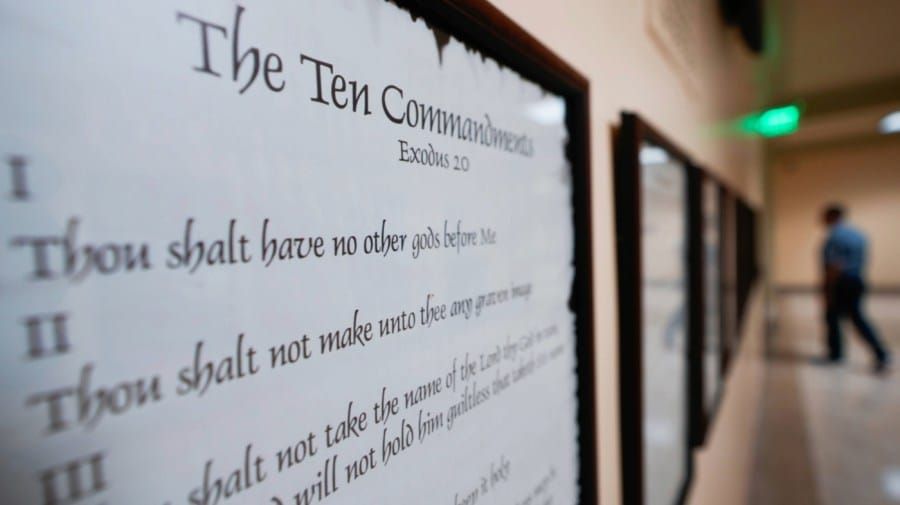
The Fifth U.S. Circuit Court of Appeals ruled Tuesday to allow Texas to require posters of the Ten Commandments in public school classrooms, overturning a lower court decision that had blocked the law, according to The Hill. The Texas statute mandates that schools display the Ten Commandments if posters are donated to the district — a donation mechanism designed, critics argue, to route around the constitutional problem rather than solve it.
The Establishment Clause of the First Amendment has meant, for over half a century, that government cannot use public schools to endorse religion. That precedent did not change Tuesday. What changed is who sits on the Fifth Circuit.
Donald Trump appointed six of the court's active judges. The Fifth Circuit, which covers Texas, Louisiana, and Mississippi, has been reshaped more aggressively by Republican administrations than almost any other federal appellate court in the country. The court's current ideological composition — and specifically the one-vote margin in Tuesday's ruling — is a direct product of that reshaping. This decision did not emerge from a persuasive new legal argument. It emerged from a court that was built to reach it.
The constitutional issue at the center of the case is not ambiguous in the existing record. In Stone v. Graham (1980), the Supreme Court struck down a nearly identical Kentucky law requiring the Ten Commandments to be posted in public school classrooms, ruling it a violation of the Establishment Clause. The Fifth Circuit's majority did not overturn Stone v. Graham — it cannot. But the 2022 Supreme Court decision in Kennedy v. Bremerton School District, which replaced the long-standing Lemon test for Establishment Clause cases with a vaguer "historical practices and understandings" standard, gave lower court judges new room to maneuver. The Fifth Circuit's majority used that room. The eight dissenters concluded they were using it wrongly.
Texas's law was not written in a legal vacuum. It was written to test this exact moment — a reconfigured federal judiciary and a Supreme Court that had already signaled its appetite for eroding the wall between church and state. Christian nationalist influence in federal institutions has accelerated across multiple fronts since 2021, and the Texas statute is part of a coordinated legislative strategy, not an isolated local decision. Louisiana passed an identical law in 2024; that case is also working its way through federal courts. Oklahoma's state superintendent has pushed for Bible instruction in public schools. The Fifth Circuit's ruling will be cited in each of those cases.
The students who will sit beneath these posters were not consulted. They include children who are Muslim, Jewish, Hindu, Sikh, atheist, and agnostic — communities whose relationship to the Ten Commandments as a religious text ranges from complicated to directly exclusionary. The law's donation mechanism does not change what the display communicates to a nine-year-old who does not share the majority's faith. It communicates that this classroom, funded by their family's taxes, belongs more to some beliefs than others. That is precisely what the Establishment Clause was written to prevent.
The ruling will almost certainly be appealed to the Supreme Court. And that is where the architecture of this moment becomes fully visible. The same judicial appointment strategy that flipped the Fifth Circuit also produced a Supreme Court supermajority that has already shown, in Kennedy and in its expanding use of the shadow docket to reshape constitutional law without full argument, that it is willing to move the Establishment Clause line. The Fifth Circuit did not act recklessly. It acted in anticipation.
What happens in Texas classrooms next fall is one question. The more consequential question is what happens when this case reaches a Supreme Court that may be ready to finish what the Fifth Circuit started — and whether the constitutional protection that has kept government out of religious instruction in public schools for more than four decades will survive a court reshaped by ideology that was built to end it. Nor is the Fifth Circuit's ruling the only place where that reshaping is visible: the same coalition invoking religious liberty in one courtroom is suing a Catholic diocese in another, making clear that the principle has always been selectively applied.