The AI industry has spent years building its infrastructure on a single unexamined premise: that the grid is a shared resource it is entitled to consume without negotiation. New York's state legislature just voted to examine that premise — and found it wanting.
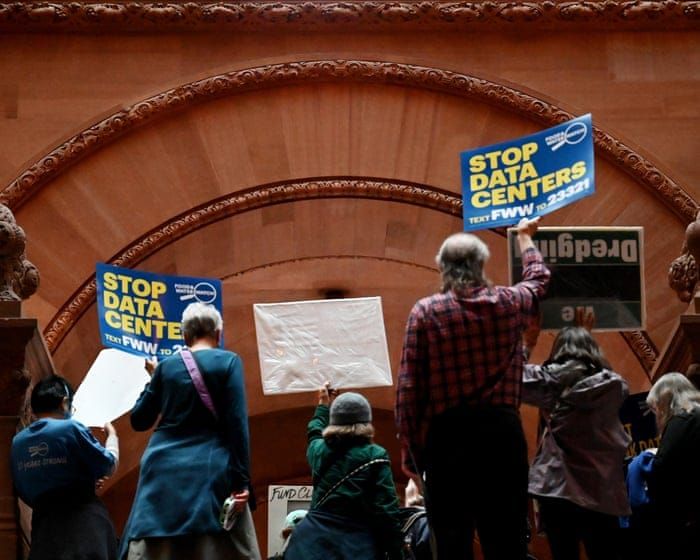
On Thursday, the New York legislature approved a one-year moratorium on the construction of large datacenters, targeting what state senator Kristen Gonzalez, the bill's author, calls "hyperscale" facilities — those drawing more than 20 megawatts of power. As The Guardian reported, the measure now heads to Governor Kathy Hochul, who will decide whether to sign it into law. If she does, New York becomes the first state in the country to legislatively reject, even temporarily, the energy terms that Big Tech has dictated to everyone else.
This is not a fringe position. It is a democratic correction. And the industry's inability to anticipate it tells you everything about how Silicon Valley has treated the public interest for the past decade.
Hyperscale datacenters are large-scale facilities that support cloud computing and AI model training. The New York moratorium targets those drawing more than 20 megawatts — enough electricity to power roughly 16,000 average American homes. A single facility of this size can strain regional grid capacity, drive up electricity prices for nearby residents, and require significant water for cooling.
The backlash against datacenter development is now bipartisan, geographically dispersed, and accelerating. In Monterey Park, California, 86 percent of voters passed a ballot initiative banning new datacenters — a result that should have been treated as a warning signal by every tech executive planning an expansion. In Seattle, the city council voted to block new datacenter construction for a year, a direct rebuke to two of the city's most powerful corporate residents. And at the federal level, Senators Bernie Sanders and Alexandria Ocasio-Cortez have proposed their own moratorium on AI datacenter construction, citing the same energy grid concerns driving the state-level fights.
New York's vote is different in one critical respect: it is the first to pass a full state legislature. That gives it a democratic weight that a city council vote or ballot initiative, however decisive, cannot match. A state law creates a legal framework. It sets a precedent other state legislatures can follow. It forces the federal government to respond. And it puts the governor of the third-largest state economy in the country on record — either as the official who stood between Big Tech and the grid, or the one who handed the keys back.
The original thesis the source material does not make is this: the New York moratorium is not primarily about datacenters. It is about who controls the terms of infrastructure development in a democracy — and whether elected governments still have the power to say no to industries that have spent years treating public resources as private property.
The industry will frame this as an attack on innovation. That framing deserves scrutiny. The AI boom has not been a neutral technological development distributed equally across the economy. It has been a capital-intensive land grab, executed by a small number of companies with access to nearly unlimited financing, against communities and grid systems that had no seat at the planning table. The companies building hyperscale datacenters do not pay the full cost of the energy they consume. They do not compensate the households whose electricity bills rise when grid capacity tightens. They do not absorb the environmental cost of the water their cooling systems pull from local watersheds. The public absorbs those costs. The companies book the revenue.
Senator Gonzalez named this directly. "We should not have to sacrifice," she told The Guardian, a phrase that is worth sitting with. The word "sacrifice" implies that something is being taken — that the communities adjacent to these facilities are giving something up so that the AI industry can scale faster. That is precisely what is happening. And the fact that it took a state legislature to say so out loud is itself a measure of how thoroughly the industry has avoided accountability.
The power question is not abstract. New York's grid is already under pressure. The state has aggressive clean energy mandates — 70 percent renewable electricity by 2030 under the Climate Leadership and Community Protection Act — and adding massive new industrial loads makes those targets harder to hit, not easier. Every megawatt committed to a hyperscale datacenter is a megawatt that cannot serve residential customers, cannot support the electrification of heating and transportation, and cannot be counted toward the state's own climate commitments. This is a direct conflict, and it has been invisible in most coverage of the AI energy debate because the industry has successfully kept the conversation at the level of national economic competitiveness rather than local grid math.
Governor Hochul's record here is not encouraging. Last year, she delayed the implementation of New York's own climate law, citing fossil fuel price volatility — a decision that drew sharp criticism from environmental advocates who noted that the volatility she cited was itself a consequence of dependence on the fuels the law was designed to phase out. The pattern suggests a governor who treats climate commitments as aspirational rather than binding when they conflict with near-term economic pressures. The datacenter moratorium tests the same fault line: will she treat the grid as a public resource requiring democratic management, or as an asset to be allocated to whoever can generate the most economic activity?
The broader political pattern is worth naming explicitly. Across the country, the communities most affected by datacenter development — the ones living with the noise, the water consumption, the strain on local infrastructure, the electricity price increases — are not the communities that benefit most from AI. The benefits of AI productivity accrue to knowledge workers, to capital holders, to the companies deploying the technology. The costs accrue to the grid, to the water table, to the utility ratepayers who live near these facilities. That is not a market failure. It is a policy failure — a consequence of regulatory frameworks that were built before hyperscale AI infrastructure existed and have not been updated to account for it.
New York's moratorium is a demand for that update. It is a legislature saying: stop, count the cost, and let the public decide whether the terms are acceptable before the infrastructure is locked in. That is not anti-technology. It is democratic governance applied to a sector that has spent years operating as if democratic governance did not apply to it.
The AI industry and its allies in government will argue that a moratorium puts American competitiveness at risk, that other states or other countries will build what New York refuses to host, that the economic opportunity will simply move. This argument has a name: regulatory capture by threat. It is the same argument used to resist environmental regulation, labor standards, and consumer protection in every industry that has ever faced public accountability. The threat is sometimes real and sometimes manufactured. What it is never, by itself, is a sufficient reason for a democratic government to surrender its authority over public infrastructure.
If Hochul vetoes the bill, the industry wins this round — but the political conditions that produced the vote do not disappear. The grid is not getting less constrained. The energy demands of AI are not getting smaller. The communities bearing those costs are not going to stop noticing. What changes if she vetoes is the timeline, not the trajectory. The question of who controls the terms of the AI energy buildout will return to every state legislature, every city council, every utility commission in the country. New York just moved it from the margins to the center. That is not nothing. That is, in fact, where the fight has always needed to be.