The tech industry has a standard playbook for local resistance. Hire a lobbyist. Attend a city council meeting. Offer a community benefits agreement with enough money to split the opposition. Wait out the fight. It has worked, reliably, for two decades — from Amazon's server farms in rural Virginia to Microsoft's campuses in the Phoenix desert. What happened in Monterey Park, California on Tuesday did not fit the playbook.
Eighty-six percent of voters in this majority-Asian city of roughly 60,000 people, situated eight miles east of downtown Los Angeles, approved a measure that bans data centers outright, according to election results from the Los Angeles County Clerk reported by The Hill. No negotiated setback. No phased approval process. A prohibition. The first voter-approved ban of its kind in the United States. The margin — 86 percent — is not a close call about zoning preferences. It is a verdict.
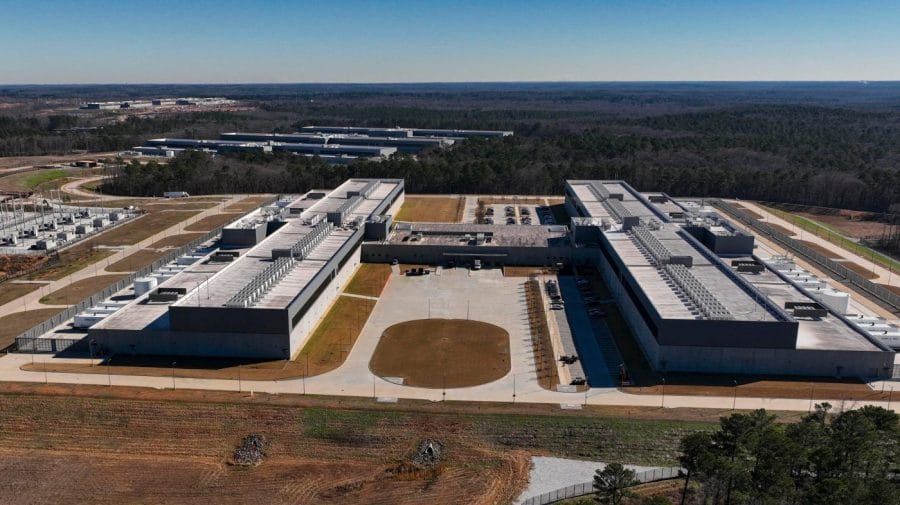
To understand what that verdict means, it helps to understand what data centers actually cost a community — not in the abstract language of environmental impact reports, but in the specific, measurable terms that residents of places like Monterey Park live with. A mid-sized data center draws between 20 and 100 megawatts of electricity continuously. At scale, a single facility can consume as much power as a small city. Water consumption for cooling systems runs into millions of gallons per year. The noise from industrial cooling equipment operates around the clock. Property values near facilities tend to fall. Tax revenues from data centers, which employ relatively few local workers for their footprint, often fail to offset the infrastructure costs they impose on local grids and water systems.
A single large-scale data center can draw 100+ megawatts of electricity — enough to power tens of thousands of homes. Cooling systems consume millions of gallons of water annually. Local employment is typically minimal relative to facility size. Tax revenues rarely offset grid and water infrastructure strain. The benefits flow to shareholders and cloud customers. The costs stay in the zip code.
The AI industry has been on an infrastructure binge. Hyperscalers — the term for the handful of companies that dominate cloud computing and AI infrastructure, including Amazon, Microsoft, Google, and Meta — have announced hundreds of billions of dollars in data center investment over the past two years. That investment has to land somewhere. It has been landing in communities that were not consulted, in counties that approved permits before residents understood what they had approved, and in states whose legislatures were, until recently, happy to offer tax incentives without asking what the neighbors thought.
As Tinsel News has previously reported, resistance to data center siting has been building across the political spectrum — from conservative rural counties in the South worried about groundwater to progressive municipalities on the coasts worried about power grid strain. What has been missing, until now, is a community that took the question directly to voters and won. Monterey Park just changed the model.
The original thesis the industry has been operating on goes something like this: local opposition is a nuisance, not a veto. Permits are approved at the county or state level. City councils can be lobbied. Community groups can be managed. And if a project stalls in one jurisdiction, there are always others — less organized, less resourced, more economically desperate — willing to accept the facility and its tax revenue. The Monterey Park vote directly challenges that assumption. A ballot measure bypasses the council. It cannot be lobbied in the usual sense. And an 86-percent margin in a diverse, working-class, majority-Asian community is the kind of number that other city attorneys notice.
The power and money dynamics here are not subtle. The companies driving AI infrastructure investment are among the most capitalized entities in human history. Microsoft's market capitalization exceeds $3 trillion. Amazon's AWS division alone generates more annual revenue than the GDP of many nations. These companies have political action committees, government affairs teams, and legal departments specifically designed to navigate local regulatory friction. Against that, Monterey Park deployed what democracies theoretically guarantee everyone: a ballot initiative and a turnout operation. The 86-percent result suggests the organizing worked. It also suggests the community's concerns were not marginal.
That the vote happened in Monterey Park specifically carries additional weight. The city is one of the most densely Asian-American municipalities in the continental United States, with a population that is approximately two-thirds Asian. It is not wealthy by California standards. It is not a college-town enclave of professional activists. It is a working-class and middle-class suburb with the demographic profile of the communities that the tech industry has historically assumed would be easiest to site facilities near — communities that lacked the political infrastructure, the legal resources, or the media access to mount effective opposition. The 86-percent vote is a direct answer to that assumption.
The systemic pattern at work here connects to a broader dynamic that Tinsel News has tracked in the AI economy: the costs of artificial intelligence infrastructure are being distributed downward while the benefits are concentrated upward. The electricity that a data center consumes strains a regional grid that everyone pays into. The water it uses comes from aquifer systems shared across communities. The noise and industrial footprint are borne by whoever lives nearby. The profits from the AI services those facilities enable flow to shareholders of companies headquartered in Seattle, San Francisco, and Redmond. This is not a new pattern in American industrial history — it is, in fact, the defining pattern. What changes when communities develop the tools to vote on it directly.
The industry's response to local resistance has typically been to escalate to a higher level of government — lobbying state legislatures to preempt local zoning authority, or seeking federal designations that override municipal decisions. That strategy has had real success: Silicon Valley spent tens of millions to block California AI regulation, and the pattern of using campaign spending to shape the regulatory environment that governs the industry's own growth is well-documented. The question Monterey Park now poses is whether that preemption strategy can hold when the opposition is framed not as anti-technology ideology but as a straightforward community land-use decision backed by an overwhelming democratic majority.
There is also an energy dimension that the vote makes newly visible. The Federal Reserve has already flagged that AI infrastructure investment is contributing to grid strain and near-term inflationary pressure — a concern that Fed officials have noted the market has largely priced out of AI valuations. Every data center that gets sited over local objection is a facility whose energy costs are externalized onto a grid that serves the surrounding community. Monterey Park's ban is, among other things, a refusal to absorb those externalized costs on behalf of an industry that has not asked permission to impose them.
The question now facing the data center industry is not whether Monterey Park's ban will survive legal challenge — it may not, and industry lawyers will almost certainly probe its limits. The more consequential question is whether this is the first of many such votes, and whether the industry's existing approach to community relations is adequate to a world where local residents can, in fact, say no and make it stick. The 86-percent margin in a city the industry probably did not see coming is the clearest possible evidence that the cost of ignoring communities has just gone up.