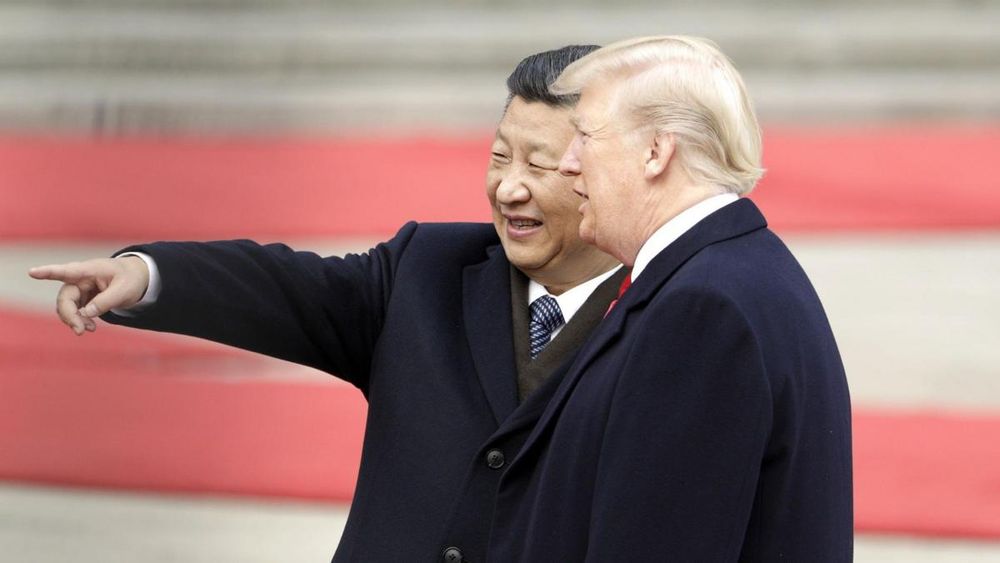
The first time Donald Trump launched a trade war against China, Beijing was caught off-balance. Tariffs hit before Chinese policymakers had fully mapped their exposure. Retaliatory measures were improvised. Diplomatic messaging was inconsistent. The Chinese economy absorbed real damage — agricultural exports to China collapsed, and American farmers required a multibillion-dollar federal bailout to survive the blowback. Both sides bled.
That was 2018. Seven years is a long time to study an opponent.
The China that Trump now faces is not the China that flinched at his first tariff salvo. Beijing spent the intervening years doing something the American foreign policy establishment consistently underestimated: treating the first trade war as a rehearsal. It mapped its vulnerabilities, built redundancies, and cultivated the relationships it would need when the next round began. The question for the second Trump term is not whether Washington has the will to pressure Beijing. It is whether Washington's tools still work on a target that has spent years engineering around them.
Between 2018 and 2025, China expanded its Belt and Road infrastructure commitments, accelerated yuan-denominated trade settlement with Gulf states and Russia, reduced its holdings of U.S. Treasury bonds from a peak of over $1.3 trillion to under $775 billion, and deepened trade ties with ASEAN nations that now collectively surpass the U.S. as China's largest trading partner bloc. These were not coincidental policy shifts. They were a direct response to demonstrated American economic pressure.
The accountability question here is structural. Washington's China strategy under both parties has operated on a consistent assumption: that economic interdependence gives the United States power it can deploy at will. That assumption was always more complicated than the rhetoric suggested. It is now empirically contested. Beijing has not decoupled from the global economy — but it has diversified away from dependence on American goodwill in ways that reduce the coercive power of the tools Trump used before and is reaching for again.
Consider the specific mechanisms. Trump's first term relied on tariffs, technology restrictions, and financial pressure. Each of these has a diminished bite in 2025. On tariffs: China's export base has partly rerouted through third countries — Vietnam, Mexico, and others became conduits for Chinese manufacturing that arrives in the United States with different labels. American importers absorbed much of the tariff cost, a dynamic that contributed to inflationary pressure that U.S. consumers, not Chinese producers, ultimately paid. The Peterson Institute for International Economics estimated that American consumers and businesses bore roughly 90 percent of the tariff burden from the first round. Beijing understood this arithmetic. Washington's political class largely refused to.

On technology: the restrictions on semiconductor exports to China, accelerated under Biden and likely to intensify under Trump, have had real effects — but they have also accelerated China's domestic chip development programs in ways that a less pressured Beijing might have deferred for another decade. Huawei's 2023 release of a 7-nanometer chip, developed despite sanctions, was not a propaganda exercise. It was evidence that the sanctions timeline had a ceiling. China is not yet self-sufficient in advanced semiconductors. But it is closer than it was, and the gap is closing faster than the export controls intended.
On financial pressure: the dollar remains the dominant global reserve currency, and that dominance remains a source of American power. But Beijing has worked methodically to build alternatives at the margins — not to displace the dollar, which remains a project beyond near-term reach, but to create enough non-dollar infrastructure that specific sanctions or financial restrictions carry less automatic pain. Yuan-denominated oil trades with Saudi Arabia and Russia, expanded swap line agreements with developing economies, and the slow growth of the CIPS payment system as a partial alternative to SWIFT are not, individually, decisive. Collectively, they represent a decade of deliberate work to reduce the radius of American financial coercion.
None of this means China is invulnerable. Its domestic economy carries structural burdens: a property sector that remains in slow-motion crisis, youth unemployment that official figures almost certainly understate, and demographic pressures that will constrain growth for decades. These are weaknesses that Washington's strategists are right to note. But noting them is different from having a strategy that exploits them — and the Trump administration's approach, as in the first term, appears to be pressure for its own sake rather than pressure designed to produce a specific, achievable outcome.
This is the accountability failure that the BBC's framing — that Beijing is arguably the most powerful competitor the U.S. has confronted in its history — gestures at but does not fully name. The United States spent the years between Trump's first and second terms without a coherent theory of what it was trying to achieve with China. Containment? Managed competition? Decoupling? Each administration used the vocabulary of all three without committing to the logic of any. China, by contrast, had a clear objective: reduce the asymmetry. It pursued that objective with consistency across administrations, because its strategic planning does not reset every four years.
The human cost of this strategic incoherence is not abstract. American manufacturing workers in sectors exposed to Chinese competition paid for a trade war that did not rebuild domestic industry — it mostly reshuffled supply chains. Farmers in Iowa and Nebraska took the retaliatory hit when Beijing targeted soybeans and pork, while the administration that launched the tariffs scrambled to compensate them with emergency subsidies. As emergency economic powers are invoked again to justify new rounds of tariffs and restrictions, the same communities are positioned to absorb the same collateral damage — with less federal appetite for the bailout checks that cushioned them last time.
Beyond agriculture, the populations most exposed to an escalating U.S.-China economic confrontation are not in Washington's strategic planning documents at all. They are in the Global South — the countries that depend on Chinese infrastructure investment, that trade in yuan-denominated contracts, that have signed onto Belt and Road arrangements precisely because American development finance retreated. When Washington treats U.S.-China competition as a bilateral contest, it erases the agency and the stakes of the dozens of countries that will be asked to choose sides they did not choose to have to choose between. As Tinsel News has covered in the context of China's positioning in the current regional crisis, Beijing has become skilled at presenting itself as the stable alternative precisely when American foreign policy is most erratic.
That positioning is the most consequential development of the past seven years — more consequential than any specific tariff rate or semiconductor restriction. China has used the period of American domestic political turbulence to build a narrative, backed by actual infrastructure and actual investment, that it is a reliable partner for countries the United States treats as peripheral. Whether that narrative is accurate is a separate question. Whether it is effective is not in serious dispute.
The original failure of Trump's first China strategy was not that it was too aggressive or not aggressive enough. It was that it had no theory of the end state. Tariffs were supposed to bring China to the table. China came to the table, signed a Phase One deal that it partially fulfilled, and used the remaining time to build the countermeasures described above. The deal was not a defeat for Beijing. It was a delay that Beijing used better than Washington did. The second term begins with the same tools, the same instinct toward pressure, and, so far, the same absence of a coherent answer to the question: pressure toward what, exactly? Beijing already knows the answer it wants. That asymmetry is the actual strategic problem — and it has nothing to do with tariff rates.