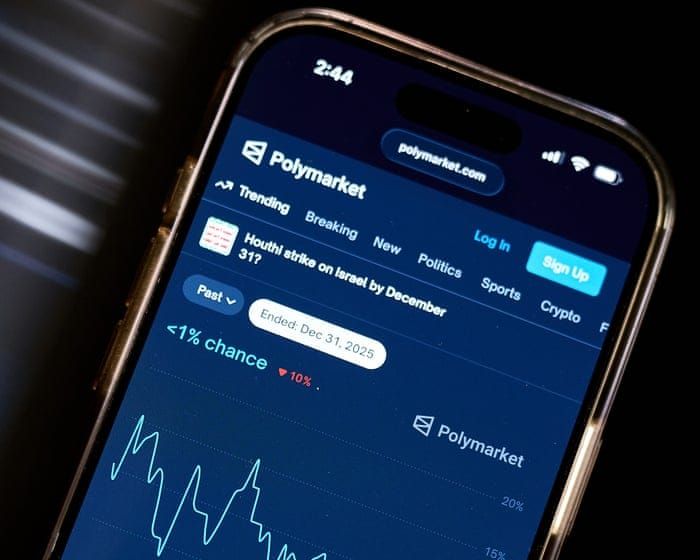
The timing of a potential U.S.-Israeli strike on Iran. The probability of a ceasefire. Whether a conflict that has already killed tens of thousands of people will expand into a wider regional war. These are not the questions of a think tank or a foreign policy briefing — they are the active betting lines on Polymarket, the prediction platform now seeking $400 million in new funding at a valuation of up to $15 billion, according to The Guardian US.
The company's pitch to investors is straightforward: conflict drives volume. Bets on the Middle East war have been among the platform's highest-traffic markets in recent months. What The Guardian's reporting does not dwell on — and what the fundraising documents almost certainly do not mention — is that some of those bets appeared to bear signs of insider trading. Wagers placed on the timing of U.S.-Israel strikes against Iran, and on the terms of a potential ceasefire, moved in ways that drew scrutiny from researchers and financial observers tracking the platform's order flows. No regulator has formally investigated. No charges have been filed. The money kept flowing.
This is the business model that a $15 billion valuation is being built on: the financialization of human catastrophe. Prediction markets have long been defended by their proponents — many of them economists and libertarian-leaning technologists — as aggregators of distributed information, more accurate than polls or expert consensus. There is legitimate academic debate about whether that claim holds. What is not debated is who bears the cost when the underlying events resolve. When a Polymarket contract on "U.S. strikes Iran before June 30" settles, someone collects. The people on the receiving end of those strikes are not participants in the market. They are the commodity.
The regulatory picture is, to put it plainly, a vacuum. Polymarket operates as a prediction market — technically distinct from a futures exchange or a sports book — which has allowed it to occupy a legal gray zone in the United States. The Commodity Futures Trading Commission reached a $1.4 million settlement with the company in 2022 over its operation without proper registration, and Polymarket subsequently geo-blocked American users. That settlement did not end the platform's growth. It accelerated it. The company relocated operational structure, retained its global user base, and continued listing contracts on events ranging from elections to military engagements. As Tinsel News has previously reported, Congress has no disclosure rules for lawmakers trading on prediction markets — a gap that becomes considerably more alarming when those markets are pricing geopolitical events that elected officials directly shape.
The insider trading concern is not hypothetical. Researchers examining order book data on Polymarket's Iran-related contracts identified unusual position-building that preceded public announcements of military developments. The platform's architecture — pseudonymous wallets, blockchain settlement, no centralized order surveillance — makes it structurally resistant to the kind of forensic analysis that securities regulators apply to equity markets. This is a feature, not a bug. It is also precisely why a $15 billion valuation is achievable: the platform has built a financial product that generates returns from geopolitical intelligence without being subject to the rules that govern every other market where geopolitical intelligence generates returns. As Tinsel News has reported, suspicious trading spikes before presidential announcements have drawn no SEC action — and prediction markets exist entirely outside even that limited oversight framework.
The fundraising round also arrives at a specific political moment worth naming. The Iran conflict has generated sustained user engagement on Polymarket precisely because it is ongoing, because its resolution is uncertain, and because powerful actors — governments, military planners, intelligence services — possess non-public information about how it will develop. That asymmetry is the platform's core product. Investors putting $400 million into Polymarket are not betting on the platform's technology. They are betting that the conflict economy it has built around Middle East violence will continue to generate volume — which is to say, they are betting that the war continues, or that new ones begin. The incentive structure does not require anyone at Polymarket to want people to die. It only requires that the platform profit more when they do.
Polymarket is a blockchain-based prediction market where users buy and sell shares in binary outcomes — yes or no questions about future events. Contracts cover elections, economic indicators, and increasingly, military conflicts. The platform settled with the CFTC in 2022 for operating without registration and subsequently restricted U.S. users, though enforcement of that restriction has been limited. The platform settles contracts in cryptocurrency and operates with pseudonymous accounts, creating significant barriers to regulatory oversight.
The $15 billion figure itself deserves scrutiny as a number. For context, that valuation would place Polymarket above many mid-sized regional banks, above most publicly traded media companies, and in the same range as established financial infrastructure firms with decades of regulatory compliance history. The justification for that number rests almost entirely on trading volume generated during active military conflict. If the Iran war ended tomorrow — if a durable ceasefire were reached, if the Strait of Hormuz reopened, if the regional escalation de-escalated — Polymarket's core revenue driver would contract sharply. The company's growth story and the continuation of the conflict are not separable. That is not an accusation. It is arithmetic.
There is a version of this story in which prediction markets are a neutral technology, no more responsible for the events they price than a futures exchange is responsible for drought. That argument collapses when the markets in question appear to have been used by people with advance knowledge of military decisions — when the "distributed wisdom" the platform claims to aggregate is, in practice, the monetization of information asymmetries created by classified briefings and closed-door government deliberations. The war-betting economy Polymarket has built is not a prediction market in the academic sense. It is an unregulated financial product layered on top of human suffering, seeking institutional capital to scale. If the $400 million round closes at a $15 billion valuation, it will be the largest single validation of that business model in the industry's history — and a signal to every competitor that there is serious money in getting there first. What happens after that depends entirely on whether any regulator decides to show up. So far, they have not.