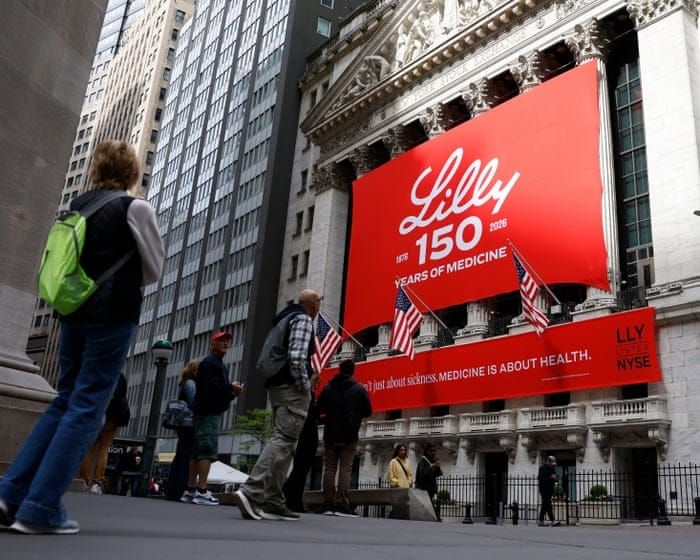
The blind trust is Washington's standard answer to the problem of a president with investments. Park your assets, appoint a trustee, step away from the controls — and the conflict of interest disappears. That is the theory. The practice, as The Guardian US documented this week, looks considerably different.
Financial disclosures show that hundreds of thousands of dollars were invested in Eli Lilly on Donald Trump's behalf in the first quarter of 2026 — the same period during which his administration moved to expand access to the company's blockbuster obesity treatments. The filings, covering the first three months of this year, show several thousand trades executed on the president's behalf across stocks and bonds, with a cumulative estimated value of between $220 million and roughly $750 million. Eli Lilly was among the specific securities named.
The original thesis the source material stops short of stating is this: the blind trust structure, as it exists in American law, is not a conflict-of-interest remedy. It is a conflict-of-interest disclaimer. The distinction matters enormously. A disclaimer says: we acknowledge the problem and have noted it. A remedy would actually prevent the president from benefiting financially from policies his administration controls. The current system does neither — and no enforcement mechanism exists to make it do so.
To understand why this matters, consider what Eli Lilly represents right now. The company is among the primary manufacturers of GLP-1 receptor agonists — the class of drugs that includes obesity treatments like tirzepatide, sold under the brand name Zepbound. These drugs have reshaped the pharmaceutical market over the past two years. Lilly's stock price has tracked that transformation. Any policy decision that expands insurance coverage, broadens Medicare or Medicaid access, or accelerates regulatory approval for obesity drugs translates, with relatively short latency, into Lilly share price movement. The Trump administration's reported move to expand access to these treatments is precisely the kind of policy that financial analysts would describe as a material catalyst for the stock.
The administration's position — implicit in the blind trust structure — is that because Trump does not personally direct the trades, no conflict exists. This argument has two problems. The first is factual: the trades were made on his behalf, by a trustee whose job is to manage assets for his financial benefit. Whether Trump placed the order is irrelevant to the question of who profits. The second problem is structural: Trump does not need to know about specific trades for the conflict to operate. He needs only to know — as any president would — that his financial interests are tied to the pharmaceutical sector, and then exercise policy authority over that sector. The mechanism does not require a phone call. It requires only that the same person controls both the policy lever and the investment portfolio.
A blind trust is a legal arrangement in which a president's assets are managed by an independent trustee, with the officeholder theoretically unaware of specific transactions. In the United States, blind trusts for presidents are conventional but not legally required. The Office of Government Ethics provides guidance, but there is no federal statute that mandates divestiture or imposes penalties for policy decisions that benefit a president's trust holdings. Disclosure is required; consequence is not.
This is not a new problem, and it is not unique to this administration. But the scale of the trading activity disclosed — several thousand transactions in a single quarter — is notable. So is the specificity of the Eli Lilly position, given the timing of the policy decision. Prior administrations have faced criticism for trust arrangements that fell short of genuine independence. What distinguishes the current situation is the breadth of the trading portfolio, the direct correspondence between identifiable policy actions and specific holdings, and the complete absence of any mechanism — legal, institutional, or political — that would impose a cost for the arrangement.
That last point deserves more attention than it typically receives. The standard political framing for stories like this is: will Congress act? The answer, based on recent history, is almost certainly no. The ethics accountability gap in Congress is structural, not incidental — members of the legislature face their own version of the same problem, as lawmakers trading on prediction markets with no disclosure rules have demonstrated. The STOCK Act, passed in 2012 to limit congressional insider trading, has been widely criticized as toothless. No equivalent statute governs presidential investment activity in relation to policy decisions. The Office of Government Ethics can issue guidance. It cannot sanction.
What the Eli Lilly disclosures actually document, then, is not a scandal in the traditional sense — not a hidden payment, not a bribe, not a secret arrangement. It is something more structurally troubling: a legal arrangement operating exactly as designed, producing an outcome that would be considered a textbook conflict of interest in any other context, and facing zero legal consequence for doing so. The system is not broken. The system is working. This is what it was built to do.
The pharmaceutical policy dimension adds a layer that should not be elided. Obesity drug access is not a trivial policy question. Millions of Americans are currently unable to afford GLP-1 treatments that their doctors recommend because insurance coverage is inconsistent and out-of-pocket costs can exceed $1,000 per month. Medicare was, until recently, prohibited from covering weight-loss drugs at all. Any administration decision to expand that access would be consequential for patients — and financially material for Lilly shareholders. Those two things are not mutually exclusive. A policy can be good for patients and good for a stockholder simultaneously. But when the person setting the policy is also the person whose trust holds the stock, the public has no way to know which consideration drove the decision.
That epistemic problem — the impossibility of knowing the actual motivating factor — is precisely why conflict-of-interest rules exist in the first place. The rules are not premised on the assumption that officials will necessarily act corruptly. They are premised on the recognition that the public cannot verify motivation, and that the appearance of independence is therefore a structural requirement of democratic governance. A blind trust that discloses hundreds of thousands of dollars in pharmaceutical stock while the administration expands pharmaceutical markets does not provide that appearance. It provides a legal shield against accountability while the underlying dynamic remains intact.
The broader pattern here connects to something Tinsel News has documented across multiple accountability stories: the consistent erosion of the oversight mechanisms that were designed to make presidential power answerable to public interest. The common thread is not illegality. It is the systematic use of legal structures to insulate financial and political self-interest from scrutiny — and the absence of any institution willing or able to impose a cost.
The question worth sitting with is not whether this specific trade was improper under existing law. It almost certainly was not. The question is whether a legal framework that permits a president to hold hundreds of millions of dollars in corporate securities while exercising policy authority over those corporations' markets is adequate to the task of democratic accountability. The disclosures filed this quarter make the answer visible. Congress, which could change the law, has not. The Office of Government Ethics, which could recommend divestiture, has no enforcement authority. And the president, whose trust just bought more Eli Lilly, has no legal obligation to do anything differently next quarter.
The obesity drug market is projected to reach $100 billion globally by the end of the decade. The policy decisions made in Washington over the next two years — on Medicare coverage, on insurance mandates, on regulatory timelines — will shape who captures that market and at what price. The president's trust is already positioned. The public has no mechanism to determine whether that positioning influenced the policies that will govern it. That is not a bug in the disclosure system. It is the disclosure system operating at the limits of what it was ever designed to do — which has never been enough.