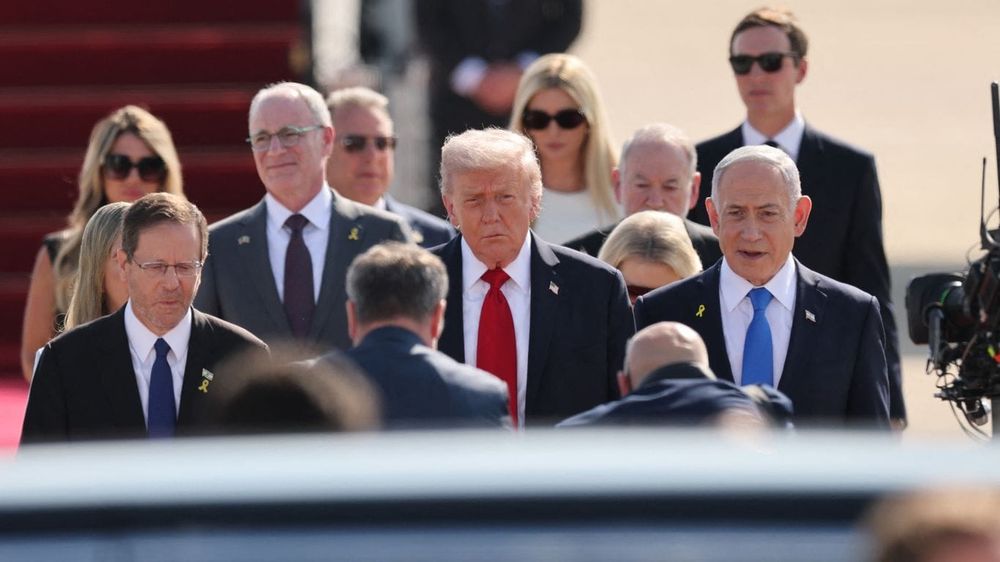
Benjamin Netanyahu is scheduled to appear in court on corruption charges. The charges — which include allegations that he accepted gifts in exchange for political favors — have been working their way through Israel's legal system since 2020. Donald Trump, in an interview with Axios, described those charges as "wine and cigars" and said that Israeli President Isaac Herzog would become a "national hero" if he issued a pardon. It was Trump, not the interviewer, who raised the subject.
That last detail is worth sitting with. Trump called Netanyahu on a Tuesday night, ostensibly about Iran. Netanyahu told him he had a court date the next morning. Trump's response, relayed to Axios, was: "In the middle of a war? Give me a break." Then, on the record, to a journalist, the U.S. president lobbied for a foreign head of state to terminate a criminal proceeding against a sitting prime minister. This is not a diplomatic aside. It is a sustained pressure campaign — one that Trump has been running, by his own account, since at least June of last year.
Netanyahu faces charges in three separate cases, including bribery, fraud, and breach of trust. He has denied all wrongdoing. The trial began in 2020 and has continued through his tenure as prime minister. Under Israeli law, a pardon requires the president's discretion — but Netanyahu has refused to admit wrongdoing or express remorse, two conditions that make a pardon legally and politically fraught. Israeli voters go to the polls in October.
The framing Trump uses — that the trial is a "witch hunt" akin to his own legal troubles — is not incidental. It is the architecture of the argument. By mapping Netanyahu's prosecution onto his own, Trump transforms a foreign criminal proceeding into a narrative about political persecution. This framing does two things: it delegitimizes the Israeli judiciary in the eyes of Trump's base, and it gives Netanyahu a rhetorical lifeline that has nothing to do with Israeli law or Israeli public opinion.
The problem is that Israel's legal system is not a subplot in American culture war politics. Netanyahu's trial involves a functioning democratic judiciary, independent prosecutors, and a president — Herzog — who has constitutional authority over pardons but has made clear he will not act until possible plea negotiations are exhausted. Herzog's position is legally and procedurally defensible. Trump's position is that this process should be bypassed entirely, and that the U.S. president's preference should determine the outcome.
This is interference in an allied democracy. The word matters. The United States does not typically describe its pressure on Israeli institutions as interference — but the standard applies regardless of which direction the pressure flows. If another head of state publicly lobbied the U.S. president to pardon a sitting official facing criminal charges, and did so repeatedly over the course of nearly a year, Washington would name what it was.
The shift in tone Trump took in his most recent interview — from calling Herzog "weak and pathetic" in March to "I like the guy, Herzog" in April — is not a change of position. It is a change of tactic. A senior Israeli official told Axios that Trump may have recognized his attacks weren't moving Herzog, or that Netanyahu himself suggested the softer approach. Either reading confirms the same thing: this is a coordinated influence operation, not a spontaneous expression of opinion.
What Trump wants is specific. He told Axios he believes Netanyahu cannot accept a settlement because any plea arrangement would likely require admitting guilt — which, under Israeli law, could ban Netanyahu from holding office for a period of time. Netanyahu has refused to admit wrongdoing. The prosecution has shown no appetite for lesser charges. The only exit from the trial that preserves Netanyahu's political career is a full presidential pardon. Trump has said so explicitly: Netanyahu needs "a full pardon," not a deal.
The accountability question here is not complicated, but it is being obscured by the diplomatic language surrounding it. A U.S. president is using the weight of the American relationship with Israel — a relationship built on $3.8 billion in annual military assistance, arms transfers, diplomatic cover at the UN, and decades of security guarantees — to pressure a foreign head of state to shut down a criminal trial. The beneficiary of that pressure is a prime minister who, if he loses the October election, faces a substantially higher probability of imprisonment. Trump told Axios he thinks Israel "looks bad" because of the trial. The country that currently looks bad is not Israel.
There is also the matter of what the pardon campaign obscures. Netanyahu's corruption charges are not abstract. The allegations include that he received gifts — including, yes, cigars and champagne — from wealthy businessmen in exchange for regulatory and political favors. These are not technical process violations. They describe a prime minister allegedly trading public office for private benefit. Trump's characterization of this as "wine and cigars" — as though the triviality of the gifts makes the alleged conduct trivial — is a framing designed to be repeated, not examined.
Readers following U.S. policy toward Israel may want to note that this pressure campaign is unfolding against a backdrop in which the Senate has been quietly shifting on arms transfers. Forty Senate Democrats recently voted to block arms to Israel — a number that would have been unthinkable four years ago. The political calculus around Netanyahu and U.S. support is changing, even as the executive branch doubles down on personal loyalty to the prime minister himself. Separately, 2028 Democratic hopefuls are publicly distancing themselves from AIPAC while their party continues cashing its checks — a contradiction that the Netanyahu pardon campaign makes harder to ignore.
What makes the current moment distinct is that Trump is not operating through back channels. He is conducting this campaign in interviews, on the record, using the language of personal loyalty — "I will very much appreciate it" — to describe what is functionally a demand. The normalization of this is the real story. A U.S. president publicly lobbying a foreign president to pardon a criminal defendant, calling it a favor he would "very much appreciate," and framing the foreign judiciary's independence as a problem to be solved: this is what democratic erosion looks like when it travels across borders.
Herzog has not complied. He has moved, procedurally, toward a negotiated settlement process — which is the correct legal step, and which Trump has already rejected as insufficient. Israeli voters go to the polls in October. If Netanyahu loses, his legal exposure grows substantially. The pardon campaign will almost certainly intensify between now and then. The question is not whether Trump will keep pressing. It is whether anyone in Washington — or in Jerusalem — will name what the pressing is.