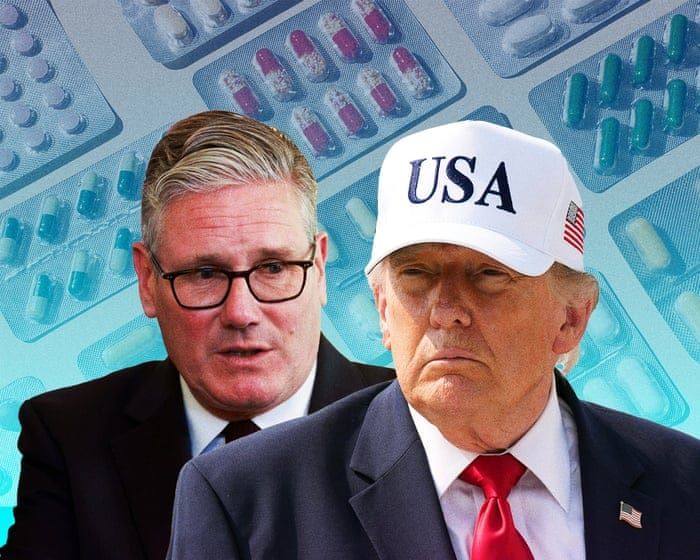
The official argument for the US-UK trade deal, agreed in December and defended by Labour ministers through the first half of 2026, is straightforward: British pharmaceutical companies get to export drugs to the United States without facing punishing tariffs, and British patients get faster access to new medicines. Both sides win.
The analysis does not support that argument. According to The Guardian, independent analysis of the deal's terms finds the NHS will be required to divert billions of pounds away from existing essential services to pay for new — and significantly more expensive — American medicines. The projected consequence: more than 229,000 excess deaths.
That number is not a worst-case projection buried in a footnote. It is the central finding of the analysis. And it forces a question that Labour ministers have not answered: if the government knew, or should have known, that this was the likely cost in human lives, what does it mean that they signed anyway?
The structure of the deal matters here, because it explains how a trade agreement becomes a public health crisis. The NHS operates on a fixed budget. When that budget is committed to paying higher prices for new American pharmaceuticals — prices set by an industry that has spent decades lobbying against price controls in any market it touches — the money has to come from somewhere. It comes from the services already running: the cancer screenings, the district nurses, the mental health teams, the hip replacements that are not glamorous enough to feature in a trade deal press release but are the actual architecture of a functioning health system. Cut those, and people die. Not abstractly. Not eventually. On a timeline that analysts can model.
This is the argument that critics of the deal — and the analysis itself — are making, and it is not a fringe position. The framing that Labour has pushed, that this is about "helping British drug exports avoid US tariffs" and "giving patients access to vital medication," is not false. But it is strategically incomplete. It names the benefit and omits the cost. As The Guardian reported, critics have accused the Labour party of capitulating to pressure from Donald Trump's administration — a charge the government has not substantively rebutted, only denied.
The power and money logic of the deal is not hard to follow. The American pharmaceutical industry has long viewed the NHS as a problem. Not because the NHS provides poor care, but because it is one of the few institutions in the world with enough purchasing power to say no to American drug pricing. The NHS negotiates on behalf of 67 million people. That negotiating power has historically kept drug costs in the UK far below what Americans pay for identical medicines. Any trade arrangement that erodes that power — by requiring the NHS to pay closer to American market prices, or by accelerating access to new drugs before cost-effectiveness reviews are complete — is, from the pharmaceutical industry's perspective, a win. The question is who bears the loss.
The NHS uses a body called NICE (the National Institute for Health and Care Excellence) to assess whether new drugs are cost-effective before approving them for NHS use. This process regularly results in the NHS paying less for medicines than patients in the United States, where no equivalent federal price-setting mechanism exists. Trade deals that accelerate drug approvals or tie NHS purchasing to American price benchmarks effectively transfer negotiating power from the NHS to pharmaceutical manufacturers.
The United States has made pharmaceutical pricing a central demand in trade negotiations for years. The Trump administration made it explicit: access to the UK market, and relief from tariffs for British exporters, in exchange for a more permissive approach to American drug pricing within the NHS. That is the deal on the table. Labour accepted it. The analysis now says the cost is 229,000 lives.
It is worth being precise about what that figure represents. Excess deaths in this context means deaths that would not have occurred if the NHS had continued to allocate its budget the way it did before the deal. They are not deaths caused by bad drugs or medical malpractice. They are deaths caused by the absence of care — the chemotherapy appointment that was cut, the GP surgery that closed, the mental health bed that was not funded. They are the deaths that happen when money is moved from one column to another in a government spreadsheet, and nobody in the room is required to say out loud what moving that money will cost.
The accountability question here is not primarily about Trump, though his administration's role as the demanding party in these negotiations is documented. The accountability question is about the Labour government, which ran on a platform of protecting the NHS, took office promising to be different, and then — under the cover of a trade deal framed as an economic necessity — agreed to terms that analysts say will kill more than two hundred thousand people. That is the gap between stated values and actual decisions. That gap is where journalism lives.
The pattern this story fits is not unique to the UK. Across the last decade, the pharmaceutical industry has used trade negotiations as a mechanism to export American drug pricing to countries that previously had the structural capacity to resist it. The Trans-Pacific Partnership contained similar provisions targeting public health systems. The USMCA renegotiation extended data exclusivity periods for biologics in ways that raised costs for Canadian and Mexican public health budgets. The US-UK deal is the latest iteration of the same strategy: use tariff pressure to pry open the one door — government purchasing power — that keeps medicine affordable in countries with universal health systems. This is not the first time the US Embassy has used its position in London to advance American corporate interests over British public policy — it is, however, the one with the highest projected body count.
There is a domestic American dimension to this story that deserves naming. The same pharmaceutical pricing system that the US-UK deal now threatens to export to Britain is the system that has made insulin unaffordable for American diabetics, that has driven Americans to buy medication across the Canadian border, that has made "medical debt" the leading cause of personal bankruptcy in the United States. The industry lobbying to impose its pricing model on the NHS is the same industry that has spent decades ensuring that Americans pay two to four times more for the same drugs than patients in comparable wealthy countries. The deal does not fix that. It spreads it.
For American progressive readers, the instinct may be to view this as a British problem. It is not. The policy architecture driving these negotiations has been under construction for years, and the UK is functioning as a proof of concept. If a Labour government — one with genuine popular support and an explicit mandate to protect public health — can be pressured into a deal that analysts project will kill 229,000 people, the precedent for what American trade pressure can extract from other universal health systems is substantial. The NHS is not just Britain's institution. It is one of the last large-scale demonstrations that a government can provide healthcare to an entire population without surrendering pricing control to the pharmaceutical industry. Eroding it has consequences that extend beyond the M25.
The Guardian's reporting, drawing on the work of columnist Aditya Chakrabortty, frames this as a story about Labour capitulating to Trump. That is accurate as far as it goes. But the deeper story is structural: a trade negotiation designed to convert a public health system's purchasing power into a revenue stream for private pharmaceutical companies, with the human cost distributed across a population that will never see the connection between a trade deal signed in a government building and the care that was not there when they needed it. The 229,000 figure is not a prediction about the future. It is an accounting of what has already been decided.
What comes next is a political fight the Labour government will try to have on its own terms — framing the deal as a necessary compromise, a protection for British exporters, a bridge to the American market. The 229,000 figure makes that framing harder to sustain. The NHS has already faced a reckoning over what happens when institutional decisions are made without honest accounting of who pays the human cost. This deal will face the same reckoning — the only question is whether it happens before or after the deaths it has been projected to cause.