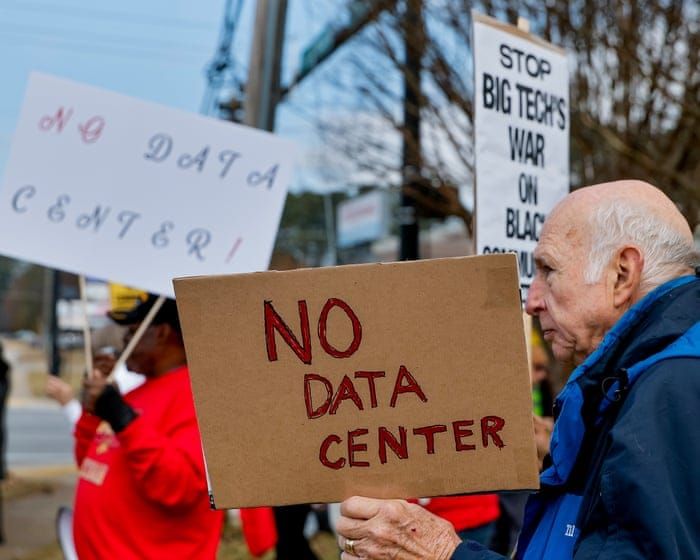
The Republican Party in Texas does not often find itself in agreement with Bernie Sanders. But last month, Texas Republicans voted to block AI datacenter construction pending adequate environmental safeguards — joining a coalition of resistance that now stretches from MAGA-friendly midwestern counties to liberal California school districts to Vermont's democratic socialist senator. The political geography of this revolt is not accidental. It is a map of where the costs of the AI boom actually land.
That map is not Silicon Valley. It is the rural counties and mid-sized cities where datacenters get built — where water tables drop, where power grids buckle, and where local governments discover, often too late, that the tax incentives they offered to attract tech investment did not come with enforceable environmental conditions. The communities bearing these costs had no seat at the table when the deals were made. They are taking their seat now, in city councils, state legislatures, and protest lines that cross every ideological boundary the industry assumed would keep opposition fragmented.
The scale of what is being built makes the stakes concrete. Amazon and Microsoft alone are driving an estimated $710 billion worth of investment in datacenters this year, according to The Guardian, as both companies race to build the infrastructure backbone for their AI products. That figure does not include Google, Meta, or the dozens of smaller operators chasing the same market. The construction boom is, by any measure, one of the largest infrastructure buildouts in American history — and it is happening almost entirely outside the regulatory frameworks that govern comparable industrial development.
This is the argument the source coverage gestures toward but does not fully make: the bipartisan datacenter revolt is not primarily about AI skepticism, and it is not about partisan politics finding an unlikely common cause. It is about what happens when a single industry secures federal deregulation, floods local markets with capital, and then discovers that the people who actually live near their facilities have not agreed to absorb the consequences. The political coalition forming against datacenters is wide precisely because the extractive logic driving the construction boom does not discriminate between red and blue zip codes.
One of Donald Trump's first acts on returning to office was to authorize what his AI action plan described as a deregulated "build, baby, build" approach to datacenter construction, as The Guardian reported. The policy was a direct response to pressure from the Silicon Valley donors who helped fund his campaign — a transaction so transparent it barely registered as news. The White House wanted speed. The industry wanted deregulation. Local communities were not part of the negotiation.
The power and money logic here is not complicated. Datacenters require enormous amounts of electricity — a single large facility can draw as much power as a small city — and enormous amounts of water for cooling systems. When they are built without binding environmental review, the costs of that consumption fall on local utilities, local aquifers, and local ratepayers. The industry's investment numbers are impressive. The community impact numbers are the ones that don't appear in the press releases.
What makes the current resistance politically durable is that it is not organized around opposition to AI as a technology. The communities pushing back are not Luddites. They are people who watched a zoning approval get rubber-stamped, saw construction begin on a facility that will consume water their farms need and power their hospitals depend on, and asked who authorized this — only to find the answer was a federal deregulation order written with input from the companies that benefit from it. That experience does not sort neatly along partisan lines. It sorts along the lines of who has power and who does not.
The accountability structure around this boom is worth examining directly. When a chemical plant wants to locate near a community, it faces environmental impact review, public comment periods, and regulatory oversight that — however imperfect — creates at least a formal mechanism for affected communities to register objections. The current datacenter buildout has largely bypassed those mechanisms, partly through deliberate federal deregulation and partly because the zoning and permitting frameworks that govern industrial development were not designed with facilities of this scale and energy intensity in mind. As our AI regulation tracker has documented, the policy architecture governing artificial intelligence infrastructure remains patchwork at best — and the gaps are not accidental.
The industry's standard response to local opposition has been to point to job creation and tax revenue. These are real benefits, and they are not nothing. But the jobs-and-taxes argument has a structural problem: it treats the community as a passive recipient of economic development rather than a stakeholder with legitimate claims over the terms of that development. A datacenter that creates 200 permanent jobs while consuming 5 million gallons of water per day from a stressed regional aquifer has made a trade. The question is who agreed to it and who benefits from pretending it was not a trade at all.
There is a systemic pattern here that the datacenter fight exemplifies with unusual clarity. The AI industry has spent years arguing, successfully, that it operates in a category that requires special regulatory treatment — that the pace of technological change makes conventional oversight frameworks too slow, too rigid, and too likely to disadvantage American companies relative to Chinese competitors. This argument has been politically effective. It has also created a situation in which one of the most capital-intensive and resource-intensive industries in the country operates with less environmental accountability than a mid-sized manufacturing plant. The communities now organizing against datacenter construction are, in effect, demanding that the industry be treated like an industry.
The bipartisan nature of the resistance matters for a reason the industry has not yet fully processed. Big tech's political strategy has historically relied on the assumption that its critics are ideologically separable — that environmentalists and rural conservatives occupy different political universes and can be managed through different channels. That assumption is breaking down. When Bernie Sanders and Alexandria Ocasio-Cortez called for a datacenter moratorium citing the energy crisis, the industry dismissed it as left-wing technophobia. Texas Republicans are harder to dismiss on those terms. The coalition forming against unregulated datacenter construction does not have a unified ideology. It has a unified experience of being on the wrong end of a decision made without them.
The White House has described the scale of protests as an unwelcome surprise, according to The Guardian. That surprise is itself revealing. An administration that treated the AI buildout as a political asset — a jobs story, a competitiveness story, a counterweight to Chinese technological development — did not build its policy around the assumption that affected communities would organize. It built the policy around the assumption that local opposition is a friction to be managed rather than a signal to be heard. The protests are now forcing a reckoning with what it actually means to build infrastructure at this scale without community consent.
The industry has a narrow window to respond to this revolt in a way that does not harden it into something more durable. Binding environmental review, water use commitments with enforcement mechanisms, and genuine public participation in siting decisions are not radical demands — they are the standard applied to comparable industrial facilities. The alternative is a political coalition that has no reason to dissolve, organized around a concrete and shared grievance, growing in states where the companies thought they had either friends or no opposition worth worrying about. The AI boom has created extraordinary wealth for a small number of companies and investors. The question now before the communities where that wealth gets physically built is simple and not going away: on what terms, and who decides.