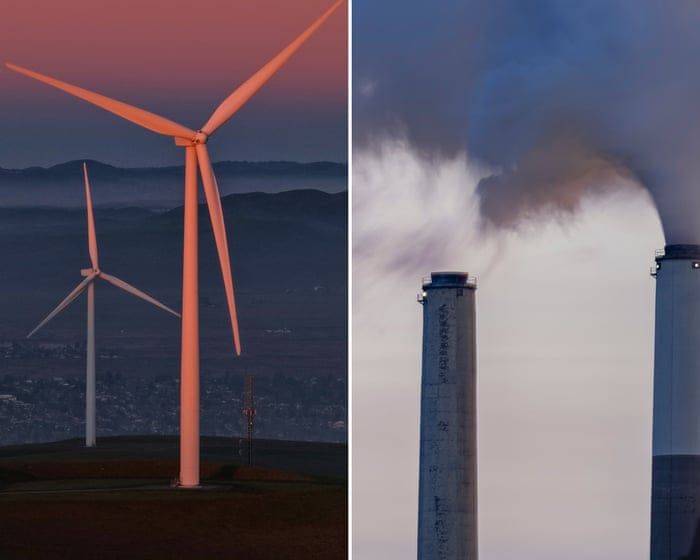
The market had already made its decision on coal. Between 2010 and 2023, more than 100 gigawatts of coal-fired generating capacity shut down across the United States — not because of regulation, not because of environmental activists, but because natural gas and wind power became cheaper to build and operate. Utilities, which are not sentimental institutions, made the economic calculation and walked away.
Then came $3.825 billion in taxpayer money to reverse that calculation.
According to reporting by The Guardian US, the Trump administration has spent $2.7 billion of public funds on its campaign against wind energy while directing a further $1.125 billion toward propping up coal production. Critics — including energy economists and Democratic lawmakers — say the expenditures are doing exactly what the market had already rejected: keeping uneconomic coal plants operating long enough to justify the campaign donations that helped put them there.
Look closer and this stops being a story about energy policy. It is a story about what happens when a presidential campaign accepts record donations from fossil fuel companies and then uses the machinery of government to honor that debt — paid for by the same working-class voters who were promised lower bills. The subsidy is not saving an industry. It is transferring wealth from utility ratepayers and taxpayers to shareholders of companies whose business model the market had already condemned.
To understand why this matters beyond the headline number, it helps to understand how electricity pricing works. When a coal plant that should have closed remains operational — propped up by federal dollars — it does not lower energy costs for consumers. It competes with cheaper sources that would otherwise dominate the grid, keeping overall electricity prices higher than they would be in a market free from political intervention. The administration's own stated rationale — energy security, grid reliability — does not survive contact with the basic economics: the plants being sustained were closing because they were expensive to run, not because grid operators wanted them gone.
The money trail is direct enough to follow without a forensic accountant. Fossil fuel companies and their affiliated PACs donated what critics described as record sums to the 2024 presidential campaign. As Tinsel News has documented, the administration has also invoked emergency wartime authorities — including the Defense Production Act — to lock fossil fuel infrastructure into place for years, if not decades. The coal subsidies fit a pattern: federal power used not to manage a market failure, but to manufacture one in reverse, keeping a losing industry solvent through public expense.
The anti-wind spending is, if anything, a starker illustration. Wind power is now among the cheapest sources of electricity generation in the United States by levelized cost — the standard industry metric that accounts for construction, fuel, and maintenance over a plant's lifetime. Spending $2.7 billion of taxpayer money to slow its deployment does not improve grid reliability. It does improve the competitive position of coal and gas relative to a technology that was beating them on price. That is not an energy policy. That is market manipulation on behalf of a donor base.
The human cost lands on the people who pay utility bills. Energy costs have been one of the most persistent drivers of household financial strain for working Americans — a reality the administration acknowledged when it campaigned on lowering them. As Tinsel News reported earlier this year, half of Americans say they cannot comfortably afford gas and groceries — and the administration's response has been to describe their financial pain as something that does not move it. The coal subsidies are not incidental to that pain. They are a structural contribution to it.
There is also a longer-term cost that does not appear on any monthly bill but will eventually. Every coal plant kept alive past its economic death date is a plant that delays the capital investment, workforce training, and grid infrastructure that a clean energy transition requires. The $3.825 billion being spent to sustain coal is $3.825 billion not being invested in the transmission lines, battery storage, and manufacturing capacity that would actually reduce consumer energy costs over the next decade. The subsidy is not neutral. It is a bet against the future placed with other people's money.
More than 100 gigawatts of U.S. coal capacity closed between 2010 and 2023, driven primarily by competition from cheaper natural gas and renewables — not regulation. The plants receiving federal support were already on utility retirement schedules before the current administration took office.
Critics quoted by The Guardian US describe the spending as "fattening the wallets of his cronies" — language that is politically charged but analytically defensible. The companies best positioned to collect federal coal support are, by definition, the companies still operating coal assets. Those companies are also, by documented record, among the largest donors to the campaigns that created the policy. The circularity is not a conspiracy theory. It is a transaction, conducted in public, at taxpayer expense.
The global dimension of this spending is worth naming directly. Countries that invested in renewable infrastructure over the past decade — Germany, Denmark, Spain, China — now have electricity grids that are structurally insulated from fossil fuel price volatility. As the current global energy disruption has made visible, nations with high renewable penetration are weathering price shocks that are hammering fossil-fuel-dependent economies. The $3.825 billion being spent to delay that transition in the United States is not just a domestic budget question. It is a strategic choice to remain exposed to exactly the kind of price volatility that is currently driving American energy bills higher.
There is a version of this story in which a government might defensibly spend public money to sustain an energy source — if doing so genuinely protected grid reliability, kept costs down, or served communities whose economic survival depends on the industry. None of those conditions apply cleanly here. Grid operators have not identified a reliability gap that only coal can fill. Consumer energy costs are not falling as a result of the subsidies. And the coal communities most affected by the industry's long decline are not the primary beneficiaries of money that flows to corporate shareholders, not to miners or their families.
What remains when you strip away the energy security framing is a straightforward political economy: an industry donated heavily to a campaign, the campaign won, and the industry is being paid back through the federal budget. Working Americans are paying higher energy bills to fund that transaction. The market had already decided coal's fate. Overriding that verdict carries a price, and it is working Americans who are being handed the bill.