The Republican Party built a generation of electoral power on the claim that religious liberty was under siege. The claim was the party's most reliable mobilizing tool — a through-line from the culture wars of the 1990s through the Supreme Court battles of the 2020s. It produced federal law, judicial appointments, and a coalition that defined itself, in part, by its willingness to fight for the right of Christians to practice their faith without government interference. That coalition now runs the government. And the government just sued a Catholic diocese to seize its land.
According to a complaint first reported by Bloomberg and confirmed by Axios, Homeland Security Secretary Markwayne Mullin has initiated a lawsuit against the Catholic Diocese of Las Cruces to seize approximately 14 acres of church land in Doña Ana County, New Mexico. The administration claims the land is necessary for border wall construction. The administration's stated valuation of just compensation: $183,071.
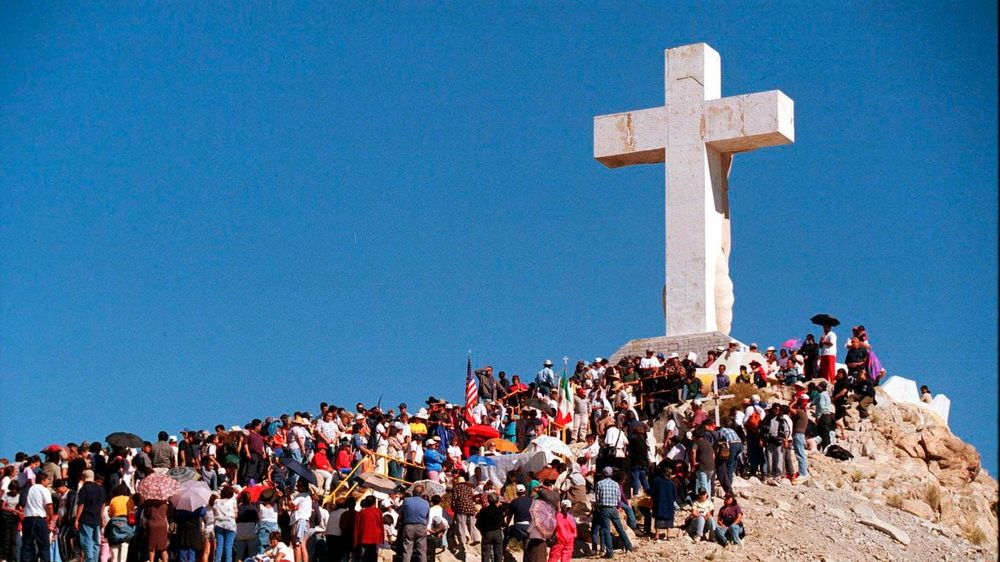
The land sits at the base of Mount Cristo Rey, a holy site in the borderlands where New Mexico meets Texas and the Mexican state of Chihuahua. At the summit stands a 29-foot limestone statue of Jesus Christ, erected in 1940. Each fall, on the feast day of Christ the King, as many as 40,000 faithful make the pilgrimage up the mountain to attend mass and view the monument. The Diocese's attorneys, in their legal response to the complaint, described the site as the location of "annual pilgrimages" where worshippers come to "marvel at the beauty of the monument and the view offered from the summit." The church is mounting a First Amendment defense alongside a claim under the Religious Freedom Restoration Act — the very statute that the Republican legal movement spent decades deploying as a shield for Christian institutions against government action.
The irony is not incidental. It is structural. RFRA was signed into law in 1993 and has since been used to challenge vaccine mandates, contraception coverage requirements, anti-discrimination ordinances, and a range of other federal and state policies that religious conservatives argued burdened their practice of faith. The law's logic is straightforward: the government may not substantially burden the exercise of religion without a compelling interest pursued through the least restrictive means. The Diocese of Las Cruces is now invoking that logic against the administration of the party that spent two decades treating RFRA as sacred text. The administration's position, implicitly, is that a border wall is a compelling government interest sufficient to override it.
The Religious Freedom Restoration Act argument the Diocese is making is not a long shot. Federal courts have consistently interpreted RFRA broadly in cases brought by religious plaintiffs — including in cases argued by the same conservative legal infrastructure that now staffs the administration making this seizure. If the government loses, it will be on the basis of a legal framework it championed. If it wins, it will have established that border wall construction overrides religious exercise rights — a precedent with implications well beyond this one diocese.
Eminent domain is the government's constitutional power to take private property for public use, provided it pays "just compensation." At the southern border, the Trump administration has used eminent domain letters to pressure private landowners, warning that if voluntary access is not granted, seizure proceedings will follow. According to Axios, pushback from local landowners has already delayed some construction and removed sections of wall from national and state parks in West Texas. The administration has stated that landowners have "almost no choice" to ultimately avoid construction.
The broader pattern here matters. Axios reports that DHS has sent letters to private landowners across the border region warning that failure to voluntarily grant access will result in eminent domain proceedings. Administration officials have stated that landowners have "almost no choice" to ultimately avoid construction. Local resistance has already delayed some sections of wall construction and forced the removal of barrier segments from national and state parks in West Texas. The administration's position is not that it will negotiate — it is that resistance is ultimately futile.
That posture toward private landowners and religious institutions alike reflects something more specific than policy disagreement. It is the application of state power to override property rights, religious exercise rights, and community objection simultaneously — in service of a construction project whose primary function is political symbolism as much as border enforcement. The border wall has never been primarily a security instrument. Independent assessments have consistently found that it does not address the primary mechanisms of undocumented entry, which have shifted toward legal ports of entry and visa overstays. What the wall does do, reliably, is generate images. The administration needs those images. The Diocese's pilgrimage site is in the way.
The communities most directly affected by this action extend on both sides of the international boundary. Mount Cristo Rey sits in the Paso del Norte region — the binational metropolitan area that includes El Paso, Texas, and Ciudad Juárez, Chihuahua. The mountain itself straddles the border. The pilgrimage that draws 40,000 people annually is not exclusively American — it draws Mexican faithful as well, for whom the monument is a shared religious landmark. The administration's legal complaint treats this as a domestic property dispute. The human reality is a cross-border community whose sacred geography is being routed through a federal courthouse.
This is also a test of whether the Catholic Church's institutional relationship with the current administration will hold under direct material pressure. The U.S. Conference of Catholic Bishops has been among the more consistent institutional critics of the administration's immigration enforcement posture, documenting the humanitarian consequences of deportation policy and border militarization. Individual bishops have been more or less outspoken. The Diocese of Las Cruces is now not a policy critic but a named defendant — its land subject to federal seizure, its religious practices potentially disrupted, its legal fees accumulating in a fight it did not choose. How the broader Catholic institutional structure responds to one of its dioceses being sued by the federal government will say something about whether institutional religion retains independent standing in this political moment, or whether the alliance between the Republican Party and Catholic conservatism is durable enough to absorb even this.
The administration's offer of $183,071 for 14 acres of land at a major pilgrimage site deserves scrutiny on its own terms. That figure — just over $13,000 per acre — does not account for the religious and cultural value of land that draws 40,000 pilgrims annually, nor for the disruption to the pilgrimage route that border wall construction would create. Eminent domain proceedings require "just compensation," but courts have long struggled with how to value property whose significance is not reducible to market price. The Diocese will almost certainly contest the valuation. The litigation will be lengthy. The administration knows this.
What this lawsuit is not is a mistake, an oversight, or an accidental collision between two arms of government. Homeland Security Secretary Mullin personally initiated the complaint. The administration was aware it was suing a Catholic diocese over a pilgrimage site containing a statue of Jesus Christ. That awareness did not stop the filing. The administration calculated that the political cost of this action — among Catholic voters, among religious conservatives, among the coalition that delivered it to power — was acceptable. That calculation may be correct. Or it may be the moment when the contradiction between the "religious freedom" brand and the actual exercise of power becomes too visible to manage.
The Diocese of Las Cruces is defending itself with the legal tools the conservative movement built. The Fifth Circuit — now among the most conservative federal appellate courts in the country, shaped substantially by the judicial appointment strategy of the past decade — will likely hear this case. The judges who will rule on whether a border wall construction project constitutes a compelling government interest sufficient to override religious exercise rights were, in many cases, appointed by the administration making that argument. The legal architecture the movement built to protect religion from government is now the architecture the government must defeat to take a church's land. That is not irony. That is a stress test.
The administration has made clear, through its own statements, that it views private landowner resistance as a temporary obstacle rather than a legitimate check. The same logic applied to a diocese. The same logic applied to a pilgrimage site. If the courts — including the ones the movement built — do not hold the line here, the precedent is not merely that this wall gets built. The precedent is that the Religious Freedom Restoration Act protects religious exercise only when the government does not want the land.