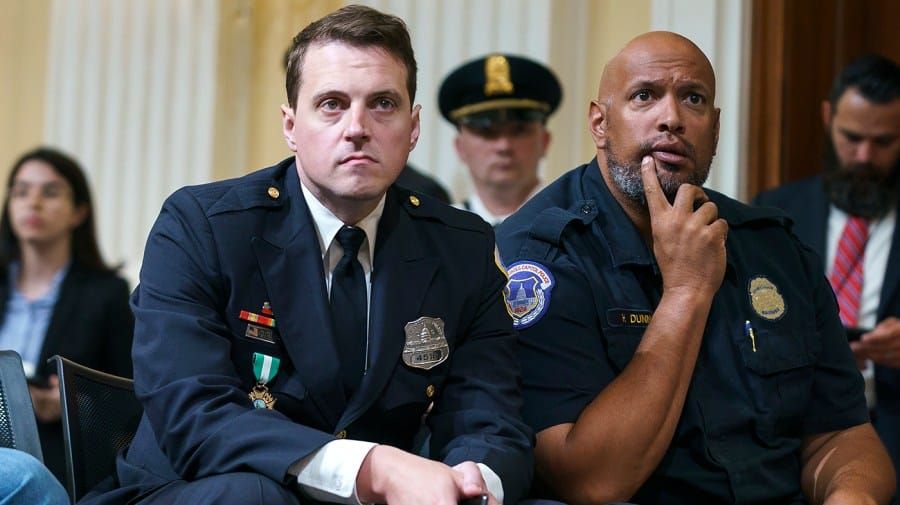
On January 6, 2021, U.S. Capitol Police Officer Harry Dunn and D.C. Metropolitan Police Officer Daniel Hodges were inside the Capitol building as a mob attempted to stop the certification of a presidential election. Hodges was crushed in a doorframe. Dunn was subjected to racial slurs while trying to hold the building. Both men did their jobs. Four years later, they are in federal court — not seeking compensation for what happened to them, but trying to prevent nearly $1.8 billion in public money from flowing to the people who attacked them.
The lawsuit, filed Wednesday and first reported by The Hill, targets the administration's so-called "anti-weaponization" fund — a pot of money that Dunn and Hodges argue will be used to compensate individuals who were prosecuted for their roles in the January 6 riot. The officers claim the fund violates the law and asks a federal court to block its disbursement. The legal challenge is narrow. The argument underneath it is not.
What Dunn and Hodges are naming in court is something the political press has largely treated as a rhetorical grievance: the federal government is preparing to use public funds to compensate people convicted of assaulting federal officers, destroying federal property, and attempting to obstruct the peaceful transfer of power — while the officers those people attacked have received no comparable restitution. The lawsuit makes that inversion concrete and puts it before a judge.
The fund's structure makes the legal challenge possible and the political logic transparent. As Tinsel News has previously reported, the anti-weaponization fund was established with no published eligibility criteria, no independent oversight mechanism, and disbursement authority concentrated in political appointees. That design is not an oversight. A fund with no rules is a fund whose rules are set by whoever controls it — and the people who control this one have already demonstrated where their sympathies lie. The administration issued mass pardons to January 6 defendants in the first days of the second term, including individuals convicted of assaulting police officers.
The pardons are the relevant context here, and they have been underreported as such. Pardons remove criminal liability. They do not create financial entitlement. The anti-weaponization fund does something the pardons could not: it converts the political rehabilitation of January 6 participants into a cash transfer, paid by American taxpayers, administered by an executive branch that has made its view of those participants explicit. Dunn and Hodges are arguing, in effect, that this crosses a legal line the pardons did not.
The anti-weaponization fund was created without published criteria for who qualifies, how much they can receive, or what oversight applies. Disbursement decisions rest with political appointees. The fund's $1.776 billion total — a number that mirrors the date of the Declaration of Independence — is drawn from public money. No congressional statute governs who gets paid.
Follow the power structure and the logic becomes clearer. The administration has, in sequence: pardoned January 6 defendants, including those convicted of violence against police; described the prosecution of those defendants as "weaponization" of the justice system; created a fund to compensate the purported victims of that weaponization; and placed control of that fund with loyalists who share that framing. Each step builds on the last. The lawsuit by Dunn and Hodges lands at the end of that chain — and it is the first legal intervention that treats the chain as a whole rather than each link in isolation.
The officers' standing to sue rests on a specific injury: they argue that a fund designed to compensate people who attacked law enforcement officers, while providing nothing to those officers, constitutes a cognizable harm. Whether a federal court agrees will depend on standing doctrine that is genuinely contested. But the lawsuit's value is not purely in its legal prospects. It forces into a judicial record — under oath, with evidence, subject to cross-examination — the question of what this fund is actually for.
That question deserves more scrutiny than it has received. The "anti-weaponization" framing has been accepted too readily by political coverage that treats it as one side's characterization of contested events. It is not. The prosecutions that the fund is designed to compensate were conducted by career federal prosecutors, reviewed by federal judges, and resulted in convictions upheld on appeal. Calling those prosecutions "weaponization" is a political claim, not a legal finding. The fund treats it as a legal finding — and proposes to spend $1.8 billion on that basis.
Dunn and Hodges are not the first people to push back on the January 6 revisionism. They are, however, among the most effective messengers, for a reason that the political press has occasionally noted but rarely analyzed: they were there. They have firsthand knowledge of what happened. They bear physical and psychological injuries from it. And they are now watching a federal fund take shape that, by the administration's own logic, treats their attackers as victims of the same government those officers serve.
The pattern this lawsuit fits into is one Tinsel News has tracked across multiple fronts: an executive branch systematically using the apparatus of government — pardons, prosecutorial discretion, funding mechanisms — to rewrite the legal and moral record of January 6. Five Jan. 6 pardon recipients have since been charged with new crimes, a pattern that complicates the "wrongful prosecution" narrative the fund depends on. The lawsuit by Dunn and Hodges is the legal system's first direct encounter with the financial dimension of that rewrite.
There is also a question that the lawsuit does not raise but that the fund's existence makes unavoidable: what does it mean for law enforcement as an institution when the federal government compensates people who attacked federal officers? Police unions have spent decades arguing that attacks on officers must carry severe consequences — that the rule of law depends on it. The anti-weaponization fund inverts that logic entirely, and does so with public money. The silence from those same unions has been notable.
The administration will argue that the fund is about remedying prosecutorial overreach, not rewarding violence — that many January 6 defendants were charged disproportionately, that the justice system was used as a political tool, and that compensation is appropriate. That argument will get its day in court. What it will have to contend with, in that court, is two named police officers with documented injuries, asking a federal judge to look at $1.8 billion in public money and explain who it is actually for. Federal courts have already found themselves in direct conflict with this administration over the limits of executive power — this lawsuit adds another front, and one with plaintiffs whose credibility is difficult to attack. The officers who held the line on January 6 are now asking the judiciary to hold a different kind of line. The question is whether it will.