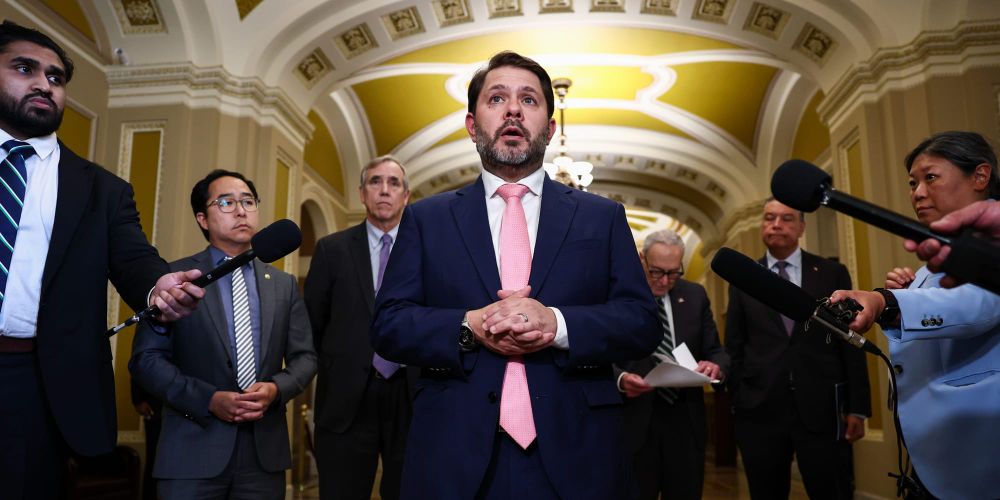
The CLARITY Act has a straightforward premise: a sitting president should not be allowed to personally profit from a financial market he regulates. Donald Trump has issued his own meme coin, his family controls a crypto platform called World Liberty Financial, and his administration has moved aggressively to weaken the oversight architecture that might otherwise constrain those ventures. The conflict is not subtle. The legislation to address it exists. What does not exist, as The Intercept has documented, is a Democratic caucus willing to pass it without flinching at the cost.
That cost is measured in campaign contributions. The crypto industry has spent years building a bipartisan donor base, and the moderate Democrats now voicing concern about Trump's self-dealing are, in many cases, the same lawmakers who have accepted money from the same ecosystem they say they want to regulate. The bind is not incidental — it is structural. And understanding it requires stepping back from the specific drama of Trump's meme coin to look at the longer pattern of how the Democratic Party manages the gap between its stated values and its actual financial dependencies.
This is not a story about hypocrisy in the retail sense. Individual politicians taking industry money while supporting mild industry oversight is the baseline condition of American politics. The more precise observation is this: the Democratic Party has constructed a donor dependency in crypto that mirrors, almost exactly, the dependency it built in finance before 2008, in pharma before the insulin pricing crisis, and in tech before the antitrust reckoning. Each time, the party arrived late to accountability — not because it lacked the policy vocabulary, but because the money arrived first.
The CLARITY Act targets presidential conflicts of interest in digital asset markets — specifically barring sitting presidents, vice presidents, and senior executive officials from issuing, promoting, or financially benefiting from cryptocurrency ventures while in office. It was introduced in response to Trump's meme coin launch and the World Liberty Financial platform, which his family controls. The bill has Democratic co-sponsors, but faces resistance from within the caucus over its potential impact on crypto industry fundraising.
The crypto industry's political spending has been aggressive and deliberately bipartisan. In the 2024 cycle, crypto-aligned PACs and individual donors poured more than $130 million into federal races — a figure that dwarfed previous election cycles and that targeted both parties with surgical precision. Coinbase, Andreessen Horowitz, and a cluster of venture-backed crypto firms have cultivated relationships across the Democratic caucus, with particular focus on members who sit on financial services and agriculture committees that hold jurisdiction over digital asset regulation. The investment has paid off: the industry helped pass crypto-friendly legislation in the House with significant Democratic support, and it has successfully slowed the kind of comprehensive regulatory framework that would most constrain its operations.
Now those same relationships are creating friction around the CLARITY Act. The legislation is targeted enough — focused specifically on presidential self-dealing rather than the broader regulatory architecture — that it should, in theory, be easy for Democrats to support without alienating the industry wholesale. But the industry has signaled discomfort with any precedent that treats crypto as a domain subject to ethics and conflict-of-interest law. Crypto's political power has always rested on a particular argument: that the sector is categorically different from traditional finance, that applying old rules to new technology misunderstands both, and that lawmakers who insist otherwise will find their next primary more competitive. That argument does not need to be made explicitly. The donation records make it for them.
The parallel to the party's recent history with AIPAC is worth naming directly. As Tinsel News has documented, 2028 Democratic presidential hopefuls are publicly distancing themselves from AIPAC while their party infrastructure continues cashing its checks. The pattern is identical: public positioning toward accountability, private maintenance of the donor relationship, and a legislative record that reflects the latter more than the former. What changes is the issue. What stays constant is the mechanism.
The accountability question the CLARITY Act forces is genuinely important, and it deserves to be separated from the partisan dynamics that have distorted its reception. Trump's crypto ventures represent something new in American political corruption: not the traditional model of a politician taking money from an industry in exchange for favorable policy, but a politician who has become the industry — who profits directly from the market conditions his own regulatory decisions create. When Trump's administration weakens SEC oversight of digital assets, the value of his meme coin and his family's platform potentially increases. The feedback loop is direct. No intermediary is required. The CLARITY Act exists to break that loop, and the fact that it faces resistance from within the party nominally committed to accountability is a story about who the Democratic Party actually serves when the costs become concrete.
There is a version of this story in which moderate Democrats thread the needle — supporting the CLARITY Act loudly enough to satisfy their base while quietly ensuring it never reaches a floor vote that would force the industry to spend against them. That version is not cynicism. It is a description of how the caucus has managed similar tensions for decades. The question is whether crypto is different enough — whether the specific visibility of Trump's self-dealing, and the specific anger it has generated among Democratic voters — to make the usual management strategy politically untenable.
The evidence from comparable moments suggests it is not. Financial reform after 2008 took years and a catastrophic economic collapse to produce Dodd-Frank, which the industry then spent a decade weakening. Pharmaceutical pricing reform required sustained public pressure over multiple election cycles before producing the limited drug negotiation authority in the Inflation Reduction Act. Tech antitrust enforcement remains functionally stalled despite bipartisan public support for action. In each case, the industry's donor relationships did not prevent legislation — they shaped it, delayed it, and hollowed it out. The CLARITY Act is at the shaping-and-delaying stage.
What makes the crypto situation distinctive is the speed of the money. The industry built its political infrastructure faster than any comparable sector in recent memory, and it did so during a period when Democratic campaigns were cash-hungry after a series of expensive and disappointing cycles. The entry price for crypto's goodwill was low, the checks were large, and the regulatory consequences seemed abstract. They no longer seem abstract. A president is personally profiting from a market he controls, and the party positioned to stop it is calculating whether stopping it is worth what it costs.
Readers looking for a parallel might consult the broader pattern of billionaire funding shaping Democratic positioning — a dynamic that predates crypto and will outlast it. The CLARITY Act is not the test of whether Democrats can regulate an industry that funds them. History has already answered that question. It is a test of how long the performance of accountability can substitute for the thing itself before voters stop accepting the substitution.
Justin Sun, one of the most prominent figures in Trump's crypto orbit, is already in litigation with World Liberty Financial over frozen tokens — a dispute that illustrates exactly how entangled the president's financial interests have become with the market he governs. That litigation has not accelerated Democratic action. The donor math has not changed. The CLARITY Act sits where legislation goes when the people who could pass it have decided, without saying so, that they cannot afford to.