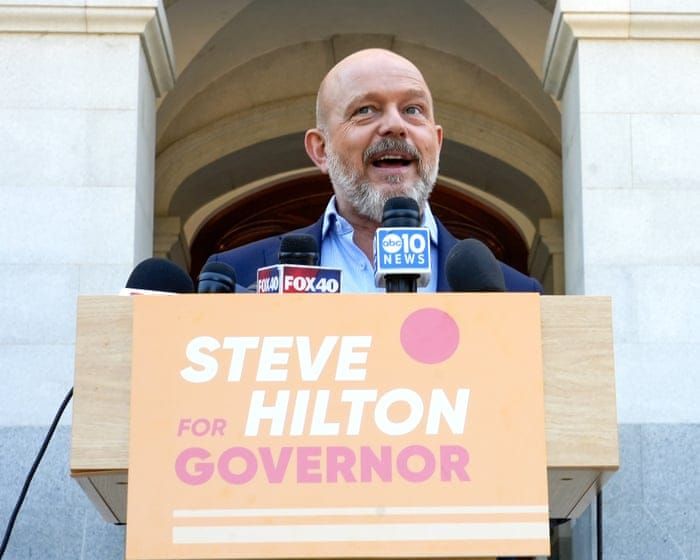
Steve Hilton has spent his career making himself useful to whoever holds power on the right. In the early 2000s, that meant branding exercises for the British Conservative Party. By the 2010s, it meant sitting inside Downing Street as one of David Cameron's closest advisers. By 2017, it meant a Fox News contract and a weekly audience of several million Americans who had never heard of Cameron and did not particularly care. And now, according to The Guardian US, it means the Republican nomination for governor of California — the largest state in the union, which his party has not won a gubernatorial race in since 2006.
The question worth asking is not whether Hilton can beat Democrat Xavier Becerra in November. The odds are steep, and California's structural Democratic advantage is well-documented. The question is what his trajectory reveals about the political movement that produced him — and about the transatlantic circulation of right-wing ideas that has, over the past decade, moved from genteel conservatism to something considerably harder.
Hilton arrived in the United States 14 years ago, according to The Guardian, having left Cameron's Downing Street operation and settled in Silicon Valley. The move itself was telling. By 2012, the Cameron project — a socially liberal, economically orthodox, pro-European conservatism — was already showing the fractures that would eventually shatter it. Hilton, by most accounts a restless ideological experimenter rather than a doctrinaire thinker, was not built for the long, grinding work of governing within those constraints. California suited him better: the startup culture, the disruption rhetoric, the sense that established institutions were problems to be solved by sufficiently clever outsiders.
What he found when he arrived at Fox News was that the American right had its own version of that disruption energy — angrier, more ethnically freighted, and far more willing to torch the institutions it claimed to be saving. The Cameron conservatism Hilton had practiced was, at its core, a management philosophy: keep the state running, just run it differently. The MAGA movement he aligned himself with by the late 2010s was something else. It did not want to manage the administrative state. It wanted to dismantle it, humiliate it, and replace its personnel with loyalists.
That Hilton made this transition without apparent difficulty is the most analytically interesting thing about him. It is tempting to read his career as opportunism — a man who reads the room and performs whatever ideology the room requires. But that framing is too easy, and it lets the structural story off the hook. Hilton is not unique. He is a data point in a much larger pattern of conservative politicians and commentators who began in the managed, technocratic center-right of the Blair-Cameron-Bush era and ended up somewhere considerably more radical. JD Vance's trip to Budapest to campaign for Viktor Orbán is the same story with an American accent. The transatlantic right has not merely drifted — it has reorganized around a different set of interests and a different theory of power.
The Cameron government Hilton served was, in retrospect, the last serious attempt by the British Conservative Party to govern as a pluralist, pro-European center-right institution. It ended with Brexit, which Cameron called and lost, and which Hilton — in a detail that should not be overlooked — publicly supported. His Brexit position put him at odds with his former boss and aligned him with the Nigel Farage wing of British politics that Cameron had spent his entire career trying to contain. That alignment was not incidental. It was a preview of where Hilton was going.
By the time he was hosting a weekly Fox News program, the Cameron-era vocabulary of "compassionate conservatism" and "the big society" had been replaced by something rawer. His show, The Next Revolution, positioned him as a populist critic of the "globalist" establishment — a framing that carried obvious resonances with the Bannon-era MAGA movement, even when Hilton avoided its most explicit nativist registers. He endorsed Donald Trump. He has maintained that endorsement through two terms and multiple federal indictments. The man who once helped craft the image of a Conservative Party that explicitly distanced itself from Thatcherite harshness is now the standard-bearer for a movement whose domestic policy agenda includes the most aggressive immigration enforcement in American history.
California uses a "jungle primary" or top-two primary system in which all candidates, regardless of party, appear on a single ballot. The top two vote-getters advance to the general election, regardless of party affiliation. This means a Republican can advance to the November ballot even in a heavily Democratic state — but also means the general election matchup is determined by primary turnout dynamics rather than party registration alone. No Republican has won a California gubernatorial race since Arnold Schwarzenegger's 2006 re-election.
Running in California adds a specific wrinkle to the Hilton story. California is not merely a Democratic state — it is the state that the national Republican Party has most consistently used as a foil. Its environmental regulations, its immigration policies, its housing costs, its tech industry: all have served as rhetorical targets for the MAGA right even as those same issues remain largely unresolved under Democratic governance. Hilton, who has lived in California for over a decade, is in the unusual position of being both an insider critic and a national Republican standard-bearer in a state where that brand is deeply unpopular.
His path through California's open primary — in which the top two vote-getters advance regardless of party — required consolidating the Republican base in a state where that base is a minority of the electorate. That he did so is a testament to his Fox News profile more than to any organic California political operation. He is, in the most literal sense, a media-political figure: his candidacy is downstream of his television career, not the other way around. This is itself a structural feature of contemporary right-wing politics, where the distinction between political entertainment and political candidacy has effectively collapsed. The replacement of credentialed political actors with loyalists and media personalities is not a California-specific phenomenon — it is the operating logic of the current Republican Party nationally.
The accountability question here is about what Hilton's candidacy does to California politics regardless of its outcome. A well-funded, Fox News-amplified Republican campaign in California gives the national right a platform to litigate its preferred culture-war arguments in the country's largest media market. The fundraising that flows to a competitive California governor's race — even a long-shot one — does not disappear if Hilton loses. It builds infrastructure, donor lists, and name recognition for future cycles. Democrats are already spending tens of millions to defend state legislative maps ahead of 2028 redistricting — a California governor's race, even a losing one, forces them to spend resources they would rather deploy elsewhere.
There is also the question of what a Hilton campaign does to the Democratic Party's internal dynamics in California. Xavier Becerra, the presumptive Democratic nominee, is a credentialed institutional Democrat — former attorney general, former HHS secretary, a career that runs through the kind of establishment progressive politics that the MAGA movement was specifically designed to run against. Hilton's campaign will try to make Becerra the face of everything that has gone wrong in California: the housing costs, the homelessness, the crime statistics, the water infrastructure. Whether that argument lands with a majority of California voters is doubtful. But it does not need to land with a majority to do damage. It needs to land with enough voters to make the race close enough to be newsworthy, and close enough to be useful as a national narrative. The same calculus applies to tech billionaires who spent tens of millions shaping California's down-ballot contests this cycle — outside money does not need to win the top of the ticket to reshape the political terrain.
That is the real function of Steve Hilton's California campaign. Not to win California — though winning is the stated goal — but to make California a stage for the next phase of a political project that began in the green rooms of British Conservative Party headquarters, ran through the Brexit referendum, crossed the Atlantic, and is now running for governor of the state it has spent a decade using as a punching bag. The transatlantic right did not produce Hilton accidentally. It produced him because it needed someone who could move between registers — Davos and Fox News, Downing Street and Mar-a-Lago — without the seams showing. Whether California voters decide to make him governor, they will be deciding something larger: whether that kind of political shapeshifting is a qualification or a disqualification for executive power.