The International Criminal Court has 124 member states. It was built, over decades of diplomatic negotiation, on a single premise: that some crimes are so grave that no government — however powerful, however allied — should be able to protect the people who commit them. On August 18, 2026, the United States government sanctioned the court's president and one of its prosecutors. The prosecutor's specific offense was investigating alleged war crimes committed by Israel in Gaza.
Secretary of State Marco Rubio, announcing the designations, called the Hague-based court a "corrupt and fatally politicized supranational court that has maliciously abused its authority and exceeded its mandate," according to The Guardian US. The targets were Tomoko Akane, the ICC's president, and Abdoulaye Seye, the prosecutor handling the Gaza investigation. Neither has been charged with any crime. Neither has been accused of personal corruption. Their offense, in the view of the United States government, was doing their jobs.
U.S. sanctions designations freeze any assets the targets hold in U.S. jurisdiction, block transactions with American entities, and can effectively cut sanctioned individuals off from the global financial system — since most international banking runs through dollar-clearing systems subject to U.S. oversight. For international legal officials, this means law firms, banks, and even academic institutions may refuse to work with them to avoid secondary liability.
The argument the administration offers — that the ICC has exceeded its mandate and become a political instrument — deserves a direct response, not dismissal. The court has real critics across the political spectrum, including some who support Palestinian rights and argue the ICC has historically moved too slowly on Israeli actions while acting swiftly against African leaders. Those are legitimate critiques of an institution with genuine procedural problems.
But the administration's critique is not about procedural reform. It is about outcome. The United States has no objection to ICC investigations of governments it dislikes — it has supported, at various moments, proceedings related to Russia, Sudan, and Libya. What it objects to, specifically and demonstrably, is the court investigating Israel. The sanctions are not a general statement about international legal overreach. They are targeted interference in a specific proceeding, aimed at specific officials, for a specific reason.
This is worth naming precisely: the United States is using its economic power to sanction individuals for the act of investigating alleged atrocities. The tool being deployed — asset freezes, financial isolation — is the same one Washington uses against arms traffickers, money launderers, and state sponsors of terrorism. It is now being applied to an international judge and a prosecutor conducting a legal inquiry. The message this sends to every international legal body, every future war crimes investigator, every human rights court is not subtle.
The pattern here is not complicated. This is not the first time the United States has moved to neutralize ICC proceedings it found inconvenient. The Trump administration sanctioned then-ICC prosecutor Fatou Bensouda in 2020, when the court was investigating alleged U.S. war crimes in Afghanistan. Those sanctions were lifted by the Biden administration in 2021. They are now back — this time aimed not at an investigation of American conduct, but at an investigation of an American ally's conduct. The scope has expanded. The logic has not changed.
What has changed is the specificity of the target. Sanctioning Abdoulaye Seye, whose portfolio includes the Gaza investigation, is not a broad statement about ICC jurisdiction. It is a surgical intervention in an active proceeding. It tells every subsequent prosecutor who might consider investigating Israeli military conduct — or, for that matter, conduct by any U.S. ally — what the professional and financial consequences will be. This is deterrence, applied not to prevent violence but to prevent accountability for violence. As Tinsel News has previously reported, Rubio's broader posture toward the ICC has been to treat the court as a hostile institution rather than an imperfect one in need of reform — a framing that makes sanction escalation the logical endpoint.
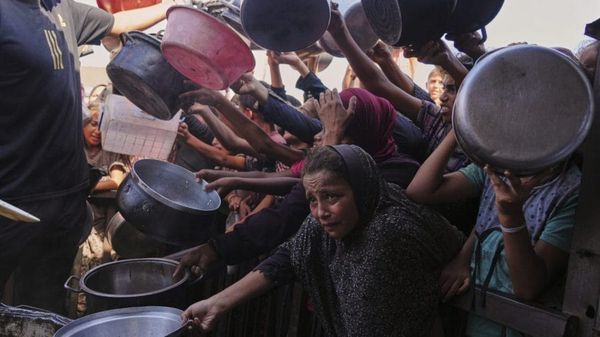
Who benefits from the ICC being unable to function is not an abstract question. There are currently active ICC proceedings, or preliminary examinations, touching on conduct in Gaza. There are documented civilian deaths — a UN inquiry has documented more than 20,000 children killed — and questions about whether specific military decisions constituted violations of the laws of armed conflict. The ICC's ability to pursue those questions depends on prosecutors being able to do their work without facing personal financial ruin for doing so. Sanctioning Seye degrades that ability directly.
There is a broader architecture being constructed here that extends well beyond any single proceeding. The United States has vetoed multiple UN Security Council ceasefire resolutions related to Gaza. It has continued weapons transfers to Israel throughout the conflict. It has now moved to financially isolate the international legal officials tasked with examining whether those weapons were used in violation of international humanitarian law. These are not three separate policy choices. They form a coherent strategy of impunity maintenance — each element reinforcing the others, each closing off a different avenue through which accountability might arrive.
For the 124 ICC member states watching this, the question is not whether they agree with every decision the court has made. The question is whether the court can function as an institution when one of the world's most powerful economies treats its officials as sanctionable targets. The answer, if the sanctions stand, is: only when the United States permits it to. That is not an international court. That is a court operating on American sufferance, subject to American veto, enforceable only against governments Washington has already decided to oppose.
Rubio's language — "corrupt and fatally politicized" — deserves particular scrutiny in this context. The ICC's alleged politicization is being cited by an administration that has openly intervened in an active ICC proceeding by sanctioning the prosecutor conducting it. The claim that the court is political is being made as justification for a political act. The circularity is not an accident. It is the argument: we are doing this because the court is political, and the court being political is defined as the court investigating our allies.
The people who bear the actual cost of this are not the diplomats in The Hague or the officials in Washington debating jurisdictional theory. They are the civilians in Gaza whose deaths are now being removed, one sanction at a time, from the domain of international legal scrutiny. The IDF's own investigation record — a pattern of probes opened and quietly closed — has already demonstrated what internal accountability looks like in practice. The ICC was, for many of the families of the dead, the only remaining institutional recourse. Washington has now sanctioned the person assigned to their case.
The designation of Tomoko Akane — the court's president, not its Gaza prosecutor — tells you something additional. Akane's role is administrative and judicial. Sanctioning her is not about disrupting a specific investigation. It is about signaling to the institution as a whole: no one at any level of this court is beyond our reach. The message is not targeted. It is comprehensive. It is designed to be felt by every judge, every prosecutor, every administrator who might someday be asked to work on a case the United States finds inconvenient.
International legal institutions are fragile precisely because they lack enforcement mechanisms of their own. They depend on the cooperation of powerful states to function. When those states decide that cooperation is conditional — available when the court targets enemies, withdrawn when it targets allies — the institution does not reform. It hollows. What remains is the form of accountability without its substance: proceedings that can be initiated, investigators who can be appointed, and findings that can be issued, all of it meaningless against any actor with a powerful enough patron willing to sanction the judges.
That is the world the August 18 sanctions are helping to construct. Not a world without the ICC — the institution will survive this. But a world in which the court's jurisdiction is understood, by every actor who matters, to stop at the borders of American alliance. The architects of that world are not in The Hague. They are in Foggy Bottom, announcing the designations.