The International Criminal Court has jurisdiction over war crimes, crimes against humanity, and genocide. It can investigate nationals of any country that has accepted its jurisdiction, and it can investigate conduct on the territory of any member state. The United States is not a member. But several of its closest allies are — and the court has been moving toward investigations that implicate American military and intelligence conduct in Afghanistan, and toward accountability proceedings connected to Gaza that directly involve U.S.-supplied weapons and U.S.-backed military operations.
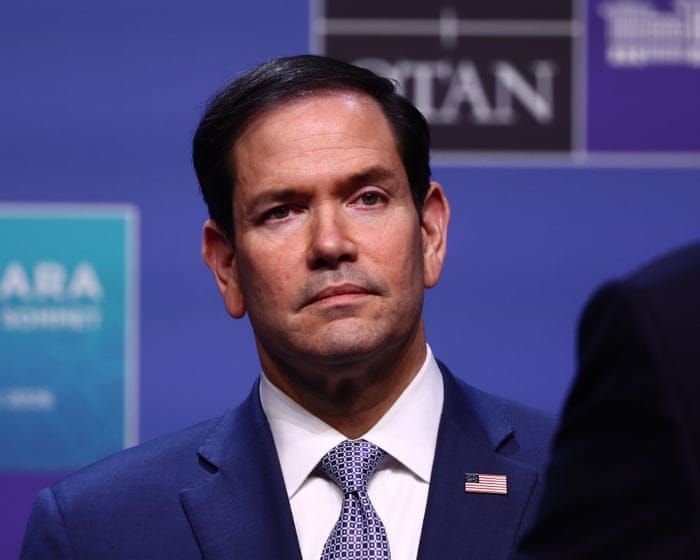
That context is absent from Marco Rubio's op-ed in the Wall Street Journal, published Monday, in which the secretary of state announced a campaign to dismantle the ICC entirely. As The Guardian US reported, Rubio framed the court as a threat to American sovereignty, conjuring images of U.S. border patrol agents and elected officials being "dragged before an international court" and judged by foreign judges. It is a vivid image. It is also a deliberate misdirection.
Border patrol agents are not who the ICC was built to prosecute. The court was designed — after Nuremberg, after Rwanda, after Srebrenica — to hold heads of state, military commanders, and senior officials accountable when their own governments would not. The populations it was built to protect are the ones currently dying in wars where American weapons are doing the killing.
The International Criminal Court, founded in 2002 under the Rome Statute, prosecutes individuals for war crimes, crimes against humanity, and genocide when domestic courts are unable or unwilling to act. The U.S. has never ratified the Rome Statute. But the ICC can still investigate crimes committed on the territory of member states — including Afghanistan, a Rome Statute member where U.S. forces operated for two decades. In 2021, the ICC's prosecutor formally authorized an investigation into alleged crimes by all parties in Afghanistan, including U.S. forces and the CIA. The court has also been examining conduct in Gaza, where member states including the United Kingdom supply weapons used in Israeli military operations.
The accountability question here is not complicated. The ICC's Afghanistan investigation — formally authorized in 2021 — encompasses alleged torture and abuse by U.S. forces and CIA operatives at detention sites. The court's preliminary examinations connected to Gaza involve weapons transfers from ICC member states to Israel. The United States, though not a member, has provided the bulk of the military assistance enabling those operations. Rubio's campaign to dismantle the court is not a defense of border patrol agents. It is a defense of the officials, the decisions, and the institutional conduct that the ICC is positioned to scrutinize.
This is a pattern with a longer history. The American Servicemembers' Protection Act, signed in 2002 by President George W. Bush, authorized the United States to use military force to free any American held by the ICC — a provision so aggressive it was nicknamed the "Hague Invasion Act" by European diplomats. The U.S. has spent two decades pressuring allies to sign bilateral agreements exempting American nationals from ICC jurisdiction. In 2019, the Trump administration revoked the visa of then-ICC prosecutor Fatou Bensouda after she sought to open the Afghanistan investigation. In 2020, it sanctioned her. The campaign Rubio launched Monday is not new. It is an escalation of a project that has been running, with varying intensity, for nearly a quarter century.
What has changed is the legal and geopolitical terrain. The ICC issued an arrest warrant in May 2024 for Israeli Prime Minister Benjamin Netanyahu and former Defense Minister Yoav Gallant over alleged war crimes in Gaza — a move that directly implicated the American officials who authorized, defended, and continued arms transfers throughout the period under investigation. Rubio's own conduct as secretary of state — including his role in continued arms approvals to Israel during active ICC proceedings — falls within the range of conduct that international legal scholars have described as potentially subject to scrutiny under complicity frameworks.
Follow the money and the picture is equally clarifying. Dismantling the ICC requires building a coalition. That coalition will be assembled through a combination of diplomatic pressure, financial inducements, and the implicit offer that governments which help destroy the court will receive cover from accountability for their own conduct. The countries most likely to cooperate are the ones with the most to hide. The architecture Rubio is proposing to construct is, in effect, a mutual impunity pact — a formal international agreement that the powerful will not be judged by the institutions built to judge them.
The populations bearing the cost of this project are not American. They are the survivors of conflicts where accountability has been systematically blocked — the Afghan detainees whose torture cases will never reach a courtroom, the Yemeni civilians whose deaths from U.S.-supplied munitions have never been adjudicated, the Palestinian families whose cases are now before a court that the United States is actively working to destroy. Rubio's op-ed does not mention these people. That omission is the argument.
The pattern here runs deeper than one op-ed or one administration. The United States has constructed, over decades, an elaborate architecture for exempting itself from the international legal frameworks it helped design. It championed the Geneva Conventions and then built a legal apparatus to argue they did not apply at Guantánamo. It helped found the Nuremberg precedent and then spent twenty years ensuring Nuremberg's institutional heir could not reach American nationals. The ICC campaign fits this pattern precisely: the U.S. supports international accountability when it applies to adversaries and dismantles the mechanisms when they approach allies — or when they approach Washington itself.
There is a global dimension to this that the Wall Street Journal op-ed format is not designed to accommodate. For the 124 states that are members of the Rome Statute, the ICC is not an abstraction. It is the only functioning international mechanism for accountability when domestic justice systems fail — which, in conflict zones, they almost always do. The Rwandan genocide, the Balkans war crimes, the atrocities in Darfur: these are not historical footnotes. They are the reason the court exists. Rubio's campaign to dismantle it will be received, in those countries and by those communities, not as a sovereignty argument but as a declaration that American power is categorically exempt from the rules it asks others to follow.
That message has consequences that extend well beyond the ICC. Tinsel News has previously documented the structural collapse in global trust in U.S. leadership — a collapse that is not cyclical but reflects accumulated decisions about which rules apply to whom. Every time Washington exempts itself from an institution it helped build, it hands China, Russia, and every authoritarian government that has ever complained about Western double standards a concrete, documented example. The ICC campaign is not a foreign policy choice made in isolation. It is another data point in the argument that the rules-based international order was always only rules for others.
The ICC will not be easily dismantled. It has 124 member states, a functioning prosecutor's office, and active cases that cannot simply be wished away. But that is not necessarily the point of Rubio's campaign. An institution under sustained American pressure — facing defunding threats, diplomatic isolation, and the withdrawal of cooperation from the world's most powerful military — is an institution whose reach contracts. Cases slow. Witnesses become harder to protect. Arrest warrants become harder to execute. The court does not have to be destroyed to be made ineffective. It has to be made to understand that pursuing certain cases carries a cost.
That is the actual goal. Not the elimination of the ICC, but the education of it — a demonstration, delivered through diplomatic and financial pressure, that accountability for the powerful has a ceiling, and that ceiling is enforced by the most powerful of all. The people who will live with that ceiling are not the ones Rubio named in his op-ed. They are the ones whose cases are already before the court — and whose only remaining recourse is now in the crosshairs.