Forty Senate Democrats voted in June to block arms transfers to Israel — a number that would have been unthinkable four years ago, when only fifteen supported a similar measure. The shift has been building for years. On Tuesday, one of the party's own senior members put a name to what that shift represents.
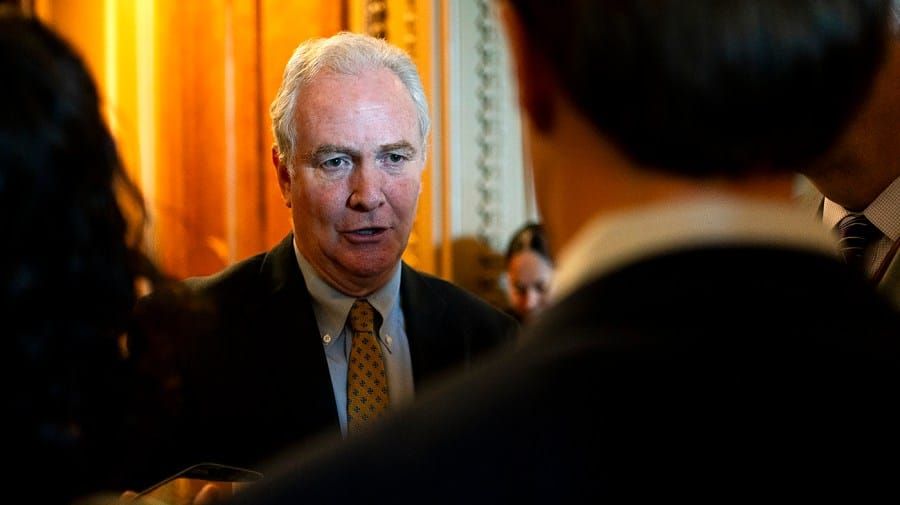
Sen. Chris Van Hollen (D-Md.) published an opinion piece in the New York Times this week declaring, in plain terms, that the Democratic Party's approach to the Israeli-Palestinian conflict has failed. "While Republicans' approach to the Israeli-Palestinian conflict has failed, so has ours," Van Hollen wrote, as reported by The Hill. The party, he argued, needs to "face a hard truth."
That is a rare sentence from a sitting U.S. senator about his own party's foreign policy record. It is also, if you read it carefully, a more damning statement than it first appears — because Van Hollen is not describing a communications failure. He is describing a policy failure. The problem was not the messaging. The problem was the strategy itself.
In 2021, 15 Senate Democrats voted to block arms transfers to Israel. By June 2025, that number had grown to 40 — the largest Democratic Senate defection on Israel-related legislation in modern history, according to Tinsel News tracking of Senate floor votes.
The original thesis that Van Hollen's op-ed does not quite make — but that the evidence demands — is this: the Democratic Party's Israel policy did not fail because it was politically miscalculated. It failed because the party substituted donor relationships and institutional inertia for moral judgment, and then spent years telling itself that the two were compatible. The political cost is now visible. The moral cost has been accumulating in Gaza for much longer.
To understand how the party arrived here, follow the money. The American Israel Public Affairs Committee and affiliated organizations have spent decades building financial relationships with Democratic politicians at every level. In the 2024 cycle alone, AIPAC-linked PACs funneled millions through shell groups into Democratic primaries, targeting incumbents who had broken with party orthodoxy on Israel. The message was not subtle: dissent carries a price. For years, most Democratic officials paid the toll and kept quiet.
The result was a party that voted for weapons transfers while individual members issued statements of concern — a posture that satisfied no one and deceived everyone. Progressives saw the votes. Arab and Muslim American communities, concentrated in swing states like Michigan, saw the votes. Young voters who had organized around the Gaza crisis saw the votes. The statements of concern were noted and filed away.
Van Hollen himself has been among the more consistent Democratic voices on this issue. He introduced legislation to condition military aid to Israel, traveled to the region to document the humanitarian situation, and publicly challenged the Biden administration's legal certifications that Israel was complying with U.S. arms law. His op-ed is not a conversion narrative. It is a senior member of the party saying, to the party, that what they all already know has to be said in public.
What makes the timing significant is where the party currently stands. The 2024 election produced a Democratic loss in which Arab American and Muslim American voters in Michigan — a state the party needed — shifted away from Democrats in numbers that almost certainly affected the outcome. Post-election analysis did not produce a reckoning. It produced a debate about whether those voters were actually responsible for the loss, which is a different and considerably less useful conversation.
The systemic pattern here is one the Democratic Party has repeated across multiple policy domains. A constituency that has long been taken for granted — in this case, Arab Americans, Muslim Americans, and a broader coalition of progressive voters organized around international human rights — makes its position clear. Party leadership acknowledges the concern in language while maintaining the policy in practice. The constituency loses faith. The party expresses confusion about why it is losing support. The cycle repeats.
What is different this time is the scale of the documented human cost against which the party's hedging is now measured. The conflict in Gaza has produced tens of thousands of civilian deaths, systematic destruction of medical infrastructure, the killing of humanitarian workers, and what multiple United Nations bodies have characterized as conditions constituting collective punishment. The Democratic Party's official position during this period was, functionally, to continue weapons transfers while expressing concern. Van Hollen is now saying that position failed. He is correct. The question the op-ed does not answer is whether the party has the institutional capacity to change it.
The accountability lens here points to a specific structural problem. Democratic Party foreign policy is shaped by a donor network, a think-tank ecosystem, and a set of institutional relationships with the Israeli government that have been built over decades. Elected officials who deviate from the consensus face primary challenges funded by outside money. Some 2028 presidential hopefuls are now denouncing AIPAC publicly while the party apparatus continues to accept its money — a contradiction that Van Hollen's op-ed implicitly names without quite resolving.
The global dimension of this story is also worth stating directly. The people most affected by the Democratic Party's Israel policy are not American voters. They are Palestinians living under conditions that international humanitarian organizations have documented in granular, sourced detail. Van Hollen's framing — that the strategy "failed" — is accurate from a domestic political standpoint. From the standpoint of the people in Gaza, the failure was not strategic. It was moral, and it preceded the election by years.
That distinction matters because it shapes what accountability actually requires. If the lesson the party takes from Van Hollen's op-ed is primarily electoral — we need to recalibrate our messaging to win back Arab American voters in Michigan — the party will have learned the wrong thing from the right admission. The failure Van Hollen is describing is a failure to apply consistent standards: to treat civilian deaths in Gaza with the same moral seriousness the party applies to civilian deaths elsewhere, and to allow donor relationships to override that standard for years.
The party now faces a choice it has been deferring. The growing Senate majority that voted to block arms transfers in June represents something real — a generational shift in how Democratic politicians read both the politics and the ethics of the issue. Van Hollen's op-ed is the senior-member endorsement of that shift. What it is not, yet, is a policy. Whether the party translates this public admission into changed votes, changed conditions on aid, and changed relationships with the donor networks that enforced the old consensus — that is the test. The admission was the easy part.