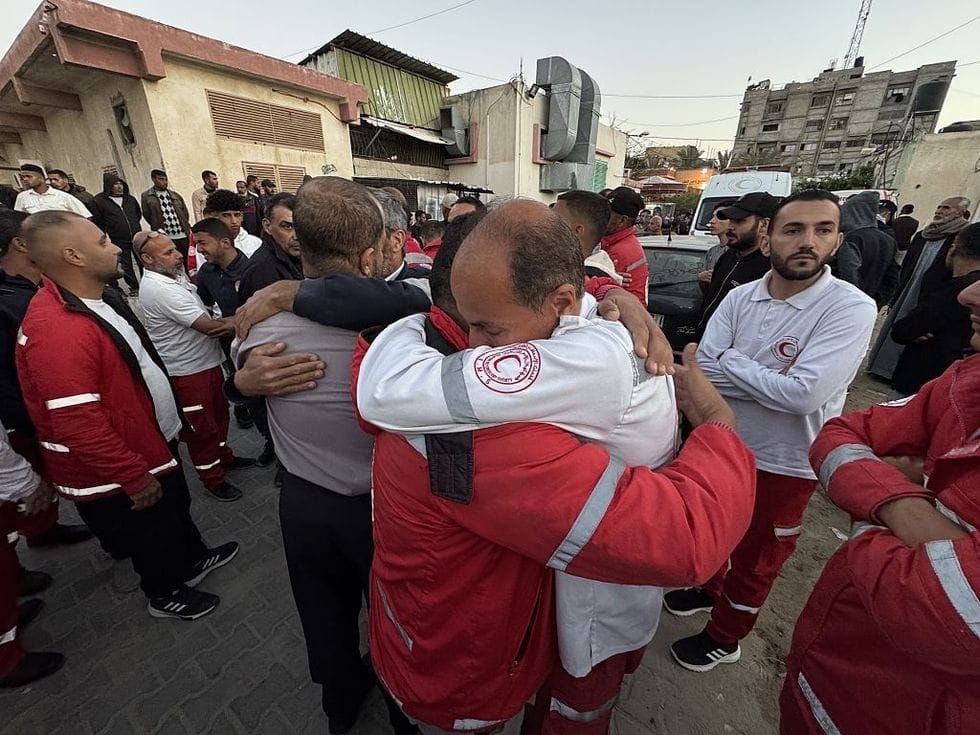
The number is precise enough to be damning: 907 aid workers killed, injured, or kidnapped in 2025, according to the Aid Worker Security Database and the UN Office for the Coordination of Humanitarian Affairs. Nearly 300 more were detained or arrested. The death toll — 350 humanitarians killed — was the second highest ever recorded. And it happened in a year when every government responsible for the worst of the violence was a signatory to the Geneva Conventions.
The framing that emerged on World Humanitarian Day was technological. Drones, OCHA noted, are putting lethal capabilities into more hands. Cheap, adaptable, and able to strike deeper into towns and cities, armed drones were linked to 80 percent of civilian deaths in Sudan in the first four months of this year. In Colombia, weaponized drone attacks quadrupled between 2024 and 2025. In Ukraine, four humanitarian convoys were struck by drones in a single week in May. In the Democratic Republic of Congo, one aid worker died in March when a drone hit a residential building. The technology is genuinely new. The pattern it is accelerating is not.
Here is the argument that World Humanitarian Day's statements did not quite make: the crisis of violence against aid workers is not primarily a technology problem. It is an enforcement problem. International humanitarian law — the body of rules that prohibits attacks on civilians, medical personnel, and humanitarian workers — has existed in codified form since 1949. The laws of war that UN humanitarian chief Tom Fletcher invoked when he said "the technology may change, but the laws of war do not" are not in dispute. They are simply not enforced. And they are not enforced because the states with the power to enforce them are frequently the same states committing, enabling, or excusing the violations.
Gaza is the clearest demonstration. Of the 350 aid workers killed in 2025, 186 — more than half — were killed there, despite a ceasefire agreement reached last October. More than two-thirds of those killed in Gaza died from aerial bombardment. This is not incidental. As Tinsel News has previously documented, Israel has opened internal investigations into high-profile killings of aid workers and civilians — investigations that have consistently produced no meaningful accountability. The cycle is now established: killing, international condemnation, investigation announcement, investigation quietly closed. The form of accountability substitutes for the substance of it.
The United States has been central to this accountability gap in Gaza specifically. The Security Council — the only international body with binding enforcement power over states — has been blocked from acting on Gaza by the U.S. veto, deployed repeatedly against ceasefire resolutions. This is not a peripheral detail. It is the load-bearing fact. When Fletcher says "states must uphold international humanitarian law and use every tool to protect civilians," he is speaking to an audience that includes Washington, which has vetoed the mechanism that would have compelled those protections. That context is absent from most coverage of this story.
The Geneva Conventions and their Additional Protocols prohibit attacks on civilians, humanitarian workers, and medical personnel. Enforcement depends on state compliance, Security Council action, or referral to the International Criminal Court. The U.S. holds veto power at the Security Council and has actively worked to undermine the ICC. No state has faced binding international consequences for attacks on aid workers in the current conflict cycle.
Sudan illustrates the same structure from a different angle. The drone strikes that killed civilians and humanitarian workers there at such scale in early 2025 are being carried out by the Rapid Support Forces — a paramilitary group whose arms supply chains run through Gulf states that maintain close relationships with Western governments. The conflict in Sudan has received a fraction of the international attention given to Gaza or Ukraine, despite producing comparable or greater civilian harm. That disparity is not random. It reflects which conflicts implicate which powerful states, and how coverage and condemnation track those implications. Tinsel News has reported on the scale of Sudan's drone warfare and the structural reasons it remains underreported.
The technology framing is not wrong — it is incomplete in a way that serves power. Drones have genuinely changed the arithmetic of violence. They lower the cost and risk of strikes, extend the reach of forces that previously could not operate in urban terrain, and create plausible ambiguity about intent. When a drone strikes a humanitarian convoy, establishing command responsibility — the legal standard required for prosecution — is harder than with a conventional airstrike ordered through documented chains of command. That ambiguity is not accidental. It is a feature of drone warfare that states have been slow to address through law, partly because the states most invested in drone technology have the least incentive to constrain it.
But the technology does not explain why 186 aid workers died in Gaza after a ceasefire. It does not explain why Sudan's catastrophe is structurally invisible to the international response architecture. It does not explain why the states that signed the Geneva Conventions in 1949 have not developed binding enforcement mechanisms in the 76 years since. Those are political choices, not technical limitations.
Fletcher's call for "real consequences" for those who break the rules was the right demand. It was also, in the current political environment, close to an abstraction. The International Criminal Court — the institution most structurally positioned to impose individual criminal accountability on commanders who order attacks on humanitarian workers — is currently under direct assault from the U.S. government, which has sanctioned court officials and threatened member states that cooperate with its proceedings. The court that could prosecute the people Fletcher is describing is being actively dismantled by the country whose veto protects those people at the Security Council. This is not a coincidence. It is a system.
So far in 2026, 82 aid workers have already been killed. Another 322 have been injured. Another 235 have been kidnapped. Those numbers come from OCHA's own reporting, released on a day designated to honor the people who take on that risk. Oxfam called on governments to uphold their obligations to protect humanitarian workers. That call has been made, in different language, after every record-breaking year of aid worker deaths. The record keeps breaking.
The standard account of World Humanitarian Day coverage runs like this: the situation is getting worse, and technology is part of why. The more accurate reading is different. The situation is getting worse because the international system has no enforcement mechanism that powerful states cannot simply opt out of, and the states with the most power to change that calculation have chosen not to. Drones are a delivery system. The decision to fire them at people wearing a Red Cross or a UN badge — and the decision to ensure that no one is held accountable for doing so — is made by human beings in governments that signed the laws forbidding it.
What changes that is not a better drone-tracking database or a new UN resolution. It is states facing costs for violations they currently absorb for free. Until the accountability gap closes — until commanders who order strikes on aid convoys face personal legal jeopardy, until arms suppliers to forces that target humanitarians face sanctions, until Security Council vetoes over mass atrocity situations carry political consequences for the states that deploy them — the numbers will continue to break records. The technology will keep changing. The impunity will not.