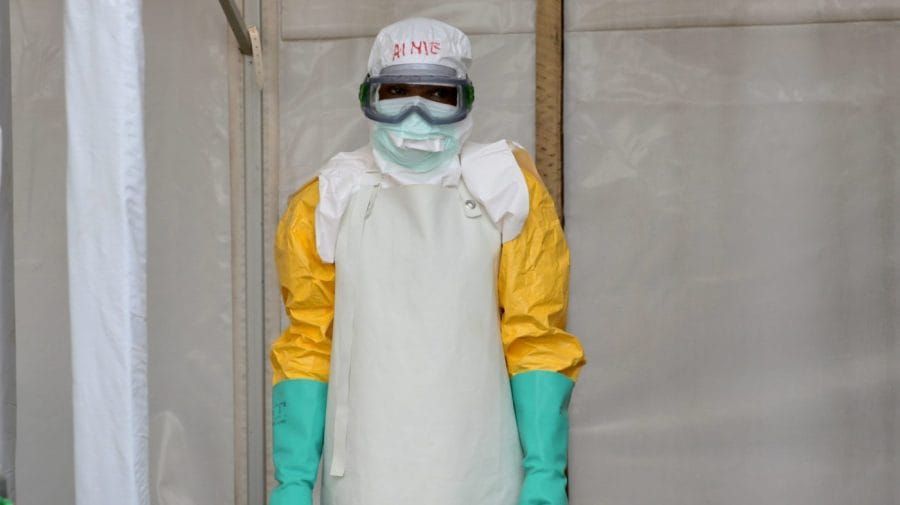
Six thousand, one hundred and eighty-six people have been diagnosed with Ebola in the Democratic Republic of Congo since May. Three thousand and seven of them are dead. According to data released Wednesday by Congo's Ministry of Health, this is the fastest-growing Ebola outbreak in the country's recorded history — and it is accelerating inside a public health infrastructure that the United States spent decades building, and then spent the first months of 2025 systematically destroying.
That is not a coincidence. It is a sequence.
The World Health Organization declared this outbreak a global health emergency in May. That declaration is supposed to trigger a coordinated international response — funding, personnel, supply chains, contact tracing networks. What it triggered instead was a response operating on a fraction of its former capacity, in a region where the agencies and programs designed to contain exactly this kind of outbreak had already been defunded, shuttered, or recalled. The U.S. Agency for International Development, which anchored global epidemic response infrastructure across sub-Saharan Africa for two decades, was effectively dismantled earlier this year — its staff fired, its programs frozen, its institutional memory scattered.
The consequences of that dismantling are not abstract. USAID funded the community health worker networks that serve as the first line of Ebola detection in rural Congo. It funded the laboratory infrastructure that allows health authorities to confirm cases quickly enough to prevent spread. It funded the logistics chains that move personal protective equipment to remote outbreak zones. It funded the trust-building programs that make it possible for health workers to enter communities where Ebola has historically been met with fear, denial, and sometimes violence. When those programs ended, the gaps they left did not fill themselves.
The outbreak's trajectory makes the timing hard to dismiss. Earlier Ebola emergencies in Congo — in 2018 and 2019, in the North Kivu and Ituri provinces — were contained with significant U.S. involvement. The 2018-2020 outbreak, which killed 2,287 people before it was declared over, was the second-deadliest Ebola outbreak in history at the time. It was contained, in part, because a functioning international response architecture existed to contain it. That architecture is no longer intact. The current outbreak has already surpassed that death toll, with no sign of deceleration.
For two decades, USAID funded the community health networks, laboratory infrastructure, and disease surveillance systems that allowed Congo and its neighbors to detect and respond to Ebola outbreaks before they became uncontrollable. The agency also funded WHO's on-the-ground emergency response capacity in the region. When USAID programs were frozen and its workforce cut earlier in 2025, those systems lost their primary external funding source. No equivalent replacement has been announced.
This is also a story about what happens when disinformation becomes a public health variable. Health workers in eastern Congo have faced violence — beatings, threats, the burning of treatment centers — from communities that have been told, via social media networks that no longer face any meaningful moderation pressure, that Ebola vaccination is a Western experiment, that health workers are the source of illness rather than its treatment. The disinformation infrastructure that made this possible was built during COVID and has never been dismantled. The community trust programs that USAID funded were specifically designed to counter it. Those programs are gone.
The accountability question here is specific, not rhetorical. Decisions were made by identifiable people in identifiable offices. USAID was restructured under the authority of the Department of Government Efficiency, with cuts implemented in the first quarter of 2025. The global health programs that were cut were not marginal line items — they were the operational core of U.S. epidemic response capacity. The officials who made those cuts were warned, in writing, by public health experts and former agency directors, that the consequences would include exactly this kind of cascading outbreak in exactly this kind of region. Those warnings are on the record. The outbreak is now on the record too.
Precision matters here about what is not being claimed. No one can say with certainty that USAID's continued operation would have prevented this specific outbreak from beginning. Ebola is endemic to central Africa; spillover events from wildlife reservoirs happen regardless of funding levels. What can be said is that the systems designed to detect spillover events early, contain them before they reach population centers, and coordinate international response when they do — those systems have been materially degraded. And the outbreak that has now killed more than 3,000 people began, spread, and crossed into the scale of a global emergency during the period of that degradation.
There is also a geographic dimension that American coverage of this outbreak has largely flattened. Eastern Congo — the provinces of North Kivu, South Kivu, and Maniema, where the outbreak is centered — is not a monolithic zone of crisis. It is a region of specific communities, specific languages, specific histories of both colonial extraction and post-colonial conflict. The people dying there are not dying because of some generic African fragility. They are dying in a region that has been systematically denied the health infrastructure that wealthier regions take for granted, and that has now also lost the external support that partially compensated for that denial. This pattern — Washington cutting aid, then watching preventable deaths accumulate — is not unique to Congo.
The WHO's declaration of a global health emergency in May was supposed to mobilize the international community. It has mobilized a response that operates in the shadow of what existed eighteen months ago. Médecins Sans Frontières and other NGOs are present, as they have been in every Ebola outbreak for decades — absorbing risk, doing the work, operating without the funding and logistical support that made coordinated containment possible in previous emergencies. The organizations doing the dying-in-the-gap work are not the organizations that made the decisions that created the gap.
Kenya's courts recently blocked a U.S.-backed Ebola quarantine facility from operating in that country — a decision that reflected both legal objections and a deeper erosion of trust in U.S. public health leadership across the continent. That erosion is not irrational. The United States spent years building credibility as a partner in African epidemic response. It spent the first months of 2025 cashing that credibility out. The Kenyan court ruling is one data point in what is becoming a broader pattern: the global health architecture that the U.S. anchored is reorganizing itself around the absence of American leadership, and not necessarily in ways that produce better outcomes for the people most at risk.
Three thousand and seven people are dead. The Ministry of Health in Kinshasa is managing a crisis with the resources available to it, which are not the resources that should be available to it, and which are fewer than they were a year ago because of decisions made in Washington. The outbreak is the fastest-growing in Congo's history. The infrastructure that existed to prevent it from becoming that is no longer intact. Those two facts belong in the same sentence — and in every piece of coverage of this crisis that aspires to tell the truth about how it happened.