ANALYSIS
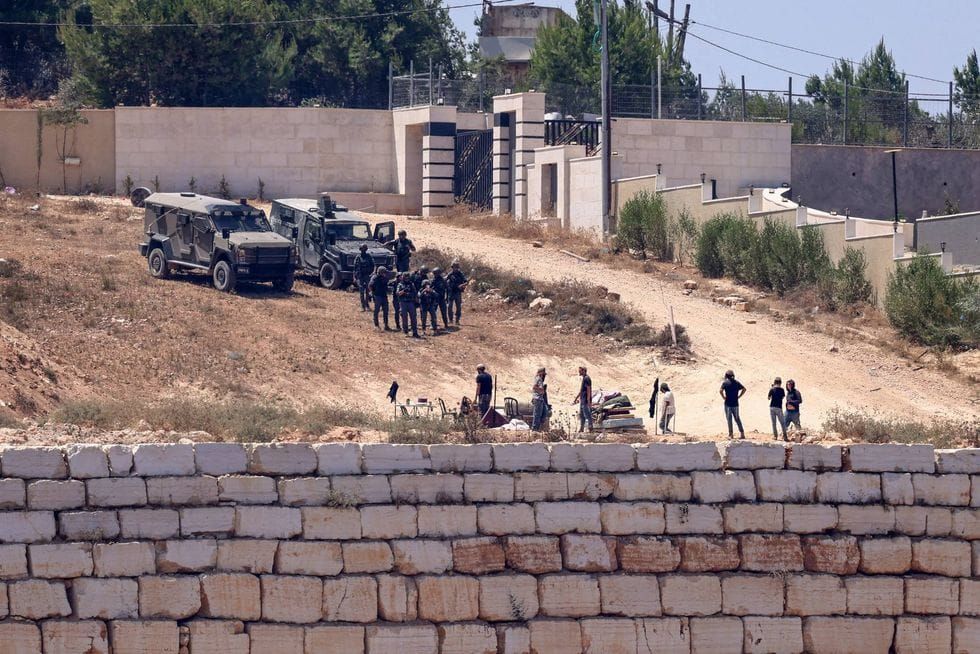
Aida Ahmed Abdullah was telling NBC News how settlers had forced her family from their home in the West Bank town of Jalud when the car arrived. The men inside wore masks. They carried sticks. According to Common Dreams, which compiled the NBC crew's firsthand accounts, the attackers jumped out, beat the people present, then jumped back in and drove away.
Abdullah was hospitalized. NBC correspondent Matt Bradley was struck twice on the arm. Cameraman Khaldoon Eid, producer Lawahez Jabari, and a driver were also injured. Jabari told NBC she saw a gun. The attackers did not use it — this time.
The attack lasted seconds. The conditions that made it possible have been decades in the making.
Israeli Prime Minister Benjamin Netanyahu called the assault a "criminal act of violence" committed by "a handful of rioters." That framing — isolated lawbreakers, aberrant behavior, a few bad actors — is the same language Israeli officials have used after every documented episode of settler violence against Palestinians and journalists. It is a description designed to be technically accurate and functionally misleading. Because the settlers who beat Aida Ahmed Abdullah and the NBC crew did not materialize from nowhere. They operate in a political and legal environment that the Israeli state has constructed, funded, and protected — and that the United States government has financed without condition.
Israeli settlements in the West Bank are considered illegal under international law. Settlers operate in a separate legal system from Palestinians in the same territory — Israeli civil law for settlers, military law for Palestinians. This dual legal structure means settlers face a fundamentally different accountability standard for the same acts of violence.
The same Saturday that Abdullah was beaten and hospitalized in Jalud, settlers conducted a nearly three-week siege of Palestinian homes in the nearby town of Qusra, according to Haaretz and Al Jazeera. They pepper sprayed Palestinian workers. They threw rocks at a building. They surrounded a fourth home with at least four residents inside. Jalud and Qusra are not connected by coincidence — they are connected by a pattern of coordinated settler pressure on Palestinian communities in the northern West Bank, a pattern that has intensified as the Israeli military's attention has been focused on Gaza.
Trita Parsi, executive vice president of the Quincy Institute for Responsible Statecraft, made the causal chain explicit on social media after the NBC attack: the settlers would not have acted against Americans without a green light from the Israeli government, and the Israeli government would not have given that green light unless it believed the U.S. government — and Ambassador Mike Huckabee — would not respond.
That analysis is not speculation. It is an accounting of incentives. When a government faces no consequence for the violence conducted by its settlers, the violence continues. When a patron government funds the patron without attaching conditions, the patron has no reason to change.

The United States sends Israel approximately $3.8 billion in military assistance per year. That figure does not fluctuate based on settler violence. It did not change after the documented case in which settlers forced a Palestinian family to exhume their father's body. It did not change after the UN condemned the practice as appalling. It has not changed now. The message that sends to the Israeli government — and to the masked men in the car — is not ambiguous.
Journalists trying to report in the West Bank and Gaza have long been targets of both settlers and the Israeli military. The IDF was found to be the leading killer of journalists worldwide for the third year in a row in 2025. That statistic matters here because it establishes that the attack on the NBC crew is not an exception to how press freedom operates in occupied Palestinian territory — it is consistent with a documented pattern. CNN correspondent Jeremy Diamond, reporting from Jerusalem, called the incident "the latest instance of unacceptable and alarming settler violence toward journalists and Palestinians." He is correct that it is the latest. He is also correct that it is not the first, or the tenth, or the hundredth.
What makes Saturday's attack different — and what explains why it received coverage that similar attacks on Palestinian journalists typically do not — is the presence of an American television crew. Eid and Jabari, both West Bank-based members of the NBC team, have been operating in this environment for years. The violence that found them on Saturday is the same violence that Palestinian journalists and civilians navigate without the protection of an American network affiliation or a Western passport. The fact that it took the beating of a foreign correspondent for this particular episode to reach American audiences is itself a form of editorial information.
The original story Abdullah was telling NBC — how settlers forced her family from their home in Jalud — never made air in the way it was intended. The attack interrupted it. But the attack is also, in a different way, the same story: Palestinian families are being removed from their land, by force, by settlers who operate with effective impunity, in a territory under Israeli military control. The displacement and the violence are not separate phenomena. They are the same policy, expressed through different instruments.
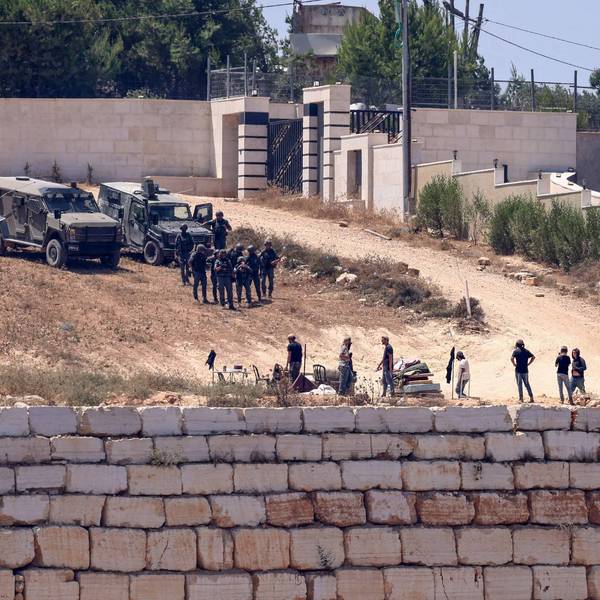
Washington has sanctioned the international officials investigating Israeli conduct and moved to dismantle the court that might hold perpetrators accountable. The U.S. has not conditioned aid on settler accountability. It has not imposed consequences on Israeli officials who authorize settlement expansion. It has not named, sanctioned, or pressured the political figures whose decisions create the legal and material environment in which masked men can beat an American television crew in broad daylight and face no immediate consequence.
Netanyahu's condemnation of Saturday's attacks will not be followed by prosecution of the attackers. Israeli human rights organizations have documented for years that settler violence against Palestinians is investigated at a fraction of the rate of Palestinian violence against Israelis, and that prosecutions are rarer still. The condemnation serves a function — it allows the Israeli government to perform disapproval while the structural conditions that produce the violence remain intact. It allows the U.S. government to accept the condemnation as sufficient. It allows the cycle to continue.
The men who beat Aida Ahmed Abdullah wore masks. They knew what they were doing was being filmed. They did it anyway. That is not the behavior of people who fear consequences. It is the behavior of people who have learned, through experience, that consequences will not come — not from the Israeli legal system, not from the Israeli government, and not from the government in Washington that funds both.