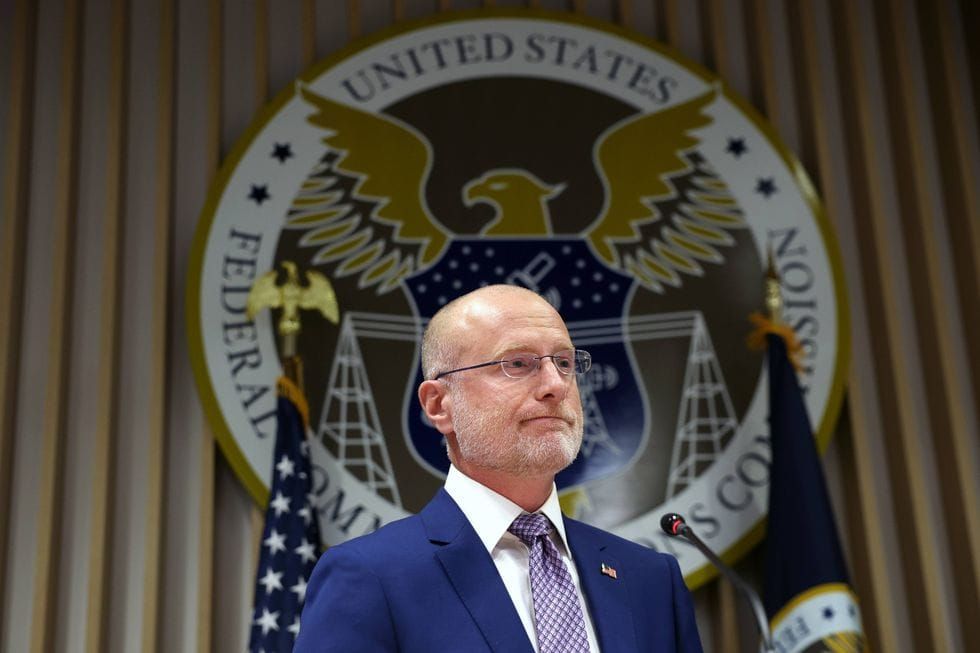
Thirty-nine percent. Congress chose that number deliberately, wrote it into statute in 2004, and made clear the FCC had no authority to change it. On Wednesday, FCC Chair Brendan Carr announced his agency will vote on August 6 to eliminate it anyway.
The number in question is the national household cap — the share of American TV households a single broadcaster can reach. The cap exists to prevent any one company from controlling what most of the country sees on local news. Carr's proposal, which he announced in an op-ed published by the far-right outlet Breitbart, would remove it entirely. The FCC's Republican majority makes approval likely. What Carr has not explained is how an independent regulatory agency overrides an act of Congress.
Anna Gomez, the lone Democratic commissioner on the five-member FCC, did not mince words. "This unlawful effort to hand control of the public airwaves to billionaire buddies of this administration will destroy local newsrooms, silence community reporting, and drive up costs for the American families who depend on local stations for news and emergency alerts," she said in a statement reported by Common Dreams. Her objection is not just political — it is constitutional. Congress set the 39% figure on purpose, and it did so after a previous FCC attempt to raise the cap failed in exactly the way Carr is now attempting.
In 2003, the FCC raised the national TV ownership cap to 45% on its own authority. Congress responded within months: it rewrote the law, set the cap at 39%, and explicitly stripped the FCC of authority to change it. Carr's current proposal would repeat the same move Congress already reversed.
Gomez made the legal history explicit: "In 2003, the commission raised the cap to 45% under its own authority. Congress stepped in within months, rewrote the law to set the cap at 39%, and made clear the FCC did not have the authority to change it. An FCC vote to raise the cap now would be unlawful, as it would mean doing the exact thing Congress has already said the commission cannot do."
The precedent is not in dispute. The FCC tried this before. Congress stopped it. Carr is trying it again — not because the law changed, but because the administration changed.
The beneficiaries of that political shift are not abstract. Politico noted that Carr's proposal "marks a likely victory for the National Association of Broadcasters and its members such as Nexstar and Sinclair, which would be freer to pursue mergers that would breach the cap." Nexstar, the country's largest TV station owner, already agreed to acquire rival Tegna in a $6.2 billion deal. A federal judge blocked the merger in April pending legal challenge. If it is finalized, the combined company would reach roughly 80% of U.S. households — more than double the statutory limit Carr is now working to delete.
The sequencing here deserves attention. The FCC approved the Nexstar-Tegna merger earlier this year. A federal court then blocked it. Now the FCC chair is moving to eliminate the very rule that made the court's intervention legally coherent. Matt Wood, vice president of policy and general counsel at Free Press, framed the pattern directly: "Just as the FCC had no power to waive a congressional statute to grease the skids for Nexstar's merger with Tegna, it has no power now to completely obliterate the limit Congress set."
The source coverage gestures toward this without saying it outright: Carr's proposal is not regulatory reform. It is regulatory cleanup — an attempt to retroactively legitimize a merger that courts have already found legally problematic by eliminating the law the courts are applying. The FCC is not changing the rules for future mergers. It is changing the rules for a specific merger that is currently in litigation.
Wood went further, defending the policy on its merits: "The national cap remains good policy. It promotes competition, localism, and diversity in broadcasting, incentivizing stations to preserve local newsrooms and local-journalism jobs instead of duplicating stories nationwide and passing that off as local news." That last phrase — duplicating stories nationwide and calling it local news — is a precise description of what broadcast consolidation actually produces. Sinclair Broadcast Group, one of the companies positioned to benefit from Carr's proposal, became notorious for requiring its local stations to air centrally produced editorial segments without local attribution. The segments ran in markets from Spokane to Tampa, delivered by local anchors, indistinguishable from local reporting.
The FCC's stated rationale — that eliminating the cap will "restore balance to the broadcast airwaves," as Carr wrote in Breitbart — inverts the actual function of the rule. The cap does not create imbalance. It prevents it. Removing it does not open the market to more voices. It concentrates the market into fewer hands. Carr published his proposal in an outlet owned by a media company with direct financial interests in the deregulatory environment his proposal would create. That is not a coincidence worth ignoring.
The broader pattern here connects to what is happening across federal media and antitrust oversight. As Tinsel News has documented in its coverage of DOJ antitrust enforcement, merger investigations are being killed from the inside — not through legal argument, but through the replacement of career staff with political appointees willing to reach different conclusions. The FCC's move fits that pattern: the law has not changed, the evidence has not changed, but the political appointees running the agency have — and so the outcome changes with them.
What makes the FCC situation distinct is the brazenness of the legal problem. DOJ antitrust decisions involve judgment calls about market definition and competitive harm. The FCC's situation involves a statute with a specific number in it, a congressional record showing why that number was chosen, and a prior FCC attempt to change it that Congress explicitly reversed. Carr is not arguing that the law permits his action. He is proceeding as if the argument does not need to be made.
The communities that will pay for this are not the ones that will benefit. Local news is not a luxury product. It covers school board meetings, zoning disputes, municipal budgets, and local elections — the civic infrastructure that national media does not touch. When a broadcast group acquires a local station and replaces its newsroom with centrally produced content, those functions disappear. The station keeps its license, keeps its signal, keeps its local branding — and stops doing local journalism. The public airwaves remain public in name only.
The August 6 vote will almost certainly pass. The FCC's Republican majority is two-to-one. Gomez can dissent, and she has — forcefully and on the record. But dissent does not stop the vote. What happens after the vote is the question worth watching: whether the courts that blocked the Nexstar-Tegna merger on statutory grounds will apply the same reasoning to the FCC's attempt to delete the statute, and whether Congress — which wrote the 39% cap into law precisely to stop this kind of agency overreach — treats this as the provocation it is. The last time the FCC tried this, Congress acted within months. The question is whether this Congress will.