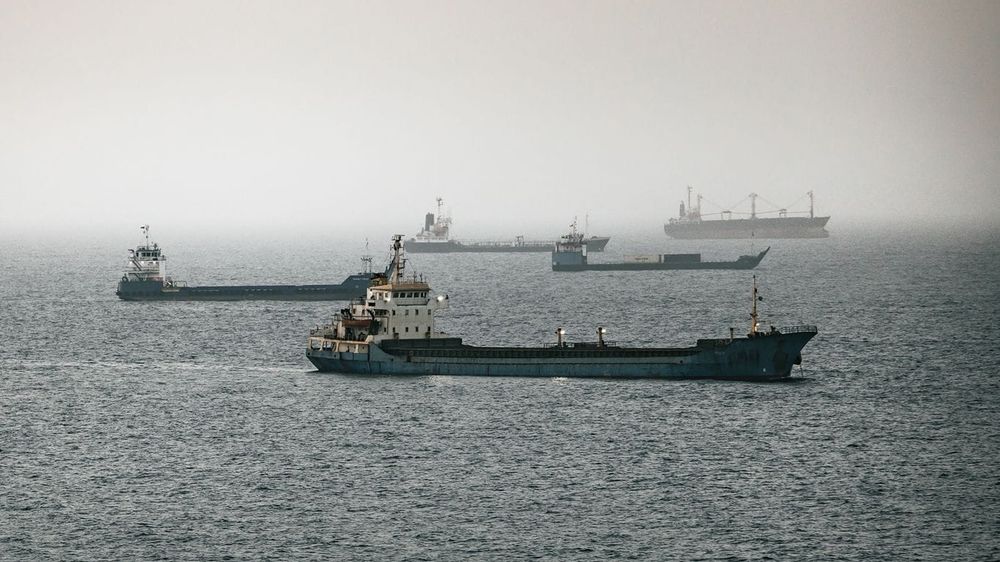
Iran's military struck three commercial ships in the Strait of Hormuz within a single 24-hour window. The agreement designed to prevent exactly this — signed less than three weeks ago — is now effectively rubble.
According to Axios, which cited two U.S. officials, Iran's military fired at least two missiles at commercial vessels transiting the strait on Monday night. The Islamic Revolutionary Guard Corps then struck a third ship Tuesday morning. The United Kingdom Maritime Trade Operations reported that a tanker traveling south near Oman's Hormuz coast was hit by an unknown projectile, triggering a fire. A second vessel was struck by an Iranian missile. Both ships sustained significant damage. No casualties were reported — a detail that, given the trajectory of this conflict, should offer less comfort than it does.
The attacks shred a memorandum of understanding under which Iran had agreed to halt Hormuz strikes — a deal reached just weeks ago after a separate one-week ceasefire on strait attacks expired without renewal. Indirect talks between the U.S. and Iran in Doha, Qatar, ended last week without progress. Washington, per U.S. officials cited by Axios, is now likely to respond with strikes against Iranian targets. The cycle — agreement, violation, retaliation, new agreement — has become the architecture of this war.
Roughly 20 percent of the world's traded oil and 20 percent of global liquefied natural gas passes through the Strait of Hormuz — a chokepoint 21 miles wide at its narrowest point. A sustained closure or sustained threat of attack does not just disrupt energy markets. It forces rerouting, raises insurance premiums on every vessel in the region, and passes costs directly to working people in the form of higher fuel and food prices. For a fuller picture of how this waterway controls the global economy, see Tinsel News's explainer on the Strait of Hormuz.
What the source reporting does not examine — and what matters here — is who benefits from the failure of these agreements. Each time a ceasefire collapses, energy markets spike. Each time markets spike, a specific class of actors profits. As Tinsel News has documented, 41 energy billionaires pocketed $23.5 billion while 32 million people were pushed into poverty by the same war. The pattern is not incidental. The financial architecture of this conflict rewards disruption. There is no equivalent constituency — no lobby, no PAC, no futures market — for the tanker crews, the Filipino and Indonesian sailors who staff most of the commercial shipping transiting this corridor, or the families in Yemen, Pakistan, and East Africa who will pay more for fuel next week because of what happened Monday night.
The MOU that just collapsed was itself a compromised document. Tinsel News's earlier analysis of the agreement found that the deal let Iran keep its most dangerous weapons — an omission that was not an oversight but a deliberate concession. A framework that halts attacks on commercial shipping while leaving the offensive capacity that enables those attacks fully intact was always a temporary arrangement, not a durable one. What collapsed this week was not a peace — it was a pause that both parties understood would be temporary.
The Doha talks that preceded this latest escalation followed the same logic. Indirect negotiations — meaning the U.S. and Iran do not speak directly, but communicate through Qatari intermediaries — are structurally slow and easy to abandon. Iran can resume attacks and then return to the table claiming grievances. Washington can threaten retaliation and then calibrate its response based on domestic political optics rather than strategic clarity. The people bearing the actual cost of this cycle are not in the room in Doha.
The anticipated U.S. retaliatory strikes, if they materialize, will follow a sequence that has already repeated several times in this conflict: American military action, Iranian escalation, diplomatic overture, temporary agreement, collapse. The Doha framework has now failed at least twice. There is no public evidence that Washington has a theory of how this ends — no stated end condition, no defined threshold for success, no articulated off-ramp that Iran has any reason to accept. The Senate has voted seven times to constrain the war's authorization and failed each time, as Tinsel News has tracked. Congress has authorized none of the spending. The legal framework for continued military action remains, as it has been from the start, disputed at best.
The three ships struck Monday night and Tuesday morning were commercial vessels — not military assets, not flagged to belligerent states, but cargo ships carrying goods through a waterway that international law treats as a global commons. The sailors aboard them work for wages. The cargo they carry feeds supply chains that reach every economy on earth. Their vulnerability is not collateral to this conflict. It is the mechanism through which the conflict is being fought — pressure applied not through battlefield victory but through the sustained threat of economic disruption. That threat has now been renewed, and the next agreement, whenever it comes, will carry less credibility than the last.