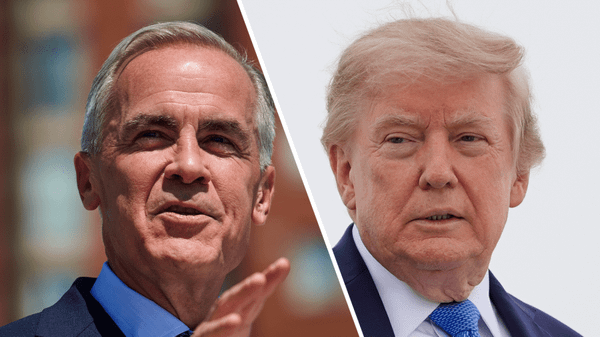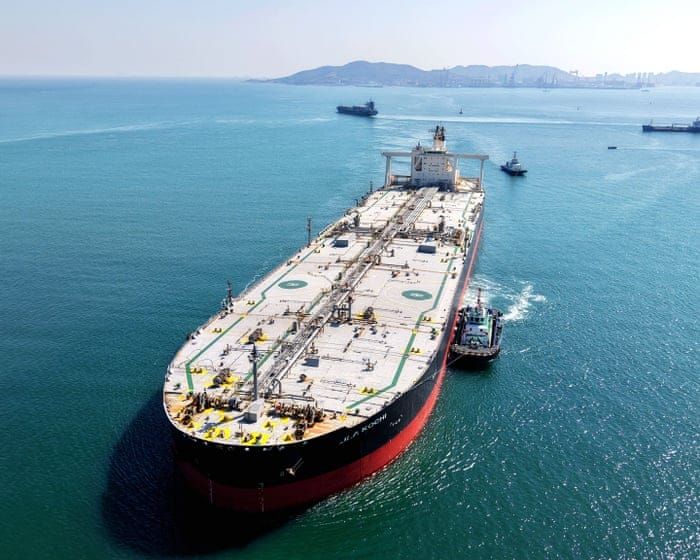
The price of Brent crude fell roughly 4 percent on Monday, landing near $83 a barrel. European wholesale gas prices dropped 6 percent. Stock markets closed at a record high. The Guardian US reported the moves came on "fresh hopes" that a US-Iran peace deal could end what analysts described as the greatest energy supply crisis in the history of the market. Donald Trump posted "Let the oil flow" on Truth Social. That post — and the market reaction to it — tells you nearly everything about how financial markets have learned to function in the age of performative geopolitics.
There is no signed agreement. There is no sanctions relief. Iran's nuclear program has not been addressed. The Strait of Hormuz — the 21-mile chokepoint through which roughly 20 percent of the world's traded oil passes, and whose closure has defined the current energy crisis — has not reopened. What moved global energy markets by billions of dollars in a single session was the anticipation of a resolution, not the resolution itself. The market is not pricing in policy. It is pricing in hope. And hope, in commodity markets, is a position that can be unwound very fast.
This pattern has a name in financial analysis: a peace premium in reverse, or what traders sometimes call a "ceasefire rally" — a spike in optimism that precedes any actual change in conditions on the ground. Markets move on expectations. When expectations shift, money moves. The problem is that in this particular conflict, the gap between official statements and verifiable diplomatic progress has been wide enough to drive a tanker through. And tankers, notably, are still not moving freely through the Strait of Hormuz.
To understand why Monday's price moves matter beyond the trading floor, it helps to understand what the oil market has actually been responding to for the past several months. The Iran conflict did not merely disrupt a shipping lane — it fractured the assumptions underlying global energy pricing. Insurers pulled coverage for vessels transiting the Gulf. LNG spot prices in Asia surged as buyers scrambled for alternative supply. The knock-on effects reached European household energy bills, Asian manufacturing costs, and the budget calculations of governments from Nairobi to New Delhi that subsidize fuel. As Tinsel News has documented, the LNG collapse pushed Asian economies back toward coal — a climate consequence that no peace deal post on Truth Social will reverse.
The beneficiaries of Monday's rally are worth identifying precisely. Equity investors in oil majors saw paper gains on the expectation of stabilizing supply chains. Hedge funds with long positions in energy futures were able to take profits. Retail investors in broad market index funds saw their portfolios tick upward with record stock closes. These are, in the main, people who already hold financial assets — the same population that benefits from market volatility when they can see it coming and position accordingly. The people who have been paying $5.80 at the pump, whose heating bills doubled, whose employers passed energy surcharges down to workers in the form of reduced hours or frozen wages — their situation did not change on Monday. A 4 percent drop in Brent crude does not immediately translate to relief at the retail level, particularly when refining margins, distribution costs, and retailer pricing strategies all create a lag between wholesale moves and what consumers actually pay.
For oil markets to sustainably return to pre-conflict prices, analysts have noted that any deal would need to address: the formal reopening of the Strait of Hormuz and restoration of shipping insurance; the lifting or suspension of sanctions that have frozen Iranian crude exports; a framework for Iran's nuclear program sufficient to satisfy both U.S. and Israeli security requirements; and a regional de-escalation agreement covering Iranian proxy forces in Iraq, Yemen, and Lebanon. None of these elements has been publicly confirmed as part of any current negotiation.
The accountability question here is not simply whether markets are being naive. Markets are not moral actors — they respond to price signals and probabilistic assessments of future conditions. The accountability question is who is generating those signals, and whether the information underpinning them is accurate. When a sitting president posts "Let the oil flow" on a social media platform without an accompanying statement from the State Department, a joint communiqué, or any verified diplomatic framework, and that post moves global commodity prices by measurable percentages, the question of market integrity becomes unavoidable. Financial regulators have long grappled with the problem of material non-public information — the principle that trading on information not available to the general market constitutes manipulation. A presidential social media post is, by definition, public. But the question of whether the underlying information it implies is accurate — and whether people with advance knowledge of that post positioned themselves accordingly — sits in a regulatory gray zone that no agency has adequately addressed. This publication has previously examined how prediction markets and war-betting platforms have created new vectors for insider advantage in exactly these scenarios.
There is also a structural pattern worth naming. This is not the first time in the current conflict that a diplomatic signal — a statement, a post, a leaked framework — has moved energy markets before any underlying conditions changed. Each of those moves created winners and losers. The winners, consistently, have been institutional investors and sophisticated traders with the tools and speed to act on information within seconds of its release. The losers have been the diffuse population of ordinary people whose economic lives are shaped by energy prices but who have no mechanism for hedging against the volatility those prices create. This is not an incidental feature of how commodity markets work. It is the architecture.
The Guardian's own analysis, published alongside the market report, noted that oil and gas prices are unlikely to return to pre-war levels for months even if the Strait of Hormuz reopens shortly. This is the detail that the headline rally obscures. Supply chains that have been rerouted do not snap back instantly. Insurance markets that withdrew coverage for Gulf shipping will not reinstate it until political risk assessments are updated, a process that takes weeks. Refineries that shifted to alternative crude grades have locked in contracts. The physical reality of energy markets operates on a different timescale than the emotional reality of financial markets. Monday's price drop was real. Its durability is not guaranteed by anything that has actually happened.
The geopolitical dimensions are equally unresolved. Iran's nuclear program — the original organizing concern of U.S. policy toward Tehran for two decades — has not been addressed in any publicly confirmed negotiating framework. The regional conflicts in which Iranian-backed forces are active participants have not paused. The sanctions architecture that has constrained Iranian oil exports remains in place. A peace deal that does not address these elements is not a peace deal. It is a ceasefire in the most provisional sense, and provisional ceasefires in this region have a documented record of collapse. The market's 4 percent optimism is pricing in a scenario that has not been constructed and may not be constructible on the timeline the price move implies.
It is worth being precise about what "Let the oil flow" actually means as a policy statement. It means nothing. It is not a sanctions waiver. It is not an executive order. It is not a treaty framework. It is a social media post designed to generate a market reaction — and it succeeded, which is precisely the problem. When presidential communication functions primarily as a market-moving instrument rather than a policy instrument, the line between governance and market manipulation becomes difficult to locate. The people positioned to benefit from that ambiguity are not the families paying $300 monthly gas bills. As this publication noted in a recent analysis of the administration's approach to the conflict, the gap between presidential rhetoric and operational strategy on Iran has been a defining feature of the entire conflict.
None of this means a genuine diplomatic breakthrough is impossible. Negotiations between the United States and Iran, if they are actually occurring, would represent a significant development with real consequences for global energy markets, for Iranian civilians who have borne the human cost of the conflict, and for the regional architecture of the Middle East. The problem is not that markets responded to the possibility of peace. The problem is that they responded to a social media post as if it were peace — and the people who wrote that post know exactly what that response looks like, and exactly who benefits from it.
If a deal materializes with the substance to justify Monday's price moves — sanctions relief, Hormuz reopening, a nuclear framework — the rally will have been prescient. If it does not, the people who moved fastest on the president's post will have extracted value from a market moment that changes nothing for the workers, the commuters, and the economies that have been absorbing the real cost of this conflict for months. That asymmetry is not a market anomaly. It is the market working exactly as designed.