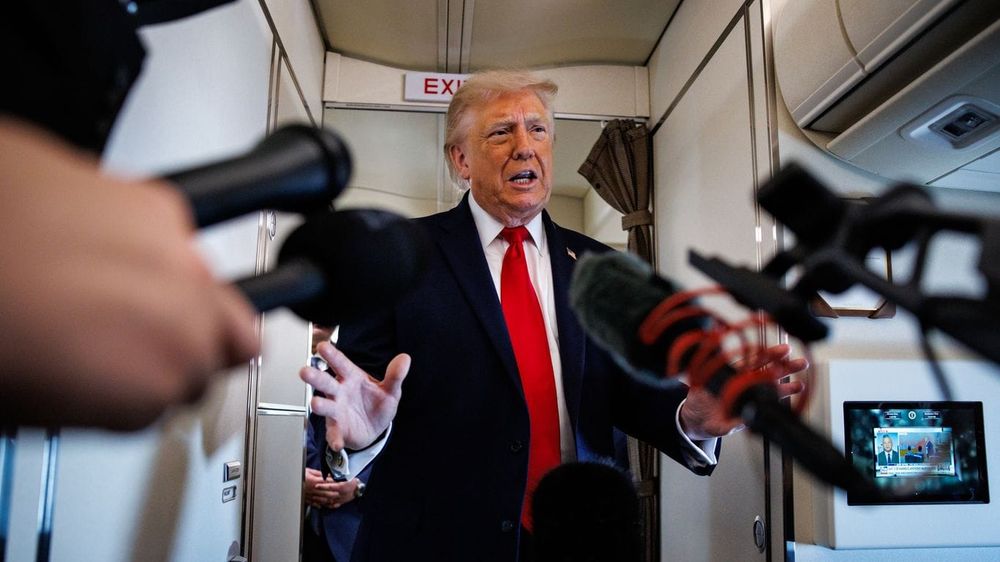
Sam Altman has been lobbying the Trump administration for a government ownership stake in AI companies for over a year. He called it an AI New Deal. He took the idea to Capitol Hill. He pitched it to senators from both parties. And last week, it worked — at least enough to get the president of the United States to float the concept publicly, telling reporters aboard Air Force One, as Axios reported, that a U.S. equity stake in AI giants would be "a beautiful thing" that would "make 'em rich."
The idea is being sold as populism. It is worth pausing on who is doing the selling.
The CEO of OpenAI — a company facing antitrust scrutiny, federal AI policy negotiations, and a pending public stock offering — has spent a year persuading a presidential administration to take a financial stake in his firm. The president who is now publicly endorsing the concept also oversees every regulatory body that would govern OpenAI's operations, its market conduct, and the terms of its eventual IPO. If the U.S. government becomes a shareholder in OpenAI, it will have a direct financial interest in OpenAI's stock price. That is not a technicality. That is a structural conflict of interest with no precedent in modern American economic policy.
Industry advocates have floated government stakes of 1–5% in top AI companies. Sen. Bernie Sanders proposed a one-time 50% tax paid in company stock. The White House has not specified a percentage. OpenAI, Anthropic, and SpaceX are all expected to pursue public stock offerings in the near term, meaning any equity stake would eventually become publicly traded government holdings.
Start with the regulatory architecture. The federal government currently shapes AI development through the FTC, which investigates anticompetitive behavior; the SEC, which will govern AI company IPOs; the Department of Commerce, which controls export licenses for AI chips and models; and executive orders that determine what AI systems the military and intelligence agencies can use. Every one of these tools affects the valuation of OpenAI, Anthropic, and the other firms now being discussed as candidates for public equity stakes. A government that holds stock in these companies has a financial reason to use those tools gently.
This is not hypothetical. The pattern is documented in other industries. When the U.S. government acquired stakes in General Motors and Chrysler during the 2009 bailout, it faced immediate pressure — and made actual decisions — that prioritized the companies' financial recovery over other policy goals, including labor protections and environmental standards. The government eventually sold its GM stake at a loss partly because holding it too long depressed the stock. The lesson from that episode was not that government ownership is inherently corrupt. It was that financial exposure creates institutional pressure that bends decisions in predictable directions. Now apply that dynamic to the companies building the infrastructure of surveillance, labor automation, and information control.
The conflict deepens when you look at the timing. Axios notes that Anthropic, SpaceX, and OpenAI are all expected to pursue stock offerings in the near term. SpaceX is racing toward a stock market debut at a $1.75 trillion valuation, with a significant share of that number built on government contracts already facing federal scrutiny. A government equity stake, announced before those offerings, would function as a public endorsement — a signal to markets that the federal government is invested in these companies' success. That is worth billions in pre-IPO valuation. The companies lobbying for this arrangement are not being altruistic. They are seeking the most powerful possible stamp of approval, one that comes with an implicit guarantee that the regulator will not do anything to tank the stock price it now owns.
Sen. Bernie Sanders' version of this idea is genuinely different in design, even if it sounds similar. Sanders proposed a one-time 50% tax paid in company stock — a levy imposed on the companies, not a negotiated arrangement with them. The distinction matters enormously. A tax is coercive; the government takes value from the company whether the company wants it to or not. The arrangement Altman has been pitching, and that Trump is now echoing, is collaborative — the companies would negotiate the terms, the percentage, and presumably the conditions. That negotiation would happen between an administration that has already demonstrated it will use regulatory power as a transactional tool and companies that have billions of dollars riding on the outcome. The Sanders proposal, whatever its other merits, does not create the same conflict because it does not require the government to become a willing partner in the companies' financial success.
There is also the question of what "the American people" actually means in this framing. Trump told reporters the public would "essentially become a partner" in AI companies' success. But a government equity stake held in a sovereign wealth fund does not give individual Americans any direct financial stake. It gives the Treasury Department — or whatever fund structure is created — a portfolio position. Whether that position benefits ordinary people depends entirely on how the fund is governed, how distributions are made, and who controls the decisions. Norway's Government Pension Fund Global, the world's largest sovereign wealth fund, took decades to build governance structures that keep political interference at arm's length. No such structure has been proposed here. What has been proposed is the concept, stripped of any mechanism that would prevent the executive branch from using it as a tool of industrial policy — rewarding compliant companies and punishing those that resist.
The AI industry's image problem is real. Axios notes that AI is broadly unpopular in the U.S., and that industry leaders believe public ownership would improve the technology's reception. That framing is telling. The goal is not to give the public meaningful power over AI development. The goal is to make the public feel like they have skin in the game — to convert skeptics into stakeholders. It is a marketing strategy dressed as economic policy. If the public actually had power over these companies, it might demand transparency about training data, accountability for algorithmic harm, or restrictions on the use of AI in hiring and surveillance. None of those demands appear anywhere in the ownership proposals being discussed. As Tinsel News has documented, Silicon Valley has spent tens of millions of dollars to prevent exactly that kind of regulatory accountability at the state level.
The OpenAI angle deserves particular scrutiny. The company published a document in April called "Industrial Policy for the Intelligence Age," which included a "Public Wealth Fund" as one of its proposals. A company drafting its own preferred industrial policy — complete with a mechanism that would give the government a financial interest in that company's success — and then lobbying the administration to adopt it is not a public-spirited gesture. It is a regulatory capture strategy. The company gets to write the rules, and then makes the regulator a shareholder so the regulator has a reason to protect those rules. Tinsel News previously reported on OpenAI's pattern of pursuing government relationships while claiming to operate in the public interest — a pattern this proposal extends into new territory.
The international dimension is also being ignored in the domestic political framing. Trump's stated rationale — "We're leading China. We're leading everybody in the world with AI, and we want to keep it that way" — treats government equity as a national competitiveness tool. But a U.S. government stake in AI companies would immediately become a subject of scrutiny by trading partners, a bargaining chip in technology export negotiations, and a model that authoritarian governments could cite when justifying their own state ownership of AI infrastructure. China's state-directed AI development is already a central point of concern for U.S. policymakers. Proposing that the U.S. government take equity positions in its own AI champions, justified by national competition with China, moves the U.S. model closer to the state-directed capitalism it claims to oppose — without any of the democratic accountability mechanisms that might distinguish it.
The proposal also arrives as Congress has been largely sidelined from AI governance. A recent executive order would give the government access to frontier AI models 90 days before public release — with no independent safety review. An equity stake would deepen that relationship further, giving the executive branch both early access to AI systems and a financial interest in their commercial success. The result is a feedback loop: the government helps AI companies succeed, the companies' success increases the value of the government's stake, and the government has less and less incentive to impose costs on the companies through regulation.
None of this means public ownership of AI infrastructure is inherently wrong. A serious proposal for democratic oversight of transformative technology — one that gave elected bodies control over the fund, created genuine transparency about AI systems, and imposed real accountability for harm — would be worth debating. What is being proposed is not that. What is being proposed is that the most powerful regulatory state in the world take a financial position in the companies it regulates, negotiated with those companies, at a moment when those companies are preparing to go public and need the government's goodwill more than at any other point in their history. This is the same administration whose president's trust traded Eli Lilly stock while his administration expanded the market for its drugs — a pattern of financial entanglement with regulated industries that this proposal would institutionalize at an entirely new scale.
The regulator becomes a shareholder. The shareholder has a reason not to regulate. The companies that lobbied hardest for this arrangement walk into their IPOs with the implicit backing of the United States government. Call it what you want — a partnership, a wealth fund, a beautiful thing. The structure is the same as every other arrangement where the people being watched end up owning a piece of the watchers.