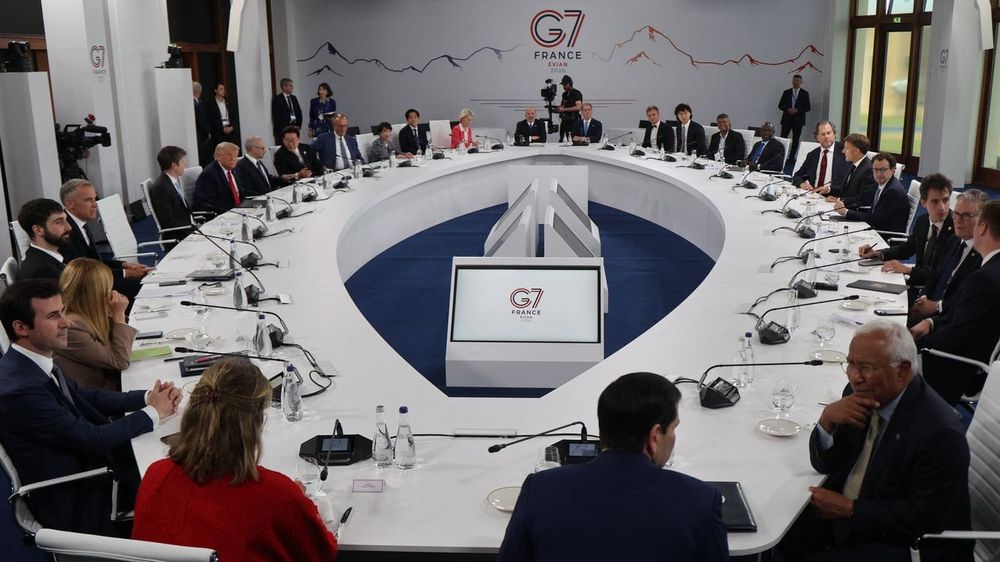
Sam Altman held bilateral meetings — bilats, in diplomatic shorthand — with multiple heads of state at this week's G7 summit in Évian-les-Bains. Ministers and cabinet members from around the world strained for a look as he entered the summit room. He posed for official photographs with the French tricolor behind him, seated in the chair that presidents and prime ministers occupy. Axios reported that the working lunch was closed to the press.
Altman runs a private company. He answers to a board, to investors, and — when legally necessary — to regulators. He was not elected by any constituency. He cannot be removed by any democratic process. And yet, at the most powerful gathering of democratic governments on Earth, he was treated as a peer to the leaders who were.
This is the transfer of sovereignty happening in plain sight: not through a treaty, not through legislation, not through any process a civics textbook would recognize — but through a photo opportunity in the French Alps that the world's press was not permitted to witness.
According to Axios, the G7 working lunch included OpenAI CEO Sam Altman, Anthropic CEO Dario Amodei, Google DeepMind CEO Demis Hassabis, Salesforce CEO Marc Benioff, Meta chief AI officer Alexandr Wang, and Arthur Mensch, CEO of French AI company Mistral AI, alongside heads of AI labs from Japan, Germany, Italy, and the United Kingdom. All three of the major American AI CEOs posed with French President Emmanuel Macron for bilateral photographs, seated in the chair typically reserved for a head of state.
The conventional framing of this moment — offered by Axios and echoed across the technology press — treats it as a natural, even inevitable, evolution of geopolitics. AI companies are building the world's future economy and security infrastructure. Of course their leaders should be at the table. The alternative, the argument goes, is that governments make AI policy without the people who understand it.
That argument deserves scrutiny, because it papers over something important: the distinction between consulting technical experts and conferring diplomatic status on the corporations they run. Governments consult nuclear physicists without seating them next to the President. They consult pharmaceutical executives without giving them bilateral meetings with heads of state. The difference, in this case, is that the AI companies have successfully made themselves indispensable — and indispensability, in Washington and in Brussels, has long been the precondition for power without accountability.
The remarks made at the closed working lunch, as confirmed by Axios, are worth reading carefully — not for what they say, but for what they assume. Altman told the assembled heads of state: "Do not cede your responsibilities to AI labs like mine." He added: "No single lab should be making the decisions." These are the words of a man who understands, acutely, how the room looks from the outside. They are also the words of a man who just held bilateral meetings with half the leaders in that room, in a session closed to the press, while seated in a chair reserved for heads of government.
Amodei told G7 leaders they must "resist the temptation to splinter" — framing democratic nations as a bloc that must stay united around AI leadership versus authoritarian governments. Hassabis, whose AI startup DeepMind was acquired by Google in 2014, told the summit: "We're at one of the most critical moments in human history." He called for "a U.S.-led standards body" that works with "the international democratic community."
The pattern in these remarks is consistent: the AI CEOs are not asking governments to regulate them. They are asking governments to partner with them — to form a kind of joint governance structure in which the companies set the technical parameters and the governments provide the legitimacy. Altman's call for "an international forum for discussion that establishes globally accepted standards for testing" is not a call for independent oversight. It is a call for a multilateral body that the companies will inevitably shape, staff, and influence — the same way financial institutions shaped the Basel accords, the same way pharmaceutical companies shape FDA advisory panels, only faster and with fewer disclosure requirements.
This is not a new playbook. It is the regulatory capture playbook, updated for the AI era and run at geopolitical scale. The companies that are building the most consequential technology in human history are positioning themselves as the natural partners of democratic governments — while remaining, structurally, accountable only to their shareholders. Altman was explicit about this at the summit: "We are an American company and will be governed by the laws of the United States." That sentence is doing a lot of work. It means: we will accept the oversight of one government, the one least likely to constrain us, and we will use that arrangement as the basis for our global governance claims.
The global dimension of this matters enormously, and it is almost entirely absent from the American coverage of this summit. The G7 nations — the United States, Canada, France, Germany, Italy, Japan, and the United Kingdom — represent roughly 10 percent of the world's population. The AI infrastructure being built by OpenAI, Anthropic, and Google DeepMind will shape the lives of the other 90 percent. Those populations had no representative in Évian-les-Bains this week. Their governments were not consulted. The countries of the Global South, which will be among the most affected by AI-driven economic disruption, labor displacement, and surveillance technology exports, were not at the table. They were, as is customary at the G7, the context rather than the subject.
The framing offered by Amodei — democracies versus authoritarian governments in the competition for AI dominance — is not wrong as a description of geopolitical tension. But it is doing something ideological when it is used to justify the current arrangement. The claim is: because China and Russia are developing AI without democratic values, the U.S. must develop AI through a partnership between democratic governments and private American companies, and this partnership is itself a form of democratic AI. The logical gap in this argument is large enough to drive a data center through. A private American company is not a democratic institution. Its decisions about training data, deployment, safety thresholds, and pricing are not made democratically. The fact that its competitors are authoritarian does not make it accountable to the people whose lives it will transform.
Tinsel News has previously examined the conflict of interest embedded in government AI partnerships, where the same entities that regulate AI companies also hold financial stakes in their success. The G7 summit takes this structural problem and elevates it to the level of international diplomacy. Governments that are simultaneously AI's cheerleaders, AI's potential regulators, and AI's security partners are not well-positioned to impose meaningful constraints on AI's most powerful actors.
There is a historical precedent for this moment, and it is not a comfortable one. In the early twentieth century, the largest industrial corporations — steel, oil, rail — became so embedded in national infrastructure that governments treated their executives as de facto partners in governance. The result was not a golden age of collaborative administration. It was a decades-long struggle to establish that private economic power required public accountability, a struggle that produced antitrust law, securities regulation, labor law, and the administrative state. That struggle was fought by democratic movements that understood the difference between a company that serves the public interest and a company that has made itself indispensable enough to claim it does.
The AI companies are moving through this cycle at a speed that makes the Gilded Age look deliberate. OpenAI was founded in 2015. Anthropic was founded in 2021. Google DeepMind, in its current form, dates to 2023. In less than a decade, their CEOs are holding bilateral meetings with heads of state at the G7 and calling for international standards bodies they will help design. The regulatory and democratic institutions that would normally provide a counterweight to this kind of power accumulation have not kept pace. As Tinsel News has tracked across jurisdictions, AI regulation globally remains fragmented, under-resourced, and heavily influenced by the companies being regulated.
The people who will bear the cost of getting this wrong are not in the room. They are the workers whose jobs will be restructured or eliminated by AI-driven automation — a process already underway, as companies cut employee benefits to fund AI spending while workers have no power to push back. They are the communities in the Global South whose data will train these systems without compensation. They are the citizens of democracies whose governments are now, in practice, co-governing with corporations that answer to no electorate.
Altman's remark — "we must err toward human liberty" — is the kind of sentence that sounds like a value but functions as a policy position. It is an argument against precautionary regulation, against mandatory safety standards, against the kind of democratic deliberation that might slow deployment. "Human liberty," in this framing, means the freedom of people to use AI tools once they exist — not the freedom of democratic societies to determine, through their own political processes, what those tools should and should not do.
The question that was not asked at the G7 working lunch — because the press was not there to ask it — is the one that matters most: what happens when an AI company's decisions conflict with the interests of a democratic population? Not the interests of a government, which can negotiate and lobby and threaten, but the interests of the people a government is supposed to represent? The answer, right now, is that there is no mechanism. The AI company will be governed by U.S. law, as Altman said. U.S. law, as currently constituted, does not require AI companies to obtain democratic consent before deploying systems that reshape labor markets, information environments, or public infrastructure.
Hassabis told the G7 leaders that in ten or twenty years, they will look back at this moment as standing "in the foothills of the singularity." He may be right about the technology. The question is what governance structure will exist at the top of that mountain — and whether it will have been built by democratic societies acting on behalf of their populations, or by a handful of unelected executives who got there first and wrote the rules before anyone else arrived.
The G7 photo — Trump flanked by Altman and Hassabis, Macron flanked by Amodei and Benioff — is not just a curiosity of contemporary geopolitics. It is a document of a specific political choice: to treat the accumulation of private technological power as equivalent to democratic sovereignty, and to do so in a closed room, with no press, and no public record of what was decided. The world's democracies just legitimized a governance structure they did not design, cannot control, and have not explained to the people who will live inside it.