Ephraim Sneh spent decades inside the Israeli military and government apparatus. He served as a brigadier general. He served as a minister of health. He is not a fringe figure, not an outside critic, not an activist with an agenda the Israeli state can dismiss. When Sneh toured the West Bank recently and described what he saw settlers doing to Palestinian villages, he did not reach for diplomatic language. "This is ethnic cleansing," he told Common Dreams, which reported on the New York Times' account of the tours. "To put it simply."
The significance of that sentence is not the phrase itself — human rights organizations, UN bodies, and Palestinian communities have used it for years. The significance is who is saying it, and what it means that they feel compelled to say it now. When the architects of the military system that administers the occupation begin publicly naming what the occupation is doing, something has shifted — not in the facts on the ground, which have been deteriorating for years, but in the willingness of Israeli institutional figures to say so out loud.
The tours are organized by Yaakov Or, a retired Israeli general who spent much of his career working inside the occupied West Bank. According to the New York Times reporting cited by Common Dreams, Or opens each tour with a direct challenge to his fellow veterans: "When I take you to see what is happening in the West Bank, you will have two choices. You can stay silent, and be complicit, or you can speak out, and tell everyone you know about what is happening."
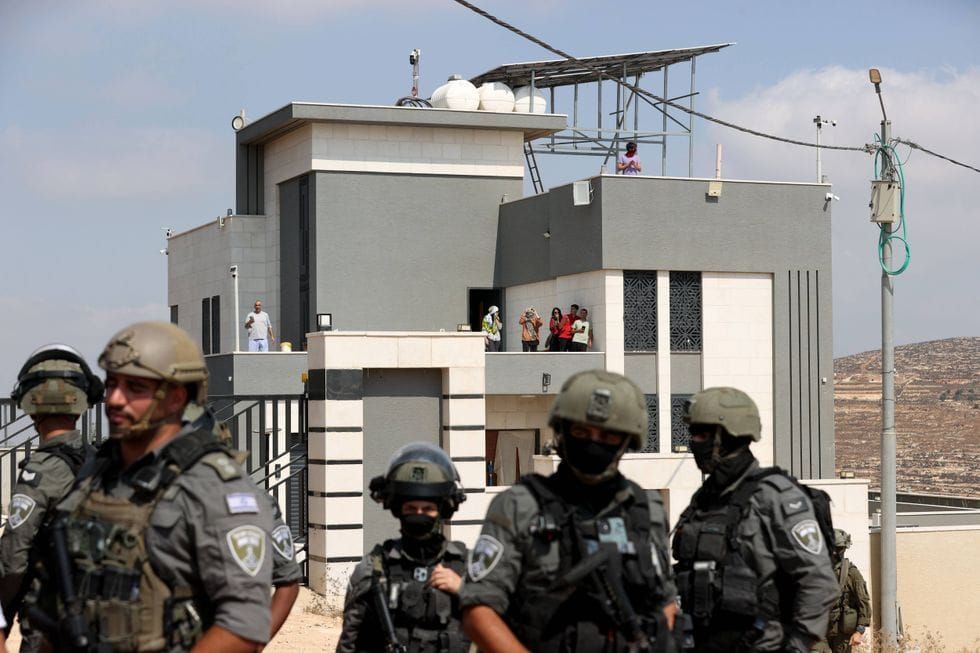
The West Bank has been under Israeli military occupation since 1967. Israeli settlements — built on Palestinian land in violation of international law — now house over 700,000 settlers. The Palestinian population living under occupation has no voting rights in the Israeli government that controls their movement, land, and resources. Settler attacks on Palestinian villages have accelerated significantly since 2022, with documentation from UN agencies, human rights groups, and now Israeli military veterans.
Retired Air Force General Asaf Agmon went further. He compared the settler attacks on Palestinian communities to the pogroms once inflicted on Jewish communities in Europe — a comparison with specific historical weight, drawn from within the Israeli military establishment itself. Agmon also warned about what this violence does to Israeli society: "Once a society behaves this way, that society is doomed." His concern was not only for Palestinians. It was for what Israel is becoming in the process of what it is doing.
Prime Minister Benjamin Netanyahu's response to the same events was to describe the perpetrators as "a very small handful of people, usually young people who come with all kinds of distress and problems, often from home." He framed settler attacks on Palestinian villages as a PR problem — something that "gives us a bad name around the world" and "harms the settlement movement." He did not frame it as a crime. He did not frame it as a policy failure. He offered the language of social work, not accountability.
The gap between those two framings — ethnic cleansing versus troubled youth — is not a matter of interpretation. It is a matter of power. Netanyahu's government includes ministers who have openly called for the annexation of the West Bank and the displacement of its Palestinian population. Finance Minister Bezalel Smotrich and National Security Minister Itamar Ben-Gvir have both made statements that go well beyond what the settler violence on the ground is doing. The violence is not happening despite the government; it is happening within a political environment the government has constructed and staffed.
Palestinian Christian theologian Munther Isaac made this connection directly in response to the demolitions in Birzeit, a West Bank town where Israeli occupation forces recently demolished two inhabited four-story residential buildings. "This is what ethnic cleansing looks like in Palestine," Isaac wrote. The demolitions in Birzeit were not carried out by settlers. They were carried out by the Israeli state — the same state Netanyahu leads, the same state that describes settler violence as the work of troubled individuals while simultaneously demolishing Palestinian homes through official channels.
The retired generals' moral clarity is also an inadvertent confession. These are men who administered the occupation for decades. They oversaw the infrastructure — the checkpoints, the permit systems, the military courts — that made Palestinian life in the West Bank precarious long before the current wave of settler violence. Their horror at what they are witnessing now is genuine. But what they are witnessing now did not appear from nowhere. It grew from a system they helped build and spent careers defending.
That is not a reason to dismiss their testimony. It is a reason to take it seriously in a specific way. When Agmon says a society that behaves this way is doomed, he is not speaking as an outside observer. He is speaking as someone who understands from the inside how institutions normalize what they once found unacceptable, how the threshold for what counts as defensible shifts incrementally until the indefensible becomes policy. He watched it happen. He is now naming it.
The United States is not absent from this picture. US Ambassador to Israel Mike Huckabee — a figure not known for harsh criticism of Israeli government policy — described settler attackers as "terrorists." That word, applied by a Trump-appointed ambassador to settlers operating with what the retired generals describe as government tacit support, is diplomatically significant. It is also, so far, consequence-free. Washington has consistently blocked international accountability mechanisms for Israeli actions in the occupied territories, and the rhetorical distance between calling settlers terrorists and doing anything to constrain the government that enables them remains vast.
The pattern here is structural, not incidental. Settler impunity in the West Bank has been documented across administrations, across Israeli governments of different compositions, across decades of international condemnation. The Israeli state's legal system applies different rules to settlers and Palestinians in the same territory — settlers are subject to Israeli civil law, Palestinians to military law. That asymmetry is not an accident. It is the architecture of the occupation, and it is what makes the violence the generals are now witnessing possible at scale.
Or's framing of the choice — silence as complicity, or speaking out — is directed at his fellow Israeli veterans. But it applies with equal force to governments that fund, arm, and diplomatically shield the state enabling what Sneh calls ethnic cleansing. The generals have chosen to speak. The political reckoning over what that silence has cost is arriving, slowly, in Washington as well — though far more slowly than the demolitions in Birzeit.
What the retired generals' testimony does, beyond the moral statement it makes, is remove one more layer of deniability. The argument that what is happening in the West Bank is contested, complex, or subject to reasonable disagreement has been weakening for years under the weight of documentation. It weakens further when the people making the ethnic cleansing argument are not Palestinian rights advocates or UN rapporteurs but retired Israeli generals who built their careers inside the system they are now indicting. Netanyahu can call the perpetrators troubled youth. His own former military leadership is calling it something else — and they have seen both up close.