Arizona just lost nearly half its food assistance enrollment. Not half its fraud. Not half its ineligible recipients. Nearly half the people who were receiving SNAP benefits a year ago — a 45% drop — are no longer in the program, according to a new analysis by the Center for Budget and Policy Priorities. Eight other states have seen participation fall by 20% or more. Across the country, roughly 5 million fewer Americans are enrolled in food assistance than were a year ago.
This is the story the One Big Beautiful Bill's sponsors are not telling. The Republican reconciliation law — passed with near-unanimous GOP support, sold as fiscal discipline — has produced the lowest SNAP participation rate in 17 years. And the people losing access to food assistance are not concentrated in blue cities that voted against the bill's authors. They are in the states that sent those authors to Congress.
The CBPP is careful to note that declines began before the law's enactment — administrative churn, pandemic-era enrollment cliffs, and state-level policy changes all contributed. But the organization's data is unambiguous on one point: "in almost all states, declines in SNAP participation accelerated after the 2025 Republican reconciliation law." The law did not create the trend. It sharpened it, deepened it, and locked it in.
What the law actually did — buried beneath the branding — was restructure how SNAP is funded at the state level. Starting in 2027, most states will be required to pay between 5% and 15% of SNAP benefit costs directly, totaling hundreds of millions of dollars annually in many states. That cost-shift is calibrated to a state's payment error rate: the more errors a state makes in processing benefits, the more it pays. The CBPP's analysis of this mechanism is worth reading in full, because it describes not a reform but a trap. The financial pressure to reduce error rates will, in practice, create pressure to deny benefits — including to people who are eligible. "The magnitude of the cost shift and the urgency surrounding error rates," the CBPP wrote, "may incentivize states to take drastic measures to reduce their payment error rates quickly and cut program costs, even if it means delaying or improperly denying benefits to eligible people."
This is the mechanism the bill's sponsors do not discuss in public. The enrollment decline visible today — 5 million people, a 17-year low — is the before picture. The 2027 cost-shift is the after.
The One Big Beautiful Bill shifted a portion of SNAP benefit costs onto states for the first time, tied to payment error rates. Beginning in 2027, most states will pay 5–15% of benefit costs — hundreds of millions annually in larger states. The CBPP projects this will create financial pressure to deny or delay benefits, including to eligible recipients. The biggest enrollment drops are still ahead.

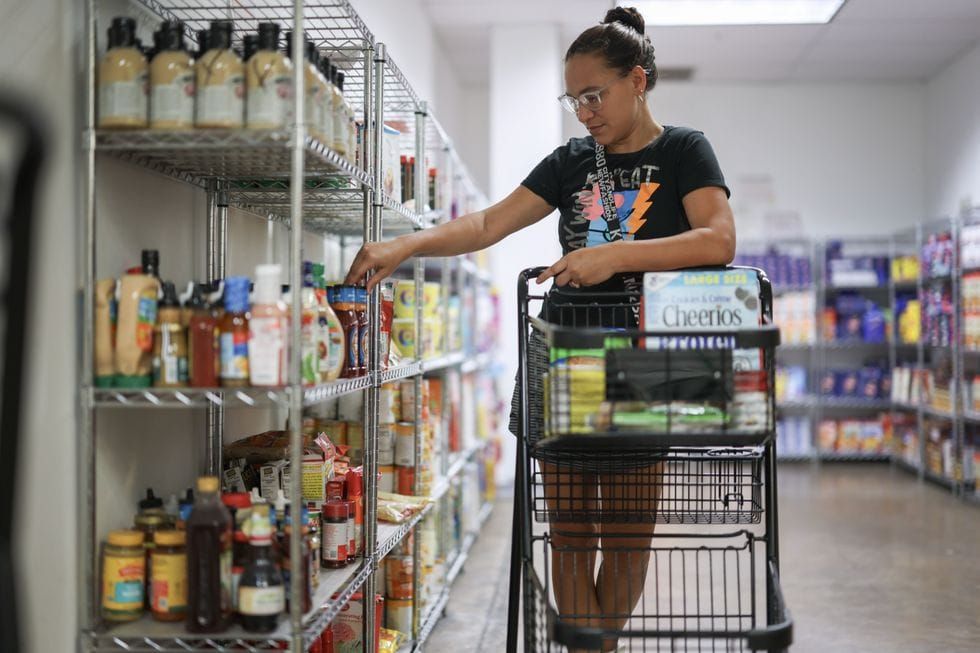
The human scale of what has already happened is documented in a parallel survey released this week by ParentsTogether Action. Two-thirds of SNAP-enrolled families report that their benefits have already decreased over the past year. Three in four say affording food is one of their biggest economic challenges. These are not abstractions. Brandi, a Kansas mother receiving Supplemental Security Income as her only income, told ParentsTogether Action that her household lost more than $120 in monthly SNAP benefits. "We have a hard time keeping up with bills," she said. Amanda, an Oregon woman, described watching her benefits cut by more than half after she found a job and reported her new income — a punishment, structurally speaking, for doing what the program's critics say recipients should do. "We also didn't receive any benefits for one month during the process," she said.
These are the stories that do not appear in the bill's name. "One Big Beautiful Bill" is a marketing phrase. What it describes, in practice, is a federal law that has removed food assistance from 5 million people, accelerated enrollment declines in 49 of 50 states, and set up a cost-shift mechanism designed to push states toward further denials starting in 2027.
The political geography of this deserves more attention than it has received. Arizona, which saw the largest SNAP enrollment drop in the country at 45%, went for Donald Trump in 2024. The states with 20%-plus enrollment declines are not a blue-state phenomenon. The people losing food assistance in the highest concentrations are, in many cases, the constituents of the members who voted for the bill. This is not an argument for cynicism about those voters. It is an argument about what the bill actually does versus what its sponsors claimed it would do — and who pays the cost of that gap.
This pattern is not new to Republican fiscal policy, but the SNAP cuts represent an unusually direct example. As Tinsel News has previously reported, 800,000 children lost food assistance in eight months under the same law, with the hardest-hit states overlapping significantly with those that voted for its authors. The enrollment collapse in SNAP is occurring alongside a broader unraveling of the safety net: four million Americans lost health coverage this year as enhanced ACA subsidies expired without congressional renewal. The people losing food assistance and the people losing health coverage are, in many cases, the same people — and their political representatives voted for both outcomes.
Follow the money and the logic connects. SNAP cuts reduce federal outlays. Reduced federal outlays enable tax cuts that disproportionately benefit higher-income households and corporations. The One Big Beautiful Bill was not designed to reduce hunger. It was designed to reduce federal spending in ways that freed up revenue for other priorities — and SNAP, which serves low-income households with limited political power, was an available target. The bill's sponsors did not run on a platform of cutting food assistance for their constituents. They ran on fiscal responsibility, government efficiency, and fraud reduction. The CBPP data does not show fraud reduction. It shows enrollment reduction — a different thing, with different consequences.
There is also a structural accountability problem embedded in the 2027 cost-shift that has not been widely examined. When states face financial penalties for payment errors, and those penalties run into hundreds of millions of dollars annually, the rational response for a state budget office is not to invest in better eligibility processing. It is to process fewer applications. Deny more claims at the margin. Make the administrative experience difficult enough that some eligible people give up. This is not a conspiracy theory — it is the documented history of means-tested program administration under fiscal pressure, and the CBPP flags it explicitly. The federal government will have successfully transferred both the cost and the political accountability for food assistance cuts to state governments, most of which did not choose this outcome and cannot absorb it without consequences.

The enrollment data will continue to worsen. The CBPP projects further declines over the next year even before the 2027 cost-shift activates. The two-thirds of current recipients who have already seen benefits decrease are a preview of a larger population that will lose access entirely. And when that happens — when SNAP enrollment reaches a 20-year low, or a 25-year low — the people responsible will point to state error rates, administrative inefficiency, and the complexity of the eligibility system. They will not point to the bill they passed, the mechanism they designed, or the constituencies they represented when they voted yes.
The CBPP's data makes that deflection harder. So does a recent federal court finding that SNAP restrictions in 23 states were designed to punish poor people — a judicial record that now sits alongside a legislative one. Together, they document not a reform but a coordinated reduction in the country's primary food assistance program, implemented through mechanisms designed to obscure who made the decision and who bears the cost. Five million people are no longer enrolled. The law that accelerated their removal has their representatives' names on it.