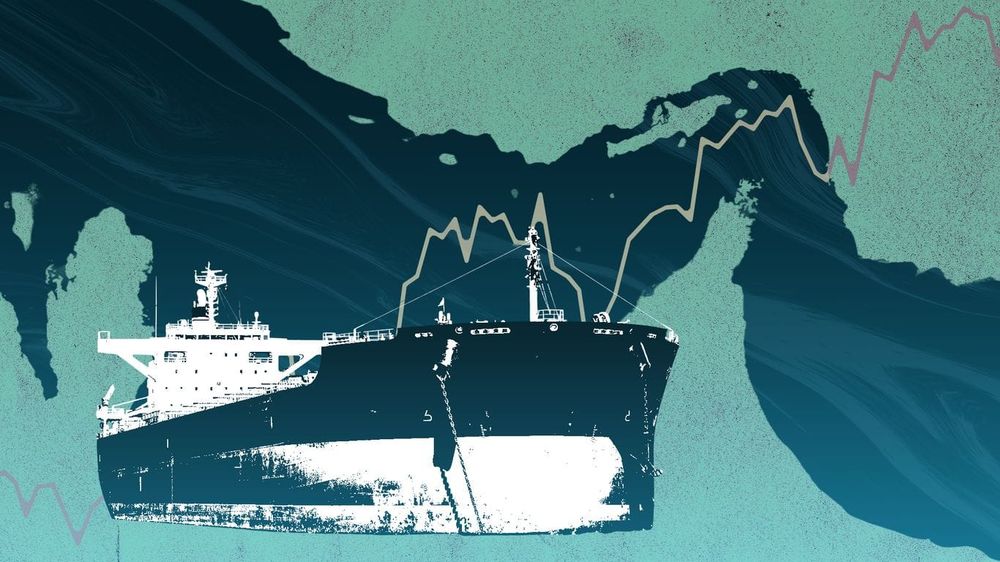
Twenty thousand mariners are sitting in the Persian Gulf right now, waiting. Their tankers carry oil, grain, and industrial cargo that the global economy requires. They know the Strait of Hormuz is technically open. They also know that Iranian forces have made clear, through both direct threats and demonstrated action, that passage is conditional — and that the conditions keep changing. So the ships do not move.
This is the operational reality that a U.S. official admitted to Axios on Thursday April 9th, in a sentence that deserves more attention than it received: the strait is "wide open," the official said — and then acknowledged that ships are not moving because they are "intimidated by the Iranians." Both things are true at once. That gap between the official description and the lived reality is not a communications problem. It is a strategic one, and it may be the defining problem of the post-ceasefire moment.
On Thursday, Iran's supreme leader Mojtaba Khamenei stated publicly that Iran "will bring the management of the Strait of Hormuz into a new stage" during upcoming negotiations with the United States. That framing — management, not just access — is the tell. Iran is not claiming to block the strait. It is claiming to run it. A Financial Times report, cited by Axios, describes the specific mechanism: $1 per barrel of oil aboard any transiting tanker, payable in cryptocurrency. Trump responded on Truth Social, writing that Iran had "better not" be charging tolls and that doing so was "not the agreement we have." The post contained no enforcement mechanism. None followed.
The original thesis the source material does not state plainly: the toll system is not primarily a revenue scheme. It is a sovereignty claim. Iran is asserting, in operational terms, that the Strait of Hormuz is Iranian-administered water — and the United States, having fought a war that ended in a ceasefire rather than a surrender, lacks the military posture to contest that claim without resuming hostilities it has already agreed to pause. Trump's posts are not bargaining power. They are evidence of its absence.
Sultan Al Jaber, head of the Abu Dhabi National Oil Company, posted on LinkedIn Thursday morning with unusual directness for a figure in his position: "This moment requires clarity. The Strait of Hormuz is not open. Access is being restricted, conditioned and controlled." Al Jaber is not a dissident or a critic. He runs one of the largest state energy companies on earth, and his country's economic survival depends on unimpeded tanker traffic. When a figure with every incentive to project stability instead tells the world the strait is closed, the gap between Washington's stated position and ground truth becomes impossible to paper over.
Oil was approaching $100 per barrel as of Thursday afternoon, according to Axios — considerably above pre-war prices. The International Maritime Organization reports that nearly 20,000 mariners remain stranded in the Persian Gulf, their operators and captains unable to determine how to transit without risking Iranian attack. Hundreds of tankers carrying oil and other vital commodities are still at anchor, per the New York Times. The economic cost of this standoff is not theoretical. It is being paid right now, in elevated energy prices, in stranded crews, in supply chains running on contingency planning rather than reliable throughput. Energy prices have already soared 40% since the Pentagon's Iran strikes shut down global oil routes — the toll system, if institutionalized, would lock that elevation in permanently.
The accountability question here is structural, not personal. The Trump administration went to war — a war with no congressional authorization, no budget, and no exit plan — and emerged from it with a ceasefire that left Iran's core advantage intact. The Strait of Hormuz was always Iran's primary strategic asset: roughly 20 percent of global oil supply transits it, along with significant volumes of liquefied natural gas. Any serious war planning would have grappled with the question of what happens if Iran survives the conflict with its ability to threaten that chokepoint undiminished. The answer, apparently, was a ceasefire and peace talks in Islamabad — while Iran publicly claims victory and begins institutionalizing toll collection.
Khamenei's Thursday message, released for the 40-day commemoration of his father's assassination by Israel on the first day of the war, described Iran as the "definite victor." He stated that Iran "did not seek war and does not seek it" now — but made clear the country intends to control the strait going forward. The framing is carefully constructed: Iran as the aggrieved party, the responsible actor, the nation that was attacked and survived. Whether or not that framing is accurate in every particular, it is the framing that will govern negotiations in Islamabad. Iran arrives at that table having demonstrated that U.S. military strikes could not remove it from the equation. The toll system is the physical expression of that negotiating position.
The power dynamics here extend well beyond the bilateral. China has positioned itself as the stable alternative throughout this crisis, and Beijing has direct economic interest in the strait's status: Chinese energy imports depend heavily on Gulf oil transit. If Iran formalizes toll collection and the United States cannot stop it, China becomes the essential broker — the party that can negotiate terms with Tehran that Washington cannot, because China did not fight the war. That is a significant geopolitical transfer of influence, achieved not through Chinese action but through the structural consequences of a U.S. military campaign that failed to produce a decisive outcome.
The 20,000 mariners stranded in the Gulf are the human face of this strategic failure. They are not Americans, by and large. They are Filipino, Indian, Pakistani, Egyptian, Indonesian — the global working class of maritime labor that keeps oil moving and whose welfare does not register in Truth Social posts or Washington press briefings. Their ships sit idle while governments negotiate, while oil prices climb, while the international legal framework governing freedom of navigation erodes in real time. The 1982 UN Convention on the Law of the Sea establishes the right of transit passage through international straits. Iran's toll system is a direct challenge to that framework. The United States, which has not ratified UNCLOS but has long invoked it as the legal basis for freedom of navigation operations, is now watching a state it just fought to a ceasefire assert sovereign administration over one of the world's most critical waterways — and responding with social media posts.
A U.S. official told Axios the administration is "considering steps" to encourage ships to move through the strait. That phrase — considering steps — is the diplomatic equivalent of an empty holster. The steps available short of military action are limited: naval escorts, which Iran could interpret as provocation; diplomatic pressure, which has produced a toll demand rather than a retreat; or sanctions, which are already extensive and have not altered Iran's behavior. The step that would definitively reopen the strait — resuming military operations — is precisely what the ceasefire was designed to prevent. Iran knows this. The toll system is structured to exploit it.
Peace talks begin in Islamabad on Saturday. Iran will arrive having already moved to institutionalize control of the strait. The United States will arrive having publicly demanded that Iran stop — and having received, in response, a public declaration from Iran's supreme leader that the strait's "management" is entering a new stage. House Republicans are already defecting on the war, and no one in the administration can articulate what victory looks like. The Islamabad talks will determine whether Washington accepts Iran's new framing as the price of a durable ceasefire, or rejects it and watches the standoff grind on — with 20,000 mariners still at anchor, oil still near $100 a barrel, and a legal order for maritime transit that the United States has no current means to enforce.
That is the actual negotiating position the United States carries into Saturday: a ceasefire it needs more than it admits, a war it cannot resume without political collapse at home, and an adversary that has spent the interval between the guns falling silent converting military survival into territorial control. The toll is $1 per barrel. The real price is the acknowledgment that American military supremacy in the Gulf has a ceiling — and Iran just found it.