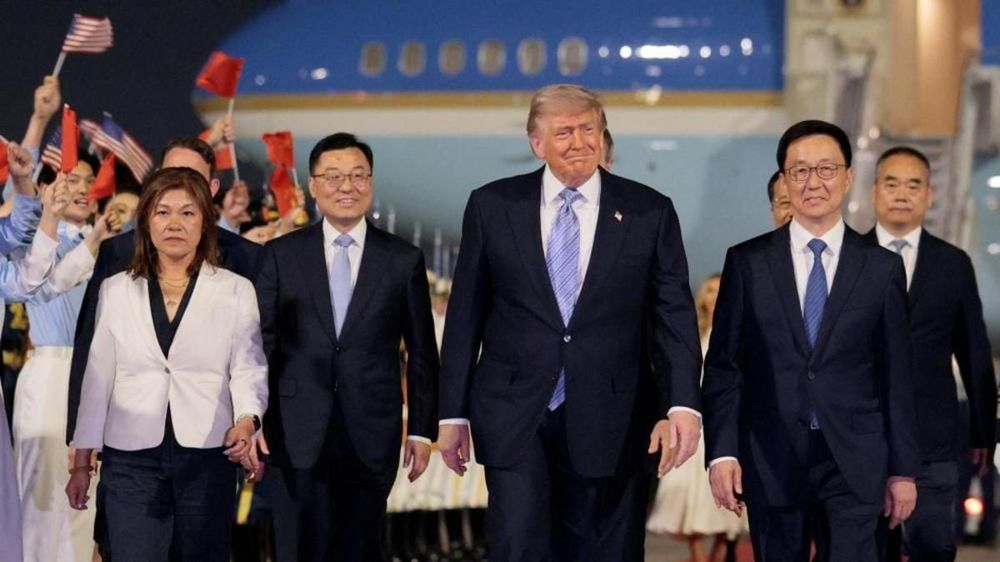
The U.S. president touched down in Beijing carrying a trade agenda and a request for China to "open up" its markets. What he brought with him, whether he intended to or not, was a balance sheet of American credibility that has rarely looked worse. The Iran war, now months old and still without a congressional authorization, an exit strategy, or a clear definition of victory, has done something that years of Chinese diplomatic effort could not: it has made the United States look like the destabilizing force in the international order — and made Beijing look like the responsible alternative.
This is the context that wire services will skip. According to BBC News, the talks are expected to cover trade, Taiwan, and Iran — with Washington pushing for Chinese market access and Beijing expected to press on Taiwan's status. But that framing treats the summit as a bilateral negotiation between rough equals. It is not. One side arrives having spent months bombing a country without legal authorization, watching its alliances fray across Europe, and presiding over energy prices that have hammered its own citizens. The other side has spent those same months positioning itself, in the UN Security Council and in diplomatic capitals from Lagos to Jakarta, as the power that wants stability.
The U.S. has been conducting military operations against Iran without a formal congressional authorization or a declared exit strategy. The Strait of Hormuz has been disrupted, driving global energy costs upward. Multiple U.S. allies have declined to join the military campaign, with the UK recalibrating toward Brussels. China has positioned itself at the UN Security Council as an opponent of the military campaign — a stance that has resonated across the Global South.
The original thesis here is one that neither the White House nor most American media coverage will state plainly: the Iran war has functionally handed China a diplomatic gift worth more than any trade concession the U.S. could extract in Beijing. Every week the conflict continues without a legal basis, every civilian casualty documented by UN investigators, every allied government that distances itself from Washington's military posture, adds to a ledger that China is actively building into a long-term argument about which great power the world should trust. As Tinsel News has previously documented, Beijing has been explicit about this framing — presenting itself at the Security Council as the stable alternative to American volatility.
The accountability question is straightforward: who decided to walk into this summit in this condition, and what did they expect to get? The president's stated opening demand — that China "open up" — is the same demand U.S. presidents have made in Beijing for three decades, with limited results under favorable conditions. Under current conditions, with the U.S. burning through cruise missile stockpiles, degrading its capacity to respond to a Taiwan contingency, and conducting a war that has no congressional mandate and no visible endpoint, the bargaining position has shifted. Beijing knows this. The question is whether Washington does.
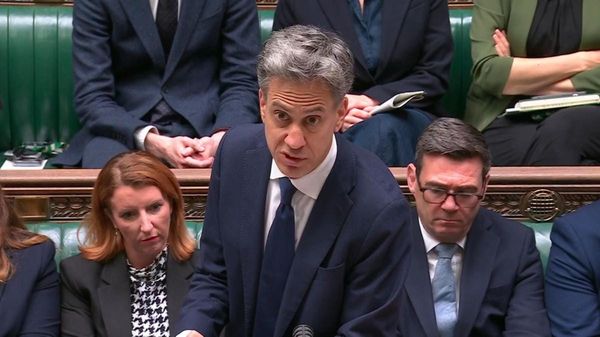
The power dynamics inside this summit are worth examining with precision. China's core demand — that Taiwan's status be acknowledged on Beijing's terms — has not changed. What has changed is the environment around it. The U.S. military is stretched. Its alliance network is strained. The UK, under Prime Minister Starmer, has been actively realigning toward Brussels rather than extending Washington's military reach into the Gulf. European governments that might have provided diplomatic cover for American pressure on Beijing are instead managing their own energy crises caused by the Iran conflict. China does not need to win this summit. It simply needs to wait.
On trade, the picture is similarly asymmetric. The president's demand that China "open up" arrives at a moment when American consumers are already absorbing the economic shock of the Iran war — gas prices elevated, supply chains strained, the Federal Reserve internally divided over how to respond to war-driven inflation. The administration has, by its own admission in a remarkable public statement, indicated that American financial pain is not a primary consideration in its Iran strategy. That statement did not stay inside American borders. It circulated in Beijing, in Brussels, in Riyadh. It was read as a confession about priorities.
The systemic pattern at work here is one that students of American foreign policy will recognize: the tendency to conduct high-stakes diplomacy while simultaneously depleting the conditions that make diplomacy effective. The U.S. arrives in Beijing asking for trade concessions while the war it is fighting has disrupted the global energy markets that Chinese manufacturing depends on — a source of genuine friction. But it also arrives having demonstrated, for months, that its military commitments are made without domestic legal authorization, without allied consensus, and without a defined end state. That demonstration has an audience far beyond the bilateral relationship.
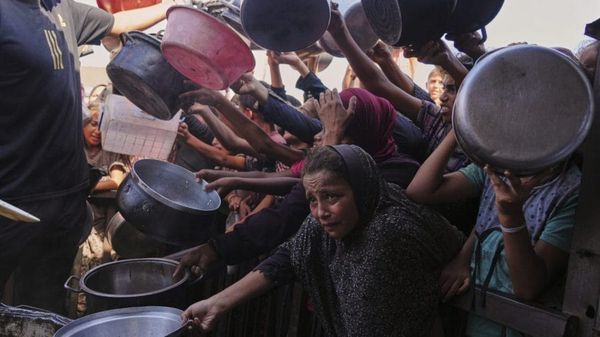
For governments across Southeast Asia, the Middle East, and Africa — the countries that will ultimately determine whether U.S. or Chinese influence shapes the next generation of global institutions — the comparison is being drawn in real time. China did not start a war. China is not burning through its munitions stockpiles. China is not being sued by UN human rights officials for striking schools and civilian infrastructure. Whatever Beijing's own record of coercion — in Xinjiang, in Hong Kong, in the South China Sea — the current contrast in global optics is working in its favor.
The Taiwan dimension of these talks carries its own logic, and it is darker than the trade headlines suggest. Beijing's expected pressure on Taiwan's status is not a new demand — it is a perennial one. But the context in which it arrives is new. The U.S. military's two-war strategy has effectively collapsed under the weight of the Iran campaign. The cruise missile stockpiles that would be required to deter or respond to a Taiwan contingency have been depleted. Beijing's military planners read those numbers. The question is not whether they will press on Taiwan in this summit — they will. The question is what they now believe the cost of pressing further, beyond the diplomatic table, might actually be.
None of this is to suggest that China is a benign actor in the international system. It is not. Its own record of suppressing internal dissent, extending economic coercion over smaller neighbors, and building military infrastructure in the South China Sea represents a set of accountability failures that deserve the same scrutiny applied to American conduct. The point is not that China is good. The point is that the current American posture has made the comparison easier for Beijing to exploit — and that the people who will pay for that exploitation are not the diplomats in the room.
They are the workers in Vietnam and the Philippines whose economies depend on stable shipping lanes. They are the Taiwanese citizens whose security rests on an American deterrence posture that has just been stress-tested and found wanting. They are the Iranian civilians bearing the cost of a war that its architects reportedly decided on instinct, without a plan for what comes after. And they are the American families paying $5-plus for gas while the administration says their financial pain does not factor into its calculations.
The Beijing summit will produce a communiqué. It may produce incremental movement on trade. It will almost certainly produce a photograph of two leaders shaking hands that both governments will use to project normalcy. What it will not produce — because no summit can — is a restoration of the strategic position the United States held before it chose this war, in this way, with this legal basis, and with this level of allied support. Beijing studied the first-term playbook carefully. The second term has given it material that goes beyond anything it could have scripted.
The talks in Beijing are not, at their core, about trade or Taiwan or even Iran. They are about which version of global order the next decade will run on. The United States is arriving to make that argument while its credibility is on fire. China is holding the door open and waiting.