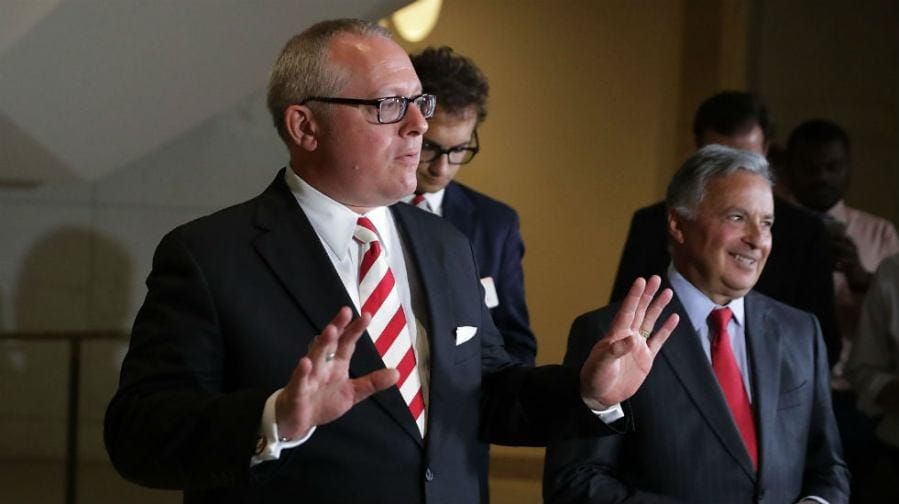
The Justice Department's $1.8 billion "anti-weaponization" fund has its first known claimant. He is not a whistleblower. He is not a private citizen swept up in an overzealous prosecution. He is Michael Caputo — longtime Trump ally, veteran of the first Trump administration, and former spokesperson for the Department of Health and Human Services — who filed a claim this week seeking $2.7 million in restitution, according to The Hill.
The fund was sold to the public as a remedy for political persecution — a mechanism to compensate Americans who had been targeted by the federal government for their beliefs or associations. The first person to use it is a man whose primary qualification appears to be his proximity to the president who created it.
That is not a coincidence. It is the design.
Caputo's filing arrives in the context of a fund that was already drawing sharp scrutiny before a single dollar moved. As Tinsel News has reported, the $1.776 billion program was created with no public eligibility rules, no independent oversight, and no transparent claims process — with the president's own former personal attorney, Emil Bauer, positioned to exercise significant influence over disbursements. The structure was not an oversight. It was the architecture.
Now that architecture has produced its first visible output: a $2.7 million ask from a man who spent years as a visible Trump surrogate, ran communications for a federal agency during the first administration, and has remained a fixture in Trump-aligned political circles. The question the fund's architects never wanted asked is now unavoidable: what is the actual standard for who qualifies?
The absence of a published answer is itself an answer. When a government program distributes public money without written eligibility criteria, the operative criterion becomes something else entirely. In this case, the available evidence suggests that criterion is political loyalty — specifically, loyalty to the administration that controls the fund.
The DOJ's anti-weaponization fund was established with approximately $1.8 billion in public money, ostensibly to compensate Americans who were targeted by government overreach. No public eligibility criteria have been published. No independent oversight body exists. The fund's administration sits within the DOJ, under officials appointed by the same administration that created it. Critics have noted the fund's $1,776 figure — a deliberate patriotic reference — and its lack of any congressional authorization for the disbursement criteria.
Caputo's history with the Trump orbit is worth examining precisely because the fund's defenders argue it exists to remedy prosecutorial abuse regardless of political affiliation. During his tenure at HHS, Caputo became publicly controversial in 2020 when he accused career scientists at the Centers for Disease Control of sedition and suggested, in a Facebook video, that he feared for his life from a coming left-wing insurrection. He later took a medical leave of absence. The circumstances of his departure and the nature of his claimed grievances against the federal government have not been detailed in public filings.
What is detailed — in the public record — is who Caputo is and who he knows. He worked on Trump's 2016 campaign. He was a paid consultant for Russian state media outlet RT America before that relationship became politically toxic. He served as HHS assistant secretary for public affairs during a period when the department faced congressional scrutiny over its handling of COVID-19 communications. He is, by any reasonable measure, a political insider with direct access to the administration that controls the fund he is now petitioning.
The Power and Money lens here is not complicated. A fund controlled by Trump appointees, with no published eligibility rules and no independent review, has produced a first claimant who is a Trump ally seeking $2.7 million. The causal chain does not require speculation. It is visible in the structure of the program itself.
There is a comparison worth making. Tinsel News has previously covered the lawsuit filed by Capitol Police officers who were attacked on January 6 — officers who argued that the same fund was being used to compensate the people who assaulted them. That tension — between the fund's stated purpose and its apparent beneficiaries — has now sharpened further. The first known claimant is not a bystander. He is a political operative from the inner circle of the administration that created the program.
This matters beyond the specific figure of $2.7 million. Public compensation funds are not novel instruments. They exist in various forms — for victims of crime, for those wrongfully convicted, for communities harmed by government negligence. What distinguishes legitimate funds from political slush funds is a simple structural feature: the decision-makers who control disbursements cannot have a political interest in who receives the money. The anti-weaponization fund fails this test on its face. The DOJ officials overseeing it serve at the pleasure of a president whose allies are now filing claims.
The accountability question that follows is direct: who else has filed, or plans to file? The Caputo claim is described as the "first known" application — a phrase that implies others may exist, or may be forthcoming, without public disclosure. If the fund operates without a public claims registry, without published decisions, and without congressional oversight of individual disbursements, then the $1.8 billion could move in ways that are never subject to public scrutiny at all.
That is not a hypothetical concern. It is the logical consequence of the fund's design. And the design, as Tinsel News has reported, was not accidental — the Senate was told the fund would operate with no eligibility rules and no oversight before it was created. Legislators who voted for the appropriation knew what they were building. They built it anyway.
Michael Caputo seeking $2.7 million from a fund designed to compensate victims of government persecution is the program working as intended — not as described. The gap between those two things is the story. And if Caputo's claim is approved without a published standard that any American could use to evaluate whether the decision was legitimate, then the fund will have confirmed what its critics argued from the beginning: it is not a compensation mechanism. It is a political reward system, funded by taxpayers, administered by loyalists, and structured to be invisible.