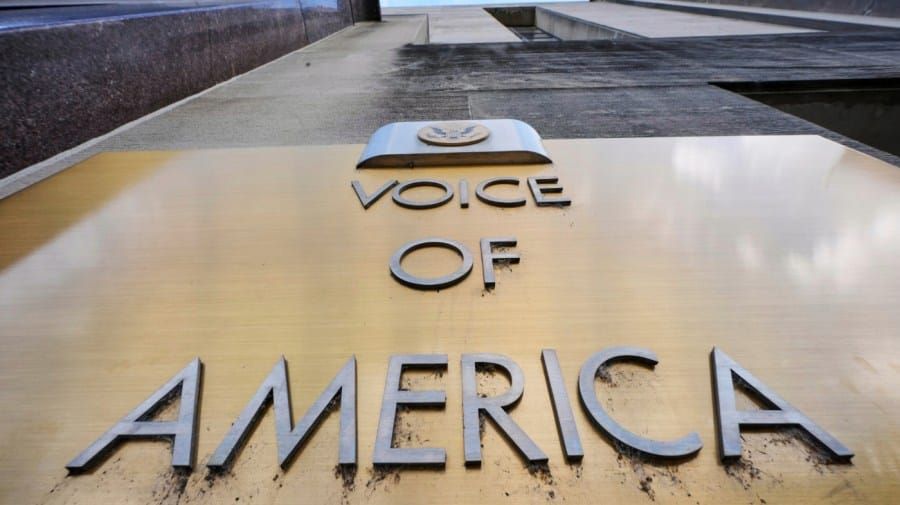
The United States government spends roughly $800 million a year broadcasting news into countries where the press is not free. Voice of America reaches an estimated 354 million people weekly, by the agency's own count, in 47 languages. The explicit premise of that investment is that press freedom is a value America will defend — not just preach. Ulviyya Alovsat is a test of whether that premise is real.
Alovsat, a journalist who worked for Voice of America's Azerbaijani service, has been imprisoned in Azerbaijan. Her fiancé, writing in The Hill, describes a U.S. government that has gone quiet — no public statement, no diplomatic pressure campaign, no named official calling for her release. The silence, he argues, is not neutral. It is a message. And the audience for that message is not just Baku.
Azerbaijan is not an outlier in its treatment of journalists. The country ranks 164th out of 180 nations in Reporters Without Borders' 2024 World Press Freedom Index — below Russia, below Belarus. The government of President Ilham Aliyev, who has held power since inheriting it from his father in 2003, has made the systematic imprisonment of journalists and opposition figures a feature, not a bug, of its governance. What makes Alovsat's case different is who employed her: an outlet funded by the U.S. Congress, operating under the U.S. Agency for Global Media, whose stated mission is to promote free expression in exactly the kinds of countries that imprison people like her.
Voice of America is funded by the U.S. Congress and operates under the U.S. Agency for Global Media. Its editorial charter commits it to covering news in countries where press freedom is restricted. The U.S. State Department publishes an annual Country Reports on Human Rights Practices that consistently documents Azerbaijan's imprisonment of journalists. The U.S. and Azerbaijan maintain diplomatic and energy ties — Azerbaijan supplies natural gas to Europe through pipelines that Western governments have actively supported as alternatives to Russian supply.
That context matters, because it explains why Washington's silence is not simply an oversight. The U.S. has concrete interests in Azerbaijan. The country sits at a strategic crossroads between Russia and Iran, and its natural gas pipelines have become more valuable to European energy security since Russia's full-scale invasion of Ukraine. American and European officials have quietly deepened those energy ties even as Aliyev's government has tightened its grip on civil society. The silence around Alovsat fits a familiar pattern: press freedom is invoked loudly when the offending government is an adversary and quietly shelved when it is a partner.
The accountability question is direct: who, specifically, made the decision not to speak? The State Department has a Bureau of Democracy, Human Rights, and Labor whose job is exactly this. The U.S. Agency for Global Media, which oversees VOA, has the standing and the platform to demand that a host government release one of its journalists. The National Security Council can raise cases like this through diplomatic channels. None of these levers appear to have been pulled. The administration has not explained why.
What is lost in the abstraction of "diplomatic relations" is what imprisonment actually means for a journalist in a country like Azerbaijan. It means interrogation. It means isolation from family. It means a legal system that does not operate independently of the executive that ordered the arrest. Alovsat's fiancé is not making a theoretical argument about press freedom norms — he is describing the lived reality of someone he loves, held by a government that has learned, from long experience, that the international community's concern has a short shelf life.
The administration's posture on press freedom has already drawn scrutiny on other fronts. The DOJ's targeting of war correspondents and subpoenas directed at outlets covering the Iran conflict have made it harder for American officials to claim the moral high ground when journalists are imprisoned abroad. Authoritarian governments notice the gap between American rhetoric and American practice. They exploit it. Azerbaijan's government has been watching Washington for years, and what it has seen is that the costs of imprisoning a VOA journalist are, so far, zero.
Alovsat's case does not require a confrontation. It requires a statement. It requires a named American official going on record to say that a journalist employed by a U.S.-funded outlet is being held unlawfully and must be released. The absence of that statement is not diplomatic nuance — it is a choice, and the people who will draw conclusions from it are not sitting in Washington. They are in Baku, and in every other capital where a government is deciding right now what it can do to a journalist without consequence.
Congress funds Voice of America to show that America means what it says about press freedom. If the journalists who work for that outlet can be imprisoned without a word from the government that pays their salaries, the argument VOA is supposed to make — that free expression has a powerful defender — collapses into something that functions more like a recruitment tool for cynicism. The test of whether the U.S. commitment to press freedom is real is not what happens when it is easy. It is what happens in Baku, right now, when it costs something.